



Learn what an AI knowledge base is, how it works, and which tools help support and operations teams deliver consistent, accurate customer answers.
When a customer asks a tricky question, the answer shouldn’t depend on who happens to know where the information lives. An AI knowledge base connects product documentation, customer context, and internal knowledge into one place, so answers are accurate and consistent no matter who’s handling the conversation.
An AI knowledge base does two things well: It gets people to the right answer faster, and it keeps that answer consistent for customers and internal teams alike. But not every knowledge base is built to do that, and the right fit depends on how your team works.
This article breaks down what an AI knowledge base is, how it functions, and how B2B companies use it to deliver consistent answers at scale — then compares the tools built to make it happen.
How AI knowledge bases turn trusted information into useful answers
An AI knowledge base is a centralized repository that uses artificial intelligence to help customers and teams find relevant information across multiple knowledge sources.
In a traditional knowledge base, users search or browse for relevant articles and read them to find solutions. In an AI knowledge base, users type their question into an AI chatbot. The AI system uses natural language processing (NLP) to interpret the question, retrieves the most relevant information from the knowledge base, and generates an answer.
Accuracy is non-negotiable in B2B support, so the AI knowledge base should draw answers only from approved company documentation, and that documentation needs to stay structured and current.
Where AI knowledge bases reduce friction across support
Quick, reliable answers help customers and free up your team’s time. Here’s where it actually shows up. Consider these key benefits of an AI knowledge base in customer service.
Answer routine questions before they enter the queue
Support teams lose real time to repetitive questions. An AI knowledge base answers them instantly, so fewer tickets hit the queue in the first place — and your team can spend that time on the work that actually needs a person.
During a service disruption, a logistics team shouldn’t be fielding routine policy questions; the AI knowledge base handles those so the team can focus on restoring service.
Keep every team working from the same trusted information
B2B teams span departments and work across multiple channels. Conflicting answers happen when each one is working off a different — or outdated — source. One AI knowledge base puts every team on the same signal, so the answer doesn’t change depending on who’s replying.
A financial services team might field the same compliance question through Slack, chat, and account management on the same day. One source of truth means the guidance doesn’t shift depending on the channel.
Bring context into view without another tool switch
Resolving an issue often means hunting for context across separate documents, manuals, and knowledge management systems — time your team could be spending with the customer instead. An AI knowledge base built into the support platform brings that context into view without the extra tool switch.
Support team members can pull up the right escalation workflow in the same window they’re already working in, without having to hunt across tools.
Catch knowledge gaps before they become service problems
Help centers go stale the moment a product changes. AI-powered tools flag the gaps as they open — missing articles, outdated answers — so teams can close them before customers hit a dead end and a new ticket lands in the queue.
A SaaS team might use its AI customer service software to spot recurring billing questions that lead to failed searches. Identifying that gap early gives the team a chance to update the documentation before it drives a spike in ticket volume.
What to look for when knowledge has to support real customer work
An AI knowledge base only earns its keep when it’s kept current and built into the day-to-day workflow, rather than treated as a side project. Here are some examples of AI knowledge base features to look for.
AI search that understands intent, not just keywords
Choose knowledge base software with semantic search and embeddings that go beyond matching exact keywords and actually understand the meaning behind your content. Customers might phrase the same question a dozen different ways; the chatbot needs to land on the same answer regardless of phrasing.
One source of truth for internal and customer-facing answers
Some providers split customer-facing content from internal documentation. Choose one that doesn’t — a single source of truth for both, so information stays consistent no matter who’s looking at it. When a customer moves from self-service into a live conversation, the answer shouldn’t change.
Analytics that show what customers keep asking
Keeping content regularly updated is a best practice for AI knowledge bases. Look for a dashboard that surfaces what customers are really asking, so you know exactly which articles to refine and which ones to write.
Escalation paths from self-service to human support
The software should do more than route complex issues to your team — it should hand off full context along with them. Front’s Coordination Tax report found that 22% of B2B companies said AI lost context during handoffs. Choose a provider built to close that gap, not create it.
AI knowledge base software for different support models
The right tool depends on what you’re solving for, whether it’s customer-facing self-service, internal knowledge management, onboarding, or fast answers to common questions. Here’s how five leading providers stack up.
Front
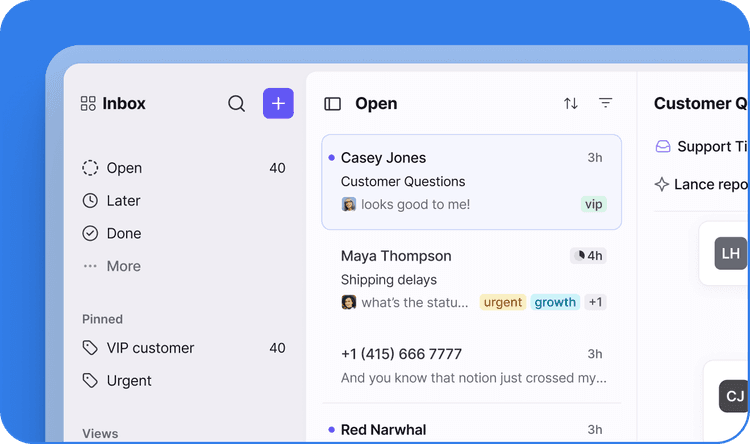
Front is built for B2B customer operations teams that need their knowledge base connected to the conversation. Front supports both internal and external knowledge bases, and its AI-powered Autopilot tool gives customers instant answers based on approved knowledge base articles. Customer support teams use Autopilot to find conversation history, retrieve knowledge base content, and summarize issues, all without needing to switch apps.
What sets Front’s AI knowledge base apart is how it handles complex conversations. When an issue needs a human, it routes to your team with the full context intact — not a blank slate. That makes it a strong choice for teams that need smooth continuity between self-service and human support.
Zendesk
Zendesk is a solid option for large organizations that want to integrate an AI knowledge base with their ticketing system.
Zendesk’s AI knowledge base helps teams unify their docs in a single system that both AI agents and human support teams can access. It offers strong workflow automation, with AI-generated article suggestions and content creation.
Customer service teams that want to use conversational AI and automation to improve self-service and boost ticket deflection can find the features they need in Zendesk.
Guru
Unlike Front and Zendesk, which offer fully functional customer support platforms, Guru specializes in knowledge base software designed for internal knowledge management.
Guru offers a broad range of integrations with customer support platforms, browsers, and chat tools like Slack and Microsoft Teams. These integrations let teams ask questions in the tools they already use and get verified answers based on company policies, documentation, and internal knowledge.
Its integrations and ease of use make Guru a strong choice for companies that need fast access to consistent sources of information across sales, customer support, HR, and operations teams.
Confluence
With its focus on technical documentation and troubleshooting, Confluence is a strong option for engineering and IT teams that need to build structured product manuals and access them with AI-powered tools.
Confluence is part of the Atlassian suite of tools, including Jira for project management and ticketing. Because of its deep integration with other Atlassian tools, Confluence helps teams collaborate on building structured documentation and answering customer queries in a single workspace.
Use Confluence to bring documents and product manuals into broader project management workflows.
Document360
Document360 is well-suited for SaaS companies looking to build a structured database of technical information, with AI-assisted information retrieval for both internal teams and customers.
As the name suggests, Document360 is designed to help teams create documents, from product and software manuals to API documentation and customer-facing knowledge bases. It’s a standalone tool, but it does offer integrations with customer support platforms, chat apps, and analytics tools. Its AI search tool cites every source so that users can check the answers.
Choose Document360 if you want to build and maintain a comprehensive set of technical documentation and make it easy for customers to search it using conversational AI.
Make your AI knowledge base part of the conversation with Front
An AI knowledge base only pays off when it’s connected to where the work actually happens, not sitting in a separate tool.
Front’s customer operations platform runs both internal and customer-facing knowledge bases from the same place. Its AI-assisted Autopilot tool draws on that knowledge base to answer customers across channels, then hands off anything complex to your team — full context attached, nothing lost in the handoff.
Book a demo to see how Front keeps knowledge, conversations, and support work in sync.