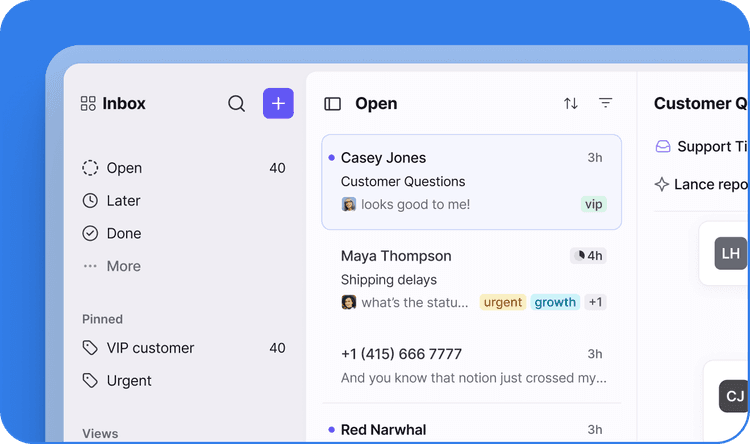




See how AI email management works across high-volume B2B workflows, and how custom Autopilot and external agents fit into prioritization, routing, and review.
It’s 9:07 a.m., and a logistics manager spots a dispatch charge buried in a 43-reply email thread. By 9:12, a carrier, a warehouse lead, and a customer are all asking for updates on different versions of the same plan. Sound familiar? The same scene plays out in financial services: client threads become unwieldy, compliance is looped into every reply, attachments bounce back and forth, and no one owns the next step.
The risk isn’t the inbox count — it’s the context gaps, silent handoffs, and assumed ownership that stack up when no one has explicit responsibility. Without a single point of accountability, the entire workflow slows to a crawl.
For operations leaders, B2B email is really a coordination system, and one that’s often under strain. When volume and stakes increase, the priorities shift to visibility, ownership, and predictable outcomes. Who’s responsible? What changed? What’s the most up-to-date source of truth?
Answering those questions often requires significant manual work, re-reading threads, reconciling versions, forwarding messages to confirm ownership, and building side systems to track status.
That’s the problem AI email management is designed to solve. Rather than replacing human judgment, it cuts down on repetitive work and surfaces the context that matters — reinforcing accountability and keeping operations running smoothly.
How AI email management improves operational workflows
As volume grows, so does operational complexity — because more messages mean more decisions, more ownership questions, and a higher risk of things slipping through the cracks.
AI email automation tools do more than simply help move messages faster. They help optimize how work moves across teams, enabling smarter choices and reducing blind spots at scale.
Here are four ways to leverage AI effectively in your daily customer service workflows.
Strategic prioritization
Not every thread requires the same urgency. Start by defining what “critical” means in your operational terms (e.g., renewal risk, shipment delays, compliance flags) and train AI to consistently surface those signals.
Controlled escalation comes next. Decide which conversations AI can resolve, which require human review, and which should be fast-tracked.
From there, teams monitor outcomes: resolution time, escalation rates, and false positives. This makes prioritization measurable and proactive rather than reactive.
Consistent quality management
Email AI assistants can draft. Humans decide.
In high-stakes environments, tone, compliance, and accuracy can’t be automated. Use AI-assisted features to generate summaries, suggest responses, and surface relevant history while keeping human review firmly in the loop.
Instead of relying on individual inbox habits, quality becomes systematic and repeatable. You’ll get faster replies without sacrificing accuracy or accountability.
Workflow optimization
Manual triage, copy-pasting context, and chasing updates are bottlenecks disguised as “just email.” Get AI to answer emails and reduce repetitive work by extracting key details and attaching relevant context before auto-routing conversations.
But the goal isn’t just fewer clicks. The focus should be on predictable service-level agreements (SLAs), clear queues, and no hidden work. That way, teams keep workflows visible and enforceable, even as volume grows, and have tangible results for forecasting to adjust systems when necessary.
Operational visibility and accountability
When ownership is unclear, tasks remain unresolved — and that’s the biggest risk of all.
Effective AI email management makes every step transparent: what was auto-resolved, what was escalated, and who’s responsible along the way. Dashboards reflect that reality, ensuring ownership follows the conversation across teams.
AI supports the workflow while accountability remains in human hands.
When to invest in email automation and AI
Service automation shouldn’t start with frustration. Instead, it should start with signals that coordination is getting harder to manage.
It’s time to pay closer attention to email management when:
Volume is rising across channels and work is scattered across inboxes and folders.
Threads involve multiple stakeholders and ownership shifts frequently.
Escalations happen because context is missing, not because decisions are difficult.
SLA performance depends on manual oversight to stay on track.
These are signs that the workflow — not the team — is under strain.
AI should never be a replacement for human judgment. It’s about restoring visibility and keeping execution predictable as complexity grows.
4 steps to implement AI email management
AI adoption doesn’t happen overnight, especially for B2B teams with high-volume interactions. It’s an operational change — one that works best with visibility, repeatability, and control built in from day one.
Here’s how to get started:
Scope AI involvement and set guardrails: Define exactly where AI participates and where it doesn’t. Decide which workflows it can triage, draft, summarize, or route. Then establish review checkpoints to protect tone, compliance, and client trust. Full automation should always be secondary to controlled support.
Align AI workflows with team operations: AI should strengthen your existing assignments, SLAs, and collaboration patterns — not create parallel processes. Routing rules, ownership logic, and escalation paths must reflect how teams already work. If AI breaks visibility, it’s misaligned.
Establish performance metrics: Measure impact using operational criteria such as SLA compliance, resolution time, escalation rates, and handoff reduction. Monitor where AI improves flow and where it introduces friction.
Roll out incrementally with feedback loops: Start with defined use cases. Evaluate outcomes and gather frontline feedback, then expand deliberately. Scale what works and refine what doesn’t. Control first, coverage second.
Following these steps ensures that AI email management strengthens coordination and accountability across high-volume, multi-team workflows.
Understanding approaches to AI email management
Teams structure AI email management around operational needs, existing workflows, and coordination requirements.
The following examples illustrate different approaches to managing AI-assisted workflows. Understanding these patterns helps operations leaders identify which method aligns with their team structure and integration needs.
AI email assistants in collaboration platforms
Some teams use collaboration platforms that embed AI directly into shared inbox environments. One example is Missive, a platform that combines shared inbox functionality with built-in AI assistance.
Operational approach: Email lives in a centralized workspace where multiple team members can review, discuss, and co-draft replies. AI assists with summarization and drafting, but the emphasis stays on shared context and coordinated responses.
Operational impact: Teams reduce internal handoffs, align faster before sending external replies, and keep workflows predictable because conversations aren’t trapped in individual inboxes.
When to choose this approach: This is best for small-to-medium teams managing moderate volume — especially groups that need internal collaboration before responding to customers. It works well in environments where shared visibility matters more than deep workflow orchestration across systems.
Enterprise email solutions with AI features
Large organizations often layer AI capabilities onto existing email infrastructure, such as Microsoft Outlook with Microsoft Copilot or Google Gemini and Gmail.
Operational approach: Teams continue working within their familiar email environments while AI surfaces priority messages, suggests replies, and reduces manual sorting. The workflow structure remains familiar to users.
Operational impact: Teams improve SLA adherence through better prioritization, reduce triage time, and gain incremental visibility into pending actions without introducing new systems.
When to choose this approach: This is ideal for large enterprises with strict IT governance. It suits organizations deeply embedded in Microsoft or Google ecosystems and teams that prioritize stability over redesigning how email flows across departments.
Automation tools with AI integrations
Other teams treat email as just one signal in a broader workflow system, using connectors like Zapier.
Operational approach: AI tools interpret incoming messages and trigger actions in customer relationship management, project management, billing, or support systems. Email becomes an entry point into larger operational orchestration.
Operational impact: Teams reduce manual copying between platforms, route messages automatically to the right system, and maintain context when conversations span tools and teams. Email tasks stay synchronized with operational systems.
When to choose this approach: Organizations with complex tool ecosystems would benefit from this approach. It works well for teams where email triggers downstream workflows across multiple systems and for operations where email is just one touchpoint in a broader customer lifecycle.
Unified customer operations platforms
Some B2B teams adopt unified platforms, like Front, that position email within a broader customer operations layer.
Operational approach: Teams treat conversations (not individual tickets or messages) as the core unit of work. Email connects to assignments, SLAs, customer lifecycle stages, and cross-team workflows. AI agents, whether configured natively or connected from elsewhere, assist with drafting, summarizing, and routing while automation enforces predictable movement across teams.
Operational impact: Teams achieve clear ownership across departments, measurable SLA compliance, and visibility across the full customer lifecycle — not just the current thread. Repetitive work decreases while human judgment remains central.
When to choose this approach: Built for B2B operations with complex multi-team handoffs would benefit from this approach. It suits organizations where email is deeply tied to onboarding, renewals, logistics, finance, or support workflows — and for leaders who prioritize cross-functional visibility and outcome tracking over inbox-level efficiency.
Key takeaways for better email management
These approaches reflect different operational priorities. Some focus on team collaboration while others optimize within enterprise infrastructure. Some orchestrate across systems, and others unify conversations and workflows into a single operational layer.
The right structure depends on team size, tool ecosystem, workflow complexity, and how email fits into your daily customer service operations. Ask yourself:
Do we need AI tools to improve individual productivity, team coordination, or cross-functional orchestration?
Where is context breaking down today?
What level of visibility and control does our scale require?
Start by mapping your operational needs, then choose the structure and features that align. Let your workflow guide the AI — not the other way around.
Turn email complexity into operational clarity with Front
Multi-stakeholder handoffs. Fragmented conversations across email, chat, and shared inboxes. Visibility that disappears as volume grows. If this sounds familiar, you don’t have an inbox problem; you have a coordination problem.
That’s where Front comes in: an open platform where your team and your AI agents manage high-volume email together.
Configure custom Autopilot agents for the workflows you know best, or connect external agents your team already trusts. Either way, ownership stays clear, context carries across every handoff, and accountability never disappears as volume grows.
Try Front today for free.
FAQs
How do B2B teams measure ROI on AI email management investments?
B2B teams measure return on investment (ROI) by tracking improvements in resolution time, SLA compliance, and reductions in cross-team handoffs. They also evaluate whether performance remains consistent as email volume grows. The best AI email assistant proves its value by making operations more predictable and measurable, often within the first few months.
What are common pitfalls when implementing AI email assistants at scale?
One of the most common mistakes is treating AI tools as a personal productivity boost instead of a coordination layer for multi-team workflows. Other pitfalls include automating without guardrails, skipping SLA integration, or rolling out too broadly without clear scope, success metrics, and phased implementation.