



See where handoffs quietly undermine customer retention by pushing B2B customers to switch providers, and whether your metrics would catch it in time.
Acquiring new accounts is only the first step. Real sustainable growth comes from ensuring those customers continue to realize value and choose to renew. If you’re dealing with flat revenue despite steady acquisition, it’s often a sign that your retention strategy needs a deeper focus.
Effective customer retention reduces churn, boosts customer lifetime value, and strengthens long-term revenue predictability. In this guide, we’ll show you how to build a strategy that supports ongoing adoption, satisfaction, and expansion.
What is customer retention?
Customer retention reflects how effectively your organization maintains and grows customer relationships over time, turning initial contracts into long-term partnerships rather than one-off deals.
Why does that matter? Simple: Retaining customers is far more cost-effective than constantly sourcing new pipeline. Existing customers ramp faster, adopt more deeply, and convert more reliably on expansions, driving higher customer lifetime value (CLV) and more resilient revenue.
Why is customer retention important?
The customer acquisition trap is real. According to McKinsey, companies that focus heavily on acquisition without investing in long-term customer retention and engagement generate significantly lower profits — often less than half of what industry leaders earn.
Those who invest in experience-led growth, on the other hand, change customer behavior for the better. Their word-of-mouth marketing is stronger. Cross-sell rates increase, and they get more repeat purchases.
That’s why retention shouldn’t be treated as an afterthought, but instead as an investment in customer loyalty and relationships that drive profitability and sustainable success.
What customers really want from your business
Ask customers what they want and the answer is pretty consistent across the board: don’t waste my time, get it right the first time, and don’t make me repeat myself.
That last one is where most companies fall short. Nearly two-thirds of B2B companies reported at least one customer-facing coordination failure in the past three months — inconsistent answers from different teams, context lost between handoffs, customers asked to repeat themselves. These aren’t edge cases. They’re what quietly erods trust long betfore a renewal conversation ever happens.
And customers notice. 59% will push their team to switch providers after three missteps or fewer. Three strikes go fast. Word spreads: one in two customers share their support experiences with coworkers, meaning a single dropped handoff doesn’t just affect one relationship; it travels.
What customers actually want is straightforward: to feel like the people helping them have the full picture. They want the rep on the line to know the account history, understand the stakes, and not start from scratch every time the thread changes hands. They want coordination that’s invisible to them — that’s brownie points to keep them coming back again and again.
Speed matters. Accuracy matters. But the thing that drives retention is whether your customers believe you understand their situation and whether they have to keep proving it to you.
6 proven strategies for improving customer retention (with examples)
Customer retention and customer experience are two sides of the same coin: You can’t strengthen one without investing in the other. And you can’t strengthen either without communication, personalization, and consistency.
One of the biggest mistakes brands make is treating retention as a one-time transaction instead of an ongoing, evolving relationship. Customers don’t stay loyal by chance; they stay because you show up for them every time.
Here are six proven strategies to help you show up when customers need you and boost retention in the process.
1. Personalize the customer experience
The value of personalization comes from making your customers feel special. That sincerity is what keeps them coming back.
But there’s a fine line between ditching the generic messaging and accidentally crossing into the “this feels creepy” territory. A good rule of thumb is to segment your communication based on where customers are in their overall journey, not on hyper-specific personal details that can make your brand feel intrusive. Focus on what they’re trying to accomplish, not what you’ve tracked about them.
Timing also matters. Customers want you to meet them where they are and recognize them across channels, but they’ll only buy when they’re ready. No amount of reminders or nudges can force that moment, and over-messaging will only push them away.
Example strategy: Let customers save their work — favorite configurations, past searches, curated product bundles — so when they’re ready to buy, they can pick up exactly where they left off without being overwhelmed in the meantime.
2. Reward loyalty and encourage repeat business
Customers don’t care about tiny, token discounts. And in many industries — especially software — up to 60% of buyers regret their purchase within 12–18 months. That means you need more than short-term price drops to win long-term loyalty.
Example strategy: Build a loyalty program to build a deeper relationship — think premium support access, early product releases, or celebrating milestones like birthdays or purchase anniversaries.
3. Ask for feedback and act on it
When customers feel like co-creators rather than passive buyers, they’re far more invested in your product (and your company).
To build that kind of customer retention program, make your communication channels easy to find, actively gather feedback through surveys, and share your roadmap once you’ve incorporated their input.
Example strategy: When a customer leaves constructive criticism, respond with appreciation, transparency, and a clear next step — even if it’s “we’re exploring this” rather than “we’ll fix it tomorrow.” Feeling heard is often more important than agreeing with the outcome.
4. Deliver consistent, high-quality support
Customers care more about how quickly you solve their problems than how “revolutionary” your product claims to be. Showing customers that you’re fast, reliable, and respectful of their time is one of the strongest retention drivers you have.
The problem is that most platforms only measure speed, not the coordination overhead behind every resolution. The typical B2B companies spend at least 3 hours coordinating for every hour actually solving customer problems. When that gap widens, customers feel it long before it ever shows up in a CSAT score.
Example strategy: Make it easy for customers to reach you and reassure them you’re on it. Offer quick, accessible support channels, acknowledge their request right away, and give a clear timeframe for when they can expect a solution.
5. Create a smooth customer onboarding experience
Customers judge a product by its onboarding process. If it’s too long, tries to teach everything all at once, or lacks interactive, hands-on guidance, they’ll feel frustrated — and they won’t be likely to return.
Example strategy: Make onboarding intuitive and self-directed, but stay one click away when they need help. Think live chat, support articles and videos, and simple onboarding checklists with progress bars to keep users motivated.
6. Build a community around your brand
Show the people behind your product, not just polished marketing messages. Use online forums, social media conversations, webinars, and Q&A sessions to highlight your team’s thought leaders and create a sense of community that helps customers feel connected to the humans behind the brand.
Example strategy: Share what your brand stands for — sustainability efforts, local partnerships, charitable initiatives, inclusive practices, or ethical sourcing. Invite customers to participate. Values-based connection often outlasts purely transactional loyalty.
Key metrics to measure customer retention success
A strong strategy for customer engagement and retention is only as good as the numbers behind it. If you want to know whether your retention efforts are paying off, start by watching these customer service metrics.
Retention rate
Your retention rate shows the percentage of customers who stay with you over a specific period of time. It helps track loyalty and long-term satisfaction. For example, an 85% retention rate means 85 out of every 100 customers kept returning.
Churn rate
Churn rate is the percentage of customers you lose within a specific timeframe. A rising churn rate signals declining satisfaction or weak product fit, making it a key metric for monitoring retention risks.
Customer lifetime value (CLV)
CLV estimates the total revenue a customer brings in over the entire relationship. It helps you understand long-term value, prioritize high-value segments, and invest in retention strategies that deliver the greatest return.
Net Promoter Score (NPS)
Net Promoter Score (NPS) measures how likely customers are to recommend your brand, revealing both satisfaction and advocacy. High scores indicate strong loyalty, while low scores highlight where experience or product improvements are needed.
Build lasting customer relationships with Front
You’ve seen the data: three strikes, amplified word-of-mouth, and rising expectations. Meeting that challenge requires more than good intentions. It requires the right infrastructure.
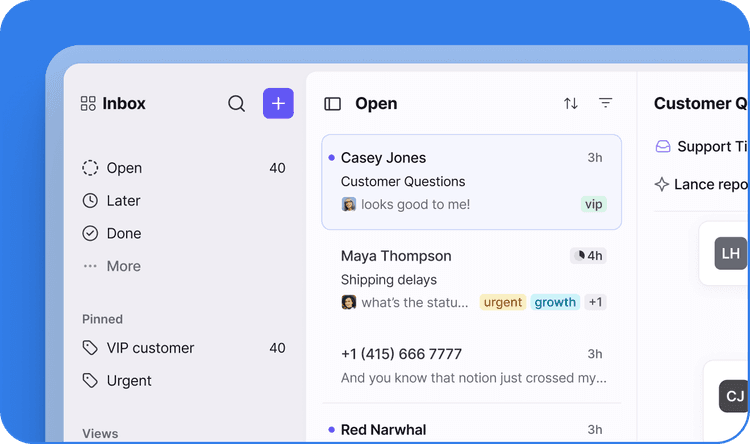
Front makes that possible by centralizing conversations, automating repetitive work, and surfacing analytics that help teams act faster — all while keeping every interaction personal and human. With Front, you can deliver reliable, empathetic support at scale and turn satisfied customers into long-term advocates.
Request a demo to see how Front helps your team build stronger customer relationships through seamless communication and collaboration.
FAQs
What are common causes of poor customer retention?
Poor retention often comes from weak onboarding, slow support, or low product value. Inconsistent communication also pushes customers away.
What’s the 80/20 rule in customer retention?
The 80/20 rule states that 80% of revenue often comes from just 20% of your customer base. It highlights the value of nurturing relationships with your most loyal buyers.
How do you calculate retained customers?
To calculate retained customers, subtract the number of new customers acquired during a specific period from your total customers at the end of that period. This shows how many existing customers continued buying from you, and it’s key to understanding how to increase user retention.