



Learn what proactive customer support looks like in practice, with real examples of how it drives retention and a stronger customer experience.
Customer support interacts with more customers, more frequently, than any other function in the business. Every question, bottleneck, and complex workaround passes through this team, giving them unmatched visibility into customer needs. Yet, many companies still treat support as a siloed service delivery function instead of a growth engine.
There’s a missed opportunity in viewing support as a cost to minimize, notes Kenji Hayward, Senior Director of Customer Support at Front and author of Support Is the Strategy. When teams optimize for deflection instead of retention, they don’t see the bigger picture: that customers with positive support experiences are 40% more likely to upgrade.
That’s why proactive customer support matters. Proactive teams don’t wait for customers to reach out — they anticipate pain points and resolve issues before customer satisfaction takes a hit. By moving from reactive “firefighting” to a coordinated operations strategy, teams can increase trust and drive long-term retention.
Reactive vs. proactive service
Understanding the difference between reactive and proactive support is the first step toward building a more resilient customer operations strategy. Here’s how the two approaches differ.
What is reactive customer service?
Reactive customer support is the traditional “help desk” model: The team responds only after a customer contacts the company. In this scenario, teams often feel like they’re putting out fires — waiting for tickets, calls, or messages to land in the inbox, then racing to resolve them as quickly as possible.
While reactive support can solve immediate issues, it usually addresses symptoms, not root causes. For B2B teams managing high-stakes relationships, staying in a reactive loop makes it harder to prevent repeat friction or improve the overall customer experience.
What is proactive customer service?
Proactive customer service means getting ahead of customer needs before they become support requests. By monitoring account activity and noticing patterns like repeated questions or common drop-off points, proactive support teams intervene as soon as an issue appears.
Key differences
Here are the main differences between these types of customer service:
Timing: Proactive support gets in front of customer needs, while reactive support waits for customers to ask for help.
Experience: Proactive support makes things easier for customers, while reactive supports only steps in after something goes wrong.
Impact: Proactive support stops problems from happening again, while reactive support fixes the same issues over and over.
Why your team should provide proactive customer support
Moving to a proactive model isn’t just about being “nice.” It’s a strategic decision that fuels both team efficiency and business growth. Here’s how shifting from reactive firefighting to coordinated customer operations can help your team turn service into a competitive advantage.
Spot at-risk customers before they churn
In a B2B context, where the stakes are high, you can’t afford to wait for a complaint. Proactive teams use tags and alerts to monitor for recurrent problems. For example, a “two-strikes” alert can flag an account with multiple complex technical hurdles, prompting a coordinated outreach from an account manager to get things back on track.
Enable customers with self-service
Today’s B2B buyers expect to find answers on their own terms. Proactive teams build and maintain a robust Help Center with guides and tutorials. This “one-to-many” approach allows customers to find answers instantly, reducing the routine volume in your inbox so your team can focus on more unpredictable, high-value conversations.
Create a personal experience at scale
Reaching out before a bottleneck happens shows customers that your team truly understands their specific business logic. Whether it’s an automated status update on a logistics delay or a Copilot-assisted reply that anticipates a follow-up question, proactive help makes every interaction feel 1:1, even as volume grows.
Amplify positive word of mouth across stakeholders
In B2B, a single support experience is often shared with entire teams or stakeholders. Proactive communication creates “share-worthy” moments that build your reputation within a client’s organization. When you solve a problem before a customer’s boss even realizes it exists, you aren’t just a vendor — you’re a mission-critical partner.
Build long-term retention through clear ownership
Proactive support is built on the foundation of clear assignments and consistent follow-up. It involves thoughtful touches like personalized check-ins and ensuring that no “wait, who owns this?” moments ever reach the customer. When you consistently demonstrate that your team is in control, you build the trust necessary for long-term retention and upgrades.
4 proactive customer support strategies that work
Proactive help is both a mindset and a set of strategies that deliver a satisfying customer experience. Here are four strategies you can incorporate ASAP, plus real-world proactive customer service examples.
1. Anticipatory communication
Anticipatory communication means making the first move so customers don’t have to ask for help. In practice, this looks like letting someone know their shipment is delayed or their subscription is about to expire. By stepping in early, you save them time, prevent frustration, and prove your support team is on the ball. These small touches make customers feel understood and leave them happier overall.
Example: A SaaS company notices a software update may temporarily impact product features. Their support team emails affected customers with instructions, tips, and reassurance.
2. Preventive education
Preventive education gives customers guidance before they get stuck. This could include onboarding checklists or short setup walkthroughs. By proactively sharing these tips and best practices — like how to troubleshoot issues — support teams help customers use the product with confidence. Aside from cutting down on repeat tickets, this reduces churn by helping customers succeed on their own.
Example: A logistics company sends proactive updates on carrier capacity constraints and routing best practices, helping dispatch teams avoid delays before shipments are affected.
3. Intelligent self-service
Intelligent self-service helps customers find answers quickly, without opening a support ticket. That can look like a searchable knowledge base or even AI that suggests the right article based on what a customer is trying to do. This is important because it meets the needs of the customers who’d rather solve things themselves than wait for a reply.
Example: A software provider implements a dynamic help center that recommends articles according to user activity. Any time users encounter a setup issue, the system sends a relevant guide so they can resolve the problem without external support.
4. Monitoring and intervention
Proactive monitoring focuses on early warning signs, such as drops in usage or performance slowdowns. Teams that address these issues head-on can fix the problem before it ever affects a customer’s workflow. This makes your company feel more reliable and can organically strengthen your reputation.
Example: A cloud service sees customers getting close to their storage limits. Instead of waiting for something to break, the support team reaches out with upgrade options and tips to optimize usage.
Turn proactive support into your operational advantage with Front
Good intentions alone aren’t enough to scale customer support. To stay ahead of customer complaints, you need an operational backbone that connects your tools and keeps teams aligned.
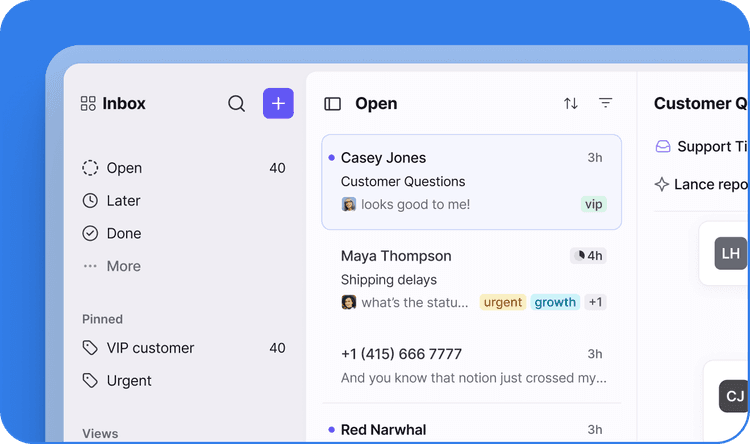
Front’s customer operations platform keeps every team, tool, and customer conversation in sync. By bringing teams and tools together in one shared workspace, Front gives every stakeholder the ability to work proactively — whether that’s support, sales, or operations. Multi-team workflows provide clear paths for teams to coordinate outreach and address issues as they come up.
Ready to see how a unified workspace helps your team (and your customers) stay aligned? Book a demo with Front today.
FAQs
What is proactive customer engagement?
Proactive customer engagement means taking the first step with customers rather than waiting for support requests to roll in. Teams get ahead of customer needs to resolve issues early or share useful information that helps customers solve problems on their own.
How do you get proactive customer service?
You can make proactive customer service a reality by shifting from reacting to tickets to predicting patterns. That usually involves looking at recurring issues and/or customer behavior, and then acting on those signals.
How do you measure the success of proactive support?
If you want to measure the success of proactive support, look for faster response times, higher CSAT scores, and fewer repeat contacts. These metrics show that support is making the customer experience better across the board.
What tools do you need to deliver proactive customer service?
Your team needs a shared workspace where conversations and customer data live together. Front’s customer operations platform can help by syncing teams and workflows in a single source of truth.