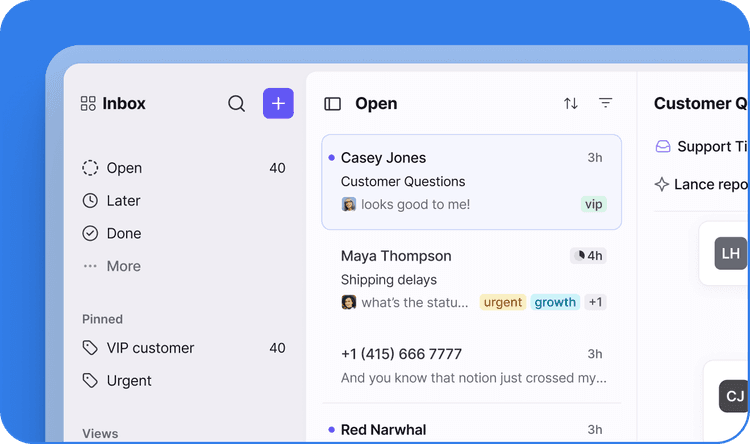





Explore six customer service practices that improve client satisfaction by keeping context intact, ownership clear, and follow-up connected across teams.
Customer satisfaction is a leading indicator of retention, growth, and operational performance. But in complex, high-stakes B2B environments, it’s one of the hardest metrics to sustain under pressure.
If you want to get better at satisfying customers, you need to address the root cause of missed expectations: slow responses, unclear ownership, disjointed systems, and reactive support. It starts with giving your team full visibility, automating the right moments, and building workflows that scale without compromising the personal touch.
In this guide, we’ll break down how to improve customer satisfaction by uncovering the key drivers, the metrics that matter most, and the strategies that deliver real results.
What is customer satisfaction, and why does it matter?
Customer satisfaction is a measure of how effectively a business meets customer needs through the entire experience, from first touch to resolution. It reflects how seamless, responsive, and valuable the customer experience feels as a whole.
High satisfaction drives stronger retention, increased account expansion, and reduced churn. Customers who get consistent, high-quality service are more likely to renew, grow their investment, and become advocates. But when service breaks down — when issues go unresolved or experiences vary between teams — trust and satisfaction are quick to erode.
Teams with clear ownership, shared visibility, and coordinated workflows are better equipped to maintain service quality as volume and complexity increase.
What drives client satisfaction?
Several core factors influence whether a customer walks away satisfied after an interaction — and whether they come back. These drivers shape the customer experience and directly impact customer retention, loyalty, and feedback.
Quality of product or service
Customer satisfaction starts with what you’re selling. A reliable product or high-quality service lays the foundation for strong experiences. If your offering delivers consistent results and real value, customers are more likely to stay loyal and advocate for your brand. When quality slips, satisfaction and retention quickly follow.
Customer service experience
Support teams play a critical role in shaping satisfaction. Fast, contextual responses that demonstrate understanding of account history and current status build confidence. When responses feel slow, impersonal, or disconnected from previous interactions, frustration builds — especially in B2B environments where customers expect coordination across departments and clarity on complex issues.
Meeting customer expectations
Customers bring assumptions about what service should look like, whether it’s fast turnaround, proactive updates, or clear outcomes. When their actual experience aligns with or exceeds those expectations, satisfaction rises. Teams that track and act on customer feedback are better equipped to close the gap and improve outcomes over time.
Value for money
Perceived value is more than price — it’s how customers feel about what they get in return. When your product or service consistently solves real problems, the investment feels worthwhile. Clear communication about outcomes and ROI reinforces confidence and keeps customers satisfied for the long haul.
Consistency across channels
A unified experience across email, chat, and other touchpoints keeps the customer journey coherent. When handoffs break down or context gets lost between systems, satisfaction suffers. Teams that operate from a shared view of the customer are better able to deliver the kind of consistent service that drives loyalty.
What’s quietly working against your customer satisfaction
Most satisfaction problems don’t start with a bad product or an undertrained team. They start earlier — in the coordination layer that customers never see but always feel.
When a request goes through more than one team, the risk compounds. Context goes missing between handoffs. Two teammates send conflicting answers. A customer who explained their situation last week has to explain it again today. None of these failures register as a missed SLA. They don’t trigger an alert. But they land, and customers notice.
The scale of this problem is harder to see than it should be. A recent study showed that nearly two-thirds of B2B companies experienced at least one customer-facing coordination failure in the past three months — context lost between handoffs, inconsistent answers from different teams, customers asked to repeat themselves. Each one is a satisfaction risk that your current dashboards are almost certainly missing.
The most common culprits:
Unclear ownership
When a conversation crosses team lanes — from support to account management, from sales to finance — the handoff is where accountability goes quiet. Someone assumes someone else has it, but no one does.
Missing context
A customer escalates a billing dispute. The agent who picks it up has the ticket. They don’t have the account history, the last three conversations, or the note from the sales team about the renewal. They’re starting cold on a relationship that’s already warm — or already fraying.
Inconsistent answers
When teams operate in separate systems with no shared view of the customer, responses diverge. What support said on Tuesday doesn’t match what account management said Thursday. The customer now trusts neither.
Reactive escalation paths
In most B2B environments, escalations happen after the damage is done — after a response took too long, after a customer expressed frustration. By then, satisfaction has already taken a hit.
The fix isn’t faster responses alone. It’s building the operational layer that keeps context intact, ownership clear, and handoffs intentional — so the problems that damage satisfaction most are visible before customers have to tell you about them.
How to increase client satisfaction: 6 strategies
Increasing customer satisfaction takes more than good intentions. It requires proactive communication, efficient internal workflows, and a team empowered to act with confidence and clarity.
These strategies can help you increase satisfaction and deliver a customer experience that scales with your business.
1. Understand the customer journey
Start by mapping the full customer journey — not just the big milestones, but every interaction that shapes the experience. This gives your team visibility into where customers face friction, so you can improve the moments that matter most. For logistics companies, that might include the handoff between dispatch confirmation and carrier communication. For financial services firms, it could be the coordination between underwriting, account management, and client support during policy modifications.
2. Listen to your customers
Customer feedback is a powerful source of insight — but only if it’s captured and acted on. Regular surveys, support conversations, and ongoing engagement can help you identify what’s working and what needs to change. Fast, visible action shows customers their input matters and builds long-term trust.
3. Meet your customers where they are
Offer support across the channels your customers already use, whether that’s email, chat, or in-app. A seamless, omnichannel customer service experience makes it easier for people to reach out and get the help they need, without repeating themselves or losing context.
This convenience reduces your customer effort score (CES), which measures how easy it is for someone to complete a task or interact with a company.
4. Deliver fast, consistent responses
Speed is a key driver of customer satisfaction, especially when issues are urgent. Equip your team to respond quickly — and consistently — with shared visibility into customer interactions, clear ownership, and efficient handoffs. This reduces confusion, builds trust, and keeps the experience on track.
5. Give your team clarity and control
Strong customer satisfaction starts with teams that have full visibility and clear ownership. Give your customer-facing teams the context, workflows, and coordination they need to resolve issues without hunting for information or waiting on other departments. When everyone operates from shared visibility — with clear handoffs, accessible history, and connected systems — your team can deliver accurate, confident responses that meet customer expectations.
What that visibility gap actually costs is worth measuring. The typical B2B company spends nearly 3 hours coordinating for every hour solving customer problems. That overhead slows response times, puts pressure on teams, and eventually surfaces in satisfaction scores.
6. Leverage artificial intelligence (AI) and automation
AI and automation are critical for scaling without sacrificing personalized service. Use AI to analyze customer signals, automate routine tasks, and support personalized replies — all while giving your team more time to focus on complex needs. The result: faster resolutions, reduced manual work, and a stronger customer experience overall.
What it takes to hit — and hold — 98-100% CSAT
These six strategies will improve your customer satisfaction scores. But what does it take to reach and maintain 98-100% CSAT while scaling your support operations?
We partnered with support leaders at Front, Aircall, Loom, PartnerHero, and Flight CX — teams consistently hitting 98-100% CSAT — to document the specific systems, processes, and coordination strategies that got them there. The guide covers tactical details the strategies above only introduce: scalable hiring processes with specific interview frameworks, tool evaluation criteria that account for team collaboration needs, process design that scales from five to 50+ team members, and how to make CSAT a company-wide priority that drives cross-functional alignment.
Get the complete guide: How to achieve 100% CSAT
How to measure customer satisfaction
Whether you’re managing client services for logistics companies or support operations for financial services firms, satisfaction is a key indicator of how well your team is meeting expectations under operational pressure. It reflects the strength of your customer experience and the gaps that may be driving churn, lowering retention, or slowing growth.
Tracking the right metrics helps you identify what’s working so you can build stronger customer loyalty over time. Tools like Front’s Smart QA make this even easier, automatically scoring every customer conversation for professionalism, empathy, tone, and personalization. Support leaders get instant visibility into service quality and sentiment without combing through transcripts.
Here are four proven ways to measure and improve customer satisfaction.
Customer satisfaction score (CSAT)
Customer satisfaction score (CSAT) is a direct way to measure how satisfied a customer feels after a specific interaction, like resolving a shipment issue, completing an account modification, or finalizing a service request. These quick, post-interaction surveys capture customer feedback while the experience is still top of mind.
Because CSAT focuses on individual moments, it’s especially useful for identifying recurring pain points in the customer journey. Over time, tracking CSAT helps teams improve service quality, address friction faster, and build stronger customer retention.
Net promoter score (NPS)
Net promoter score (NPS) measures customer loyalty by asking how likely someone is to recommend your business to others. Unlike CSAT, which captures feedback about a specific interaction, NPS reflects how customers feel about your brand over the course of their entire journey.
Used together, CSAT and NPS provide a more complete view of customer satisfaction, combining moment-by-moment insights with long-term sentiment. This helps teams track loyalty trends, uncover deeper feedback, and prioritize improvements that matter most.
Behavioral indicators
Surveys aren’t the only way to measure satisfaction. Customer behavior — like repeat purchases, renewals, churn, referral activity, and support volume — reveals how people really feel about your product or service. These signals help teams assess whether satisfaction is turning into long-term customer loyalty and retention.
Tracking behavioral trends alongside metrics like CSAT, NPS, and customer effort score gives you a more complete picture of what’s working and where engagement might be at risk.
Build continuous improvement cycles
Customer satisfaction metrics only drive value when they inform how your team operates. Review customer feedback, quality scores, and conversation trends regularly to identify patterns and adjust workflows accordingly.
By turning insights into action, you create a continuous improvement cycle that strengthens every touchpoint and builds a more resilient customer experience over time.
Improve customer care and satisfaction with Front
In high-volume, multi-team environments, satisfaction breaks down when conversations are scattered, context is missing, and ownership is unclear.
Front is built to solve those operational challenges. It brings every conversation — across email, SMS, chat, and more — into one shared workspace, with deep integrations that connect your tools, data, and workflows. That means fewer silos, faster resolutions, and a better experience across the entire customer journey.
Here’s how Front helps teams improve customer satisfaction and retention:
Bring every customer conversation into one place: Centralize email, chat, SMS, and more into one unified workspace, so your team has the full context — and your customers never have to repeat themselves.
Automate workflows without losing control: Route messages, trigger actions, and streamline approvals to reduce response times and improve consistency across every interaction. Automation handles the repetitive coordination work so your team can focus on complex, high-value customer interactions.
Connect your entire customer operations stack: Access account history, CRM data, order details, and support records directly within every conversation through deep integrations with Salesforce, HubSpot, and 130+ other tools. Full context means faster resolution and fewer handoffs.
Track satisfaction and performance at scale: Monitor CSAT, NPS, and customer sentiment, and use Smart QA to evaluate tone, empathy, and professionalism across every conversation. Operations leaders get real-time visibility into service quality without manual review.
Want to see how Front helps you deliver more human support at scale? Try Front for free — no heavy setup required.
FAQs
What are the 3 Cs of customer satisfaction?
The 3 Cs of customer satisfaction are consistency, communication, and care. Consistency means delivering reliable service across every channel. Communication involves timely updates and clear next steps. Care reflects understanding customer needs and responding with appropriate urgency. For B2B operations teams, these principles translate into unified workflows, full visibility across conversations, and the coordination needed to meet high-stakes expectations.
What’s the 10 to 10 rule in customer service?
The 10 to 10 rule suggests acknowledging customers within the first 10 seconds of contact and following up within 10 minutes of resolution. While originally designed for in-person retail, the principle applies to B2B operations: Rapid acknowledgment builds confidence, and proactive follow-up catches issues before they escalate. Automation and routing workflows help teams meet these targets without constant manual oversight.
How does customer satisfaction impact retention?
Customer satisfaction directly influences retention by shaping whether clients renew, expand, or churn. In B2B relationships, dissatisfaction often stems from operational friction, like slow responses, lost context, or unclear ownership. Teams that maintain high satisfaction through coordinated handoffs and visible accountability see stronger renewal rates. Measuring satisfaction through CSAT, NPS, and behavioral signals helps identify retention risks before they become cancellations.