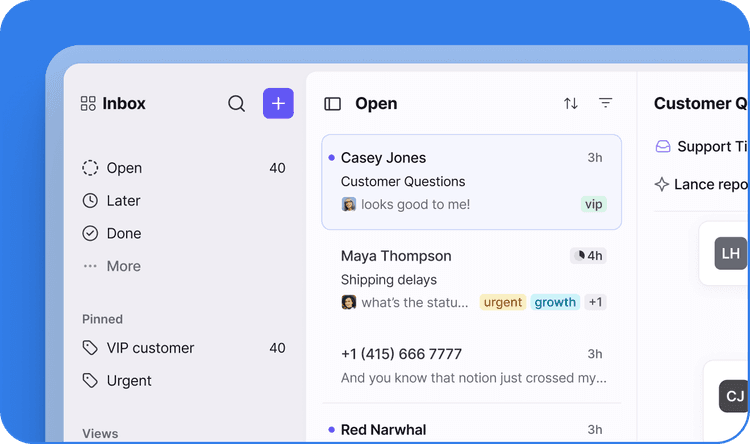





Explore the main types of customer service and learn how modern teams combine automation and human connection to deliver more personal support.
Why do so many teams still treat modern customer service like a cost center, when in reality it’s one of the few levers that lifts both retention and contract value? After all, your B2B customers would pay 40% more for better support.
Customer service has come a long way since the “email us, and we’ll get back to you (eventually)” era. Today, it’s a proactive, multi-channel, relationship-driven practice. And by combining empathy with automation, you can create service networks that improve the experience of both customers and support agents.
In this guide, we break down different types of customer service and show you how to use each one without overcomplicating your support operation.
What is customer service, and why does every business approach look different?
Many people hear “customer service” and immediately picture someone firing off a complaint. While troubleshooting is a big part of providing support, true customer service is every interaction where your team provides clarity, a resolution, or a place to make someone feel heard. This might be answering a customer’s quick chat inquiry, decoding an error they swear wasn’t there yesterday, or confirming their setup is actually working.
Because every business has its own goals, tools, and team structure, no two service approaches look the same. Great support is about combining the right types of service so the experience feels effortless to the customer.
5 customer service types and how to use each one effectively
Every type of customer service solves a specific need or operational mess. Each aligns with a different aspect of customer behavior and will impact how your team operates.
We’ve broken down the five main types, what they do, and why each one matters.
Reactive customer service
What it is: Reactive customer service responds to customer problems after they occur. Think of it as the classic “help me, something’s broken” model.
Why it matters: Even the simplest product can confuse or frustrate someone. Reactive support ensures no problem goes unanswered.
Example: A customer experiences a problem and sends an email inquiry. Your team resolves it promptly, preventing frustration from escalating.
Proactive customer service
What it is: Proactive service anticipates any issues or needs and addresses them before customers even notice.
Why it matters: Tackling issues before they become a problem reduces incoming tickets, boosts trust, and shows customers you’re on top of their experience.
Example: No one has complained yet, but you’ve noticed repeated login errors. You send a quick customer alert with a workaround before anyone needs to contact support.
Self-service support
What it is: Self-service support provides customers with the resources to help themselves, such as FAQs, knowledge bases, tutorials, or in-app tips.
Why it matters: When people solve minor issues on their own, it frees up your support team to tackle more complex problems.
Example: You write a step-by-step guide on how to import data and post it in your help center. A customer who would ordinarily need extra support follows the guide and gets up and running on their own.
Personalized service
What it is: Personalized service is tailored support that considers a customer’s history, preferences, and setup.
Why it matters: Customizing support to someone’s specific needs, creates loyalty, speeds up the resolution, and shows them they’re more than just a ticket number.
Example: A customer’s subscription is up for renewal, so an account manager reviews their usage patterns and contacts them to suggest a package that better suits their needs.
Omnichannel or unified service
What it is: Omnichannel service is a coordinated support experience spanning email, chat platforms, social media, SMS, and other channels.
Why it matters: Engaging your customers wherever they are ensures consistency and convenience.
Example: A customer starts a web chat but gets disconnected. You follow up via email, with the full conversation history at hand, avoiding any repeated explanations.
How customer service systems help teams blend every approach
In the past, many customer service systems were just glorified ticketing systems. But modern platforms unify messages across service channels, automate repetitive tasks, and keep conversations intuitive and empathetic.
And while automation can increase efficiency by handling the boring stuff like routing tickets and follow-ups or flagging common issues, it’s support agents who offer the most thoughtful solutions. Great tools amplify great service, but they don’t replace the skills that make it work.
Suzy draws the line simply: “AI will give you an answer, but it’s not necessarily the correct one. It’s answering from what it’s been given. Support knows what’s actually correct, because we know how that customer has things set up.”
Customer service skills that make every interaction count
Even with the smartest platform in the world supporting them, agents are still the ones who turn a customer inquiry ticket into a real conversation. These skills are essential to any customer service strategy:
Empathy: understand what the customer is feeling so you can respond like a person, not an automated reply
Clear communication: say what needs to be said simply and directly, without confusing the customer
Active listening: pay attention to what the customer says and what they really mean so you can find the right solution
Adaptability: switch tone, tools, or tactics depending on the situation
Problem solving: untangle messy issues quickly and confidently, using your head to get creative if necessary
Teamwork: loop in the right people and share knowledge so every customer has a positive experience
How Front helps you deliver the right type of customer service
No matter the channel, Front brings every customer conversation into one collaborative workspace, so your team isn’t jumping between disconnected tools.
Take Countsy, for example. This high-touch finance and HR partner for startups was drowning in folders, follow-ups, and the “Wait … who’s supposed to reply to this?” problem. Before Front, Countsy’s consultants had to file emails manually, track requests from memory, and guess which teammate owned the next response. Personalized service was the goal, but inbox chaos made it feel like a pipe dream.
After switching to Front in a phased, collaborative rollout, Countsy could respond to customer service requests at a sustainable, achievable pace. Today, the company runs over 600 shared inboxes. Every consultant has instant context, a full history, and the ability to respond faster.
Front didn’t just help Countsy organize its communication; it gave its consultants the structure and clarity they needed to use the skills that make service exceptional: thoughtful problem solving, effortless teamwork, and responsiveness with empathy.
Request a demo today and discover how Front helps teams deliver every kind of customer service faster, smarter, and more personally.
FAQs
What are the 4 types of customer service?
The four main types of customer service are reactive, proactive, self-service, and personalized. Reactive service responds to problems after they pop up, proactive service handles issues before any tickets come in, self-service lets customers fix things themselves, and personalized service tailors every response to each customer’s unique situation.
What are the 3 important qualities in customer service?
The three most important qualities in customer service are empathy, problem-solving, and teamwork. Be quick to respond, actively listen, and work with teammates to resolve issues fast.
What are the different styles of customer service?
Support can be reactive, proactive, personalized, omni-channel, or self-service. Each style answers a different need, fixing problems, preventing headaches, tailoring experiences, or making life easier across different service channels. Smart teams mix and match styles so customers get what they need quickly and painlessly.
What’s good customer service?
Good customer service solves problems efficiently and makes customers feel seen, valued, and heard. It blends speed, empathy, and teamwork into an experience that’s smooth, human, and frustration-free. In short, it keeps customers happy, loyal, and coming back for more.