



See how the top Zendesk competitors and alternatives stack up on pricing, collaboration, and AI features, so you can pick the right fit for your team.
Zendesk calls itself a “complete customer service solution” with AI agents that offer “beautifully simple service.” Those promises sound great on paper. But for many teams, the reality is a maze of tabs, tickets, and workarounds that slow things down instead of speeding them up.
That’s when you know it’s time to start looking for something different — tools that don’t just talk about simplicity but actually deliver it. Platforms that make omnichannel support feel fast, collaborative, and under control.
In this guide, we’ll show you what a true Zendesk alternative looks like, how today’s best options compare, and which one your team can adopt without a learning curve that bites back.
Where does Zendesk fall short?
Zendesk was built to close tickets. That was the job in 2007, and the architecture has never really left that era. Every interaction becomes a ticket. Every ticket lives in its own lane. And the moment a customer issue requires more than one team — say, billing needs to loop in account management, or logistics needs to pull in dispatch — the platform has no real answer for it.
That’s not a feature gap. It’s a structural one.
Ticket-based systems are optimized for volume, not coordination. They’re designed to route, categorize, and close — not to keep context alive as ownership shifts across teams and tools. So when a customer escalates something complex, your team isn’t just solving the problem. They’re also hunting for backstory, chasing down the right person, and manually bridging the gap between systems that weren’t built to talk to each other.
This is exactly what the Coordination Tax describes. According to a recent survey, the typical B2B company spends nearly 3 hours coordinating for every 1 hour spent actually solving customer problems. Zendesk’s siloed ticketing model is a direct contributor to the ratio — it just wasn’t designed for the kind of multi-team, multi-step work that defines modern B2B customer operations.
The result: resolution times that look reasonable on the dashboard, and operational drag that doesn’t show up anywhere (maybe in burnt-out agent exit interviews if you’re lucky).
What makes a modern help desk platform better than Zendesk?
Zendesk worked when support meant queues and ticket volume. But today’s teams need speed, visibility, and control.
Modern help desks do more:
Shared inbox: one clean view for email, chat, and social without things collapsing mid-migration or in day-to-day ops
Collaboration that works: no duplicate replies, no phantom AI agent assignments — just clear roles and real teamwork
AI and automation: routine tasks handled automatically so agents can focus on actual problems, not copy-pasting or categorizing
Omnichannel support and self-service: the ability for customers to help themselves before they ever hit your inbox
Actionable analytics: clear insights into what’s happening, what’s trending, and where the backlog’s building — without wrestling with reports
Zendesk isn’t built for that kind of speed. It’s a ticket machine with too many bolt-ons. And today’s savvy teams are choosing platforms that flex, move fast, and make support feel less like a second job.
Top 10 Zendesk competitors and alternatives
We looked at ten Zendesk competitors who are redefining what modern customer service looks like, organizing them by use case, strengths, and what kind of teams they actually serve.
Here’s what we found.
1. Front
Front is the customer operations platform built for teams who need structure, speed, and visibility — without sacrificing the personal touch. It combines a unified workspace, AI automation, and rich customer context so your team can move fast and show up like humans, not a help desk. And unlike clunky legacy tools that take months to implement, Front gets you going fast.
Key features:
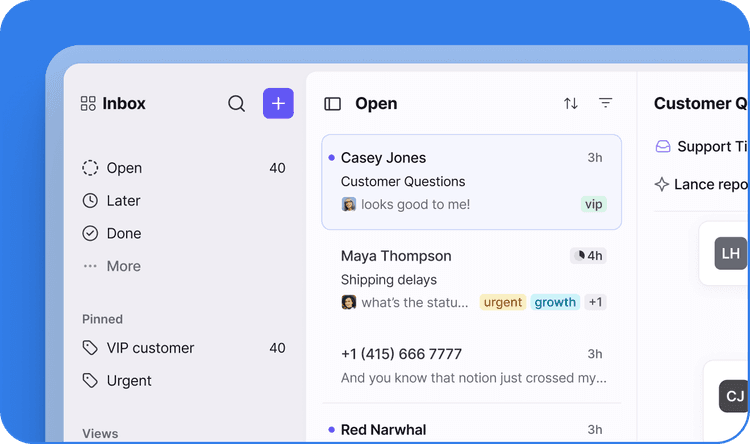
Unified agent workspace: bring together your support queue, shared team inboxes, and personal email in one view, then @mention a teammate, loop in experts (even people outside your org), and keep every conversation in one place
Quality-first AI automation: unlike deflection-focused tools that prioritize ticket reduction over customer satisfaction, Front AI recognizes patterns in your customer service data to triage tickets and suggests the right next steps for each
Straightforward migration from Zendesk: Front’s pre-built migration tool brings your history over easily, and Front offers custom onboarding and technical consultation for larger teams with complex workflows to ensure a smooth transition
Ideal team type: mid-market B2B teams that want scalable collaboration — big enough for process, small enough to stay agile
See Front in action:
2. Freshdesk
Freshdesk is a cloud-based support platform with familiar ticketing workflows — without the Zendesk-level price tag. But simplicity has its limits. It won’t take long before you hit a ceiling with scale, customization, and reporting.
Key features:
Omnichannel support: delivers consistent support across WhatsApp, email, phone, and social — all from one place
AI email agent: auto-solves queries in over 20 languages before they reach your team
Ideal team type: smaller SaaS or support teams that don’t need much customization and prioritize getting set up fast — even if it means revisiting the decision down the road
3. Kapture CX
Kapture CX is an AI-powered customer support platform designed for mid-market and enterprise teams. It brings customer conversations across channels into a unified workspace and uses AI and automation to help teams manage high volumes of support requests. Its focus on configurable workflows and industry-specific use cases can make it a fit for organizations with more specialized support operations.
Key features:
AI and workflow automation: Uses AI agents and configurable automation for tasks such as query resolution, ticket routing, escalations, and agent assistance.
Omnichannel support: Brings conversations from email, live chat, WhatsApp, social media, voice, and other channels into a unified agent workspace.
Ideal team type: Mid-market and enterprise support teams looking for AI-powered automation, omnichannel support, and configurable workflows.
4. Help Scout
Help Scout is closer to a shared inbox than a full-fledged help desk, which makes it easy to learn — and easy to outgrow. You get basic tagging, workflows, and a knowledge base without the overhead of more complex platforms. But if your team needs detailed reporting or cross-functional collaboration, Help Scout may start to feel stretched.
Key features:
Email-style shared inbox: manages support like normal email, with organized threads and built-in visibility
Lightweight automation: keeps you ahead of collisions, applies tags, and auto-routes conversations to the right agents
Ideal team type: small, email-heavy support teams that don’t need deep workflows or cross-team coordination
5. Zoho Desk
Zoho Desk is a cloud-based help desk platform that checks the multichannel box, offers workflow automation, and includes AI-powered suggestions. It also gives teams flexibility to connect with other tools via Zapier or open APIs. But usability can be a tradeoff. Zoho Desk’s interface often feels clunky, and configuring it to handle more complex processes will likely take extra time and technical effort.
Key features:
Unified inbox: keeps every channel (email, chat, and social) in one organized view
Flexible integrations: doesn’t require a heavy IT lift to connect with other apps through Zapier or open APIs
Ideal team type: growing teams that need the basics plus multichannel coverage and are comfortable trading UX polish for budget flexibility
6. Salesforce Service Cloud
Salesforce Service Cloud is a heavyweight platform built for enterprise environments — and deeply integrated into the broader Salesforce ecosystem. It connects support with sales data, powers omnichannel messaging, and delivers real-time, context-rich insights.
But with power comes complexity. Teams often need dedicated admins or consultants to manage setup, updates, and integrations. And customization tends to come with a learning curve (and a steep price tag).
Key features:
AI-driven case suggestions: surfaces relevant responses and recommendations to help agents resolve issues faster
Omnichannel routing: directs inquiries across channels based on availability, priority, and skill set
Ideal team type: large enterprises or teams already invested in Salesforce that can dedicate resources to configuring and maintaining a more structured, admin-heavy support process
7. LiveAgent
LiveAgent stands out in Zendesk comparisons as a lightweight option for startups that only need the basics: social integrations, live chat, and traditional ticketing.
Key features:
AI chatbot: auto-answers common questions and suggests responses
SLA rules: automated ticket prioritization and routing based on custom service level agreement (SLA) settings
Ideal team type: early-stage startups that only need foundational support features and aren’t yet thinking about complexity or scaling systems
8. Jira Service Management
Jira Service Management is built for structured service delivery, with request tracking, SLA monitoring, and customizable workflows that integrate tightly into the Atlassian ecosystem.
But while it works well for internal ops and technical teams, its email templates often confuse end users, which can hurt engagement and resolution times.
Key features:
Configurable queues: organizes requests based on priority and deadlines to meet SLAs efficiently
Self-service portal: helps customers find answers on their own, reducing inbound volume
Ideal team type: technical support or IT teams inside enterprises that are already embedded in the Jira ecosystem and don’t mind trading customer-facing polish for back-end control
9. Pylon
Pylon is a lightweight, AI-assisted support platform that turns Slack into your help desk, with fast ticketing, shared context, and real-time collaboration. It’s built for speed, but teams managing multiple channels or high-volume workflows may find Pylon’s scope a bit narrow.
Key features:
Omnichannel inbox: a single place to manage conversations from Slack, Teams, email, and Discord
Context and collaboration tools: don’t require different tools to view customer history, loop in teammates, or stay aligned
Ideal team type: growing B2B teams that support customers in Slack and want fast, context-aware collaboration — even if it means working within a more limited channel set
10. Intercom
Intercom is a messaging-first support platform that blends AI automation with customer engagement tools. It’s designed to streamline conversational support — from chat to global messaging — all in one place. But while Intercom is fast and sleek, deeper workflows or visibility across teams can require extra layers of setup or added tools.
Key features:
AI automation: handles routine queries, drafts replies, and moves faster on common requests
Two-way inbox and messaging: lets teams manage conversations and reply in real time from a unified inbox
Ideal team type: teams focused on automating chat-first support and messaging at scale who don’t mind trading internal clarity for external speed
How to select the right platform for your team
Picking the right alternative to Zendesk means finding a tool that fits your team, your workflows, and the ways your customers want to be supported.
Use these steps to choose a platform that speeds things up instead of slowing you down:
Identify your team’s biggest blockers. Where do tickets pile up? Where does context get lost? Start with the pain points that matter most.
Match the tool to your team’s shape. Not every platform fits every team. Factor in your size, complexity, and customer volume.
Check how collaboration actually works. Look for features that make it easy to comment, assign, and share context without switching tools.
Balance AI with a human touch. Automation should reduce busywork — not make replies feel robotic.
Pick something that can grow with you. Choose a platform built to adapt, so you’re not switching again in a year.
Bring it all together with Front: The modern Zendesk alternative
When Bentobox needed teams to move faster and stay aligned, Zendesk fell short. Conversations were siloed, add-ons piled up, and context took too many clicks.
Front flipped the script from day one. Response times dropped by 27%, teams handled queries nearly 50% faster, and smart routing got every message to the right person without manual juggling. Manager handoffs got smoother with tags, and CSAT surveys were sent automatically after each interaction. As Erin Forden, Customer Experience Manager at Bentobox, put it: Front delivered the best out-of-the-box functionality they could find.
Request a demo today to see why more teams are choosing Front when Zendesk can’t keep up.