



Explore the best Intercom alternatives for strong customer support, clear workflows, and an AI-powered service that delivers a better customer experience.
One of the biggest challenges facing B2B companies and customer support teams is maintaining clear, consistent customer communication as support volumes grow, use cases diversify, and expectations rise.
Delivering timely, contextual support across channels without losing efficiency or personalization becomes increasingly difficult as your business scales. Many teams rely on Intercom to help handle their customer service, but as you grow, you might start questioning whether the platform’s pricing and feature structure are right for you.
This guide details the top 10 Intercom alternatives for mid-market support teams, including platforms that handle complex workflows, preserve customer context, and scale alongside your business.
What should you look for in an Intercom alternative and why?
While Intercom’s AI-powered real-time chat, ticketing, and shared inbox make it appealing, some mid-market teams find the tool doesn’t quite suit their setup.
At the mid-market stage, customer operations require more than fast response times — they demand coordination across teams, clear ownership of complex requests, and visibility into multi-channel workflows.
That coordination overhead is real and measurable: the typical B2B company spends nearly 3 hours coordinating for every 1 hour spent solving customer problems, and that ratio holds regardless of company size or platform investment.
For mid-market teams specifically, the pressure compounds as operations scale — customer touchpoints per request jump from 8 at smaller companies to 11 — meaning more handoffs, more context to maintain, and more places for things to break down. Platforms similar to Intercom can offer greater control to users, integration options that better fit complex B2B workflows, and more effective collaborative operations, helping you establish a quality-first AI strategy.
Here are four key factors to keep in mind when considering Intercom alternatives:
Pricing: Always inquire about pricing structures, including flexible options like monthly or annual costs. For instance, Intercom’s seat-based model, combined with additional charges per AI agent resolution and add-ons, can make it difficult for teams to forecast true monthly costs, especially as volumes grow.
Customer communication: Ensure any platform you consider allows you to communicate with your customers in a way that suits your business model. Intercom is built for quick interactions or efficiently resolved questions, but when support requests become more complex, Fin (Intercom’s AI agent) can struggle. Avoid tools that produce responses that feel generic, sound off-brand, or require highly specific prompt phrasing to produce accurate answers.
Customization: When AI usage is billed per resolution, teams naturally want tighter control over how the program responds, with granular data to analyze its performance. Intercom, and Fin in particular, offers limited response customization by brand voice or customer segment, while alternatives focus on delivering more visibility when you need it most.
Learning curve: The speed at which you can get up and running with a new platform really matters, especially if your team is accustomed to Intercom’s workflows. Alternatives with dense interfaces or extensive configuration requirements can slow adoption and make ongoing optimization more challenging for support teams.
Top 10 Intercom alternatives: Key features and pricing options
Finding the right alternative to Intercom can feel overwhelming when many options promise the same thing: More efficient customer support with less effort. Instead, be on the lookout for platforms that simplify workflows, maintain context, and scale alongside your growing B2B team.
To help guide your decision, here are 10 Intercom alternatives and their pricing options.
1. Front
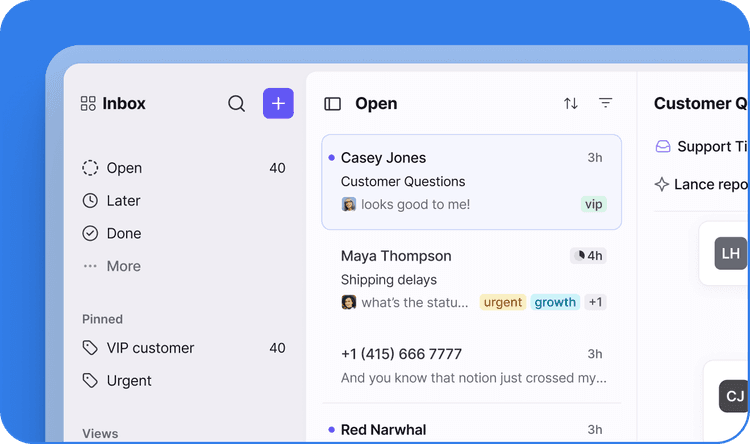
Front is built for B2B customer support teams that need more than just live chat. The platform centralizes customer conversations in a single platform while providing teams with the structure they need to manage ownership, priorities, and response quality at scale.
Support reps can collaborate within conversations and tickets, loop in other teams by @mentioning, and bring full customer context to every reply. Front’s AI scales automation safely without sacrificing service quality: You choose which routine questions Autopilot handles, while Copilot supports agents with complex or unpredictable issues — all within flexible workflows that adapt as your operations evolve.
Since Front is built for B2B teams with complex customer operations, smaller B2C companies who aim to deflect as many tickets as possible might not utilize its full suite of features.
Pricing options:
Front offers three plans that scale with seats and business size. The most affordable option starts at $27/seat per month, billed annually.
Autopilot pricing is currently being piloted. Contact sales for pricing details.
Take a look at how Front handles routing, collaboration, and automation in one place:
2. Kustomer
Kustomer is designed around working with unified customer profiles rather than individual tickets. It supports multi-touchpoint interactions across channels with omnichannel messaging, automation, and analytics.
It’s a good option for environments with high interaction volume or longer resolution cycles. That said, it may not suit mid-market B2B teams that prioritize real-time collaboration and lightweight, inbox-driven workflows.
Pricing options:
Kustomer has Enterprise and Ultimate plans at $89–$139 per seat per month, with AI agents billed separately. Its pricing may be better suited to enterprise teams than mid-market support.
3. Drift (by Salesloft)
Drift is a conversational engagement platform built around AI-powered chatbots, predictive routing, and CRM integrations to capture and qualify leads, automate common replies, and schedule meetings. Drift features a conversation-centric structure, and the platform’s intent-driven interactions make it a great choice for sales-focused teams in particular.
Its sales-first architecture means teams focused on post-sale support operations and multi-team service coordination may find it less suited for managing complex customer service workflows that require cross-functional collaboration.
Pricing options:
Drift’s pricing isn’t public. Teams need to request a demo and receive a customized quote.
4. Zendesk
Zendesk is a legacy support platform that handles high-volume, omnichannel case management with a ticket-first model. The platform is easily scalable and supports integration with a great deal of third-party apps. For teams in need of structured workflows and standardized reporting, Zendesk can be a great choice.
However, its ticket-first model can feel rigid for teams that prioritize conversation-based collaboration, and its extensive feature set often requires significant configuration time.
Pricing options:
Zendesk’s customer service plans cost between $19-$169 per agent per month, with some features only available as additional add-ons.
5. Help Scout
Help Scout is a lightweight, email-style shared inbox that’s easy to adopt and manage. If you’re looking for a platform to support all your basic workflow, tagging, and knowledge base needs, Help Scout is a good catch-all.
While it excels at simplicity, Help Scout may lack the advanced workflow automation and multi-team coordination features that larger operational teams need.
Pricing options:
Help Scout offers Standard, Plus, and Pro plans at $25–$75 per seat per month, with AI answers billed separately at $0.75 per resolution.
6. Gorgias
For e-commerce businesses, Gorgias has several valuable features, including Shopify and BigCommerce integration, a centralized inbox, task prioritization, and full customer history. However, be aware that as an e-commerce sector-specific tool, it lacks many features that more generalized mid-market teams may need.
Pricing options:
Gorgias uses a ticket-based tiered system with plans starting at $10 per 50 tickets per month, up to $750 per 5,000 tickets per month. Its AI agent is added to the bill separately, and voice and SMS support are add-ons.
7. Zoho Desk
Zoho Desk is a cloud-based help desk that comes with multichannel support, workflow automation, and AI-powered suggestions. It integrates fluidly with other tools via Zapier and APIs, offers ticketing and asset management solutions, and supports the sending of customer satisfaction surveys. Teams managing complex, multi-stakeholder workflows may find its collaboration features less robust than platforms purpose-built for operational coordination.
Pricing options:
Zoho Desk offers Express, Standard, Professional, and Enterprise plans at $7–$40 per user per month.
8. Freshdesk
Freshdesk supports ticketing workflows and omnichannel support, including email, phone, WhatsApp, and social media.
The platform’s AI email agent can auto-solve queries in more than 20 languages. Larger organizations may encounter limits with Freshdesk’s scalability, customization, and reporting, making it a better fit for smaller teams in need of a fast setup.
Pricing options:
Freshdesk’s Growth, Pro, and Enterprise plans are priced between $15–$79 per agent per month. Freshdesk Omni plans start at $29 per agent per month.
9. LiveAgent
LiveAgent offers basic support with live chat, social integrations, AI chatbots, and SLA-based ticket routing. Its simplicity makes it better suited for early-stage startups that need foundational tools than for growing B2B support teams looking for cross-channel collaboration.
Pricing options:
LiveAgent offers four different plans based on company size, with pricing starting at $15 per agent per month, up to $69 per agent per month.
10. Tidio
Tidio combines live chat, help desk, chatbot automation, and AI agent features with the goal of providing a better overall customer experience.
The platform can handle common questions and lead capture efficiently. Tidio also offers advanced automation and customization options, though these are largely locked behind higher-tier pricing plans. Its focus on e-commerce and lead generation makes it well-suited for online retailers, but B2B teams managing complex, multi-stakeholder workflows may find its collaboration and routing capabilities too basic for operational needs.
Pricing options:
Tidio has separate pricing for its customer service platform and AI agent, Lyra. The platform has four standard plans starting at $24.17 per month for 100 billable conversations, up to $749 per month for custom billable conversations. Lyra’s pricing scales with the number of conversations, starting at $32.50 per month.
Front vs. Intercom: Which is the better support tool?
To help you decide between Front’s customer operations platform and Intercom’s support messaging tool, here’s a comparison of the core functions, integration capabilities, usability, and customization of both, alongside price points.
Make 5-star service a reality with Front
Unlike tools built around quick deflection, Front is designed for teams managing complex, high-stakes customer operations where every interaction matters.
High-volume, multi-team support doesn’t have to mean slower responses or inconsistent service. Front provides your team with a unified workspace to handle support queries efficiently, alongside AI that scales safely without sacrificing quality.
See the difference for yourself by booking a demo with Front today.