


Compare the best AI customer service software and see how Front AI helps teams deliver faster, smarter, and more human support across every channel.
AI customer service tools have flooded the market, but most chase automation speed over actual performance. The question isn’t how fast AI can respond — it’s whether it understands context, keeps humans in control, and provides accurate information when stakes are high.
In this guide, we’re cutting through the noise to highlight 12 standout AI customer service platforms based on how they balance automation with human oversight, handle complex interactions, and give teams the context they need to deliver great service.
AI customer service software vs. AI chatbots: What’s the difference?
There’s been a lot of talk recently about AI-powered customer support tools replacing human agents. But those conversations miss the point. Instead, think of your customer experience (CX) strategy as “AI + human support.”
The best AI customer service software is much more than a chatbot on your website. Yes, these tools automate responses to routine questions, but they also assist service teams across the customer experience: routing escalations to the right teammate, quickly gathering and summarizing context, suggesting informed replies, analyzing customer satisfaction, and more.
With strong AI software, customer needs are met as efficiently as possible without losing the human connection that keeps customers happy and loyal.
Compare the 12 best AI customer service software for 2026
An e-commerce business might need an AI chatbot to deflect 80% of routine, “what’s my order status” inquiries. A third-party logistics company might need a unified workspace where AI plays the role of copilot, helping multiple stakeholders gather context and solve urgent, high-stakes requests. And your business might need both.
So instead of picking an overall winner, we’re giving you an overview of 12 leading customer service platforms, with an assessment of what they’re known for, where they excel, and why you might choose them.
1. Front
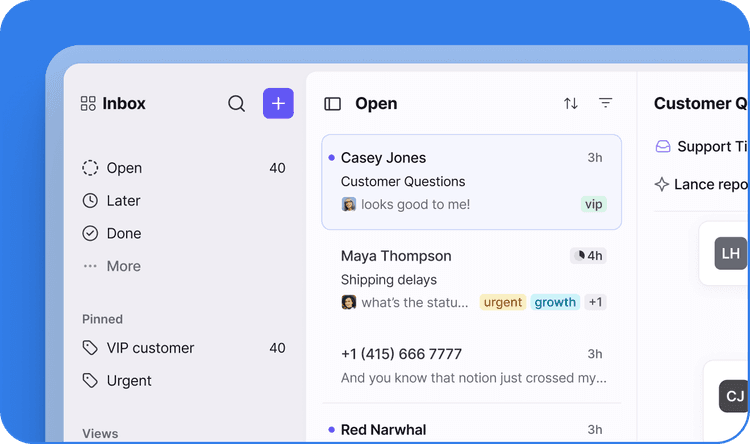
Front is the only AI customer support software built for teams who deal with complexity, not just volume. It brings every customer conversation — across email, chat, SMS, and more — into one shared workspace, alongside AI that learns from every message and interaction.
Unlike tools that bolt on automation as an afterthought, Front’s AI is core to how the platform works, handling routing, extracting insights, and accelerating resolution without taking humans out of the loop.
Front gives teams clarity and confidence to scale automation strategically — without sacrificing the consistency and excellence customers expect. And with Smart Quality Assurance (QA) and Smart Customer Satisfaction (CSAT), every improvement is measurable.
2. Sprinklr
If you want to go beyond customer service and integrate other functions like marketing and social media, Sprinklr offers a unified platform for doing just that. It uses conversational AI for greater efficiency across all your outreach work, but its broad focus may come at the cost of depth in the customer support experience.
3. Freshworks
Best known for its Freshdesk ticketing system, Freshworks also offers a range of AI customer service software, such as Freshchat for chat-based customer support and Freddy AI for summarizing conversations, suggesting replies, and more. While useful for handling routine queries, it may require multiple tools to build the kind of integrated workflow modern teams need.
4. Intercom
If you don’t need a fully integrated solution and just want an AI chatbot to resolve simple queries and feed the more complex ones to human agents, Intercom’s Fin AI agent could be a good fit. It aims to streamline customer service and streamline efficiency, though it stops short of giving teams full visibility across all customer interactions.
5. Zendesk
Although it’s been around since 2007, Zendesk has recently introduced AI-powered customer support tools to streamline workflows and automate over 80% of support interactions. It’s a solid option for cutting costs, but teams focused on maintaining high-quality, human-first support might find it less flexible.
6. Salesforce Service Cloud
Salesforce Service Cloud extends the company’s CRM capabilities into customer service. It’s ideal if you’re already deep into the Salesforce ecosystem. That said, its AI tools are more add-ons than core features, which can make deployment and iteration slower than expected.
7. Ada
Ada is designed for teams that want to automate a large share of their customer support. Its AI agents provide quick responses and deflection at scale, but deeper collaboration and continuity between bots and humans may take extra work to configure.
8. Gladly
Gladly helps teams shift from tickets to conversations, with a focus on building relationships instead of closing cases. Each customer has a unique interaction thread for agents to reference. However, the platform may feel more consumer-focused than enterprise-ready for teams handling complex support.
9. Kustomer
Kustomer, like Gladly, centers support around unified customer timelines. Conversations are centralized, and agents have historical context in one place. While it streamlines visibility, its native AI capabilities are still catching up compared to more AI-forward platforms.
10. Help Scout
Help Scout supports shared inboxes with AI features like summaries, suggestions, and translation. It’s approachable and easy to use, though teams looking to scale their AI strategy across multiple channels and workflows might run into limits.
11. Tidio
Tidio’s AI customer service software gives you the basics like a help desk and live chat, along with an AI agent to handle repetitive queries. It’s a good option for small and medium-sized businesses looking for a simple solution, but it lacks the operational depth needed by larger or fast-scaling teams.
12. Kommunicate
Kommunicate is built around automation and integrations, making it easy to train a chatbot and connect it with tools like Zapier, Slack, and WhatsApp. However, it focuses more on tech flexibility than delivering a seamless customer experience end-to-end.
Choose the AI customer service software that fits your reality
What do your customers need, and how can your team best use AI for customer support to meet those needs? The answers to these questions will determine the best AI customer service software for your business.
Although many platforms emphasize automation, speed, and efficiency, the best AI recognizes when it can deliver accurate answers, and when to take a step back, escalate, and play a supporting role to your service team.
That balance isn’t just good practice. It’s where most platforms fall short. More than 70% of B2B companies ran into significant AI problems in the past three months, and the failures weren’t broken automations. They were coordination failures: AI generating extra coordination work (24%), losing context at handoff points (22%), sending requests to the wrong team (20%). Speed without context doesn’t reduce the operational load. It just moves it somewhere else.
Here are some key factors to consider when choosing AI customer service software:
Integration: Your agents need to see everything in one place, not switch between separate standalone tools.
Context and accuracy: Does the AI have access to your full customer history, or is it limited to a support queue? AI that sees the complete picture delivers more accurate answers.
Control: Are you able to define exactly which topics and interactions AI will automate and which will route through your team? Can you see when AI is automating and intervene when needed?
Scalability: The platform should grow with your team without requiring constant reconfiguration or expensive upgrades.
Remember, AI needs to work for your real-life operations, so focus less on theoretical speed tests and automation claims and more on meeting real customer needs.
Front: The AI for high-stakes businesses who need quality and control
Using AI for customer service isn’t about replacing human agents. In fact, smart use of AI can make your customer service more human by freeing your agents from repetitive tasks and giving them the tools they need to exceed customer expectations every time.
If you’re frustrated by fragmented, standalone tools that just aren’t doing the job, try using Front AI to bring clarity and confidence to your customer operations. Front offers AI you can trust while providing a unified workspace where your team can access every customer conversation across email, chat, SMS, and more. It helps customer service teams work smarter and scale responsibly, providing all the analytics you need to measure success and improve service quality.
See why 9,000 businesses trust Front to boost customer satisfaction to 87%, improve productivity up to 46%, and reduce average response times by 25%. Book a demo today.
FAQs
What’s the best AI chatbot for customer service?
The best AI customer service software solutions provide so much more than just a chatbot. For example, Front’s AI-powered platform helps your team manage conversations across multiple channels and provide a five-star customer experience, without losing that all-important human touch.
Do companies like Microsoft use AI for customer service?
Yes, companies like Microsoft use AI to enhance customer service, but they still rely on human agents, too. Many platforms now include tools that help support reps troubleshoot issues, suggest replies, and resolve tickets faster. It’s a blend of automation and human support that reflects how most modern teams operate today.
How much does AI customer service cost?
The cost of AI customer service software varies widely depending on which tool you choose and how big your organization is. The platforms typically offer different levels too, from basic plans to those with more advanced features. For example, Front’s pricing starts at just $25 per person per month for the Starter plan and goes up to $105 per person per month for the Enterprise plan.