


Compare the top help desk solutions for 2026 and see how each one helps support teams stay fast, aligned, and in control.
Help desk solutions aren’t just about ticketing anymore. Today, the best platforms act as central hubs for collaboration, resolution, and automation, helping support teams move fast and stay in sync.
B2B support teams face high stakes and constant pressure. They need systems built to handle complexity, not hide it. The right help desk solution gives every support specialist the context and control to lead conversations instead of just logging them.
Here’s a roundup of the top help desk platforms on the market, plus tips for choosing the right one for your team.
What makes a great help desk solution?
There’s no shortage of help desk software options that field simple inquiries, but very few that stand up to the pressure and complexity of a B2B business. Teams like yours will need, at a minimum, these essential help desk features:
No matter which support desk system you choose, make sure it has these basic features:
Collaboration support: Some issues are too complex for one person to solve. Your support agents will inevitably need to bring in other teams to help with advanced queries. The typical B2B company spends nearly 3 hours coordinating for every hour actually solving customer problems. Your help desk software should make it easy for context and interactions to travel with tickets, continuing that paper trail.
AI and automation: The best service desk systems reduce repetitive work for agents while giving customers faster access to answers through automated knowledge bases and self-service. The key is keeping automation in the background so interactions still feel personal and human.
Third-party integrations: Your help desk should connect seamlessly with the tools your team already uses, like CRM platforms, project management software, and communication channels.
Scalability: Help desk solutions should grow with your team, handling increased volume and complexity without requiring a complete system overhaul.
The top 8 help desk solutions for support teams
Here are eight help desk systems that support collaboration, context sharing, and automation visibility.
1. Front
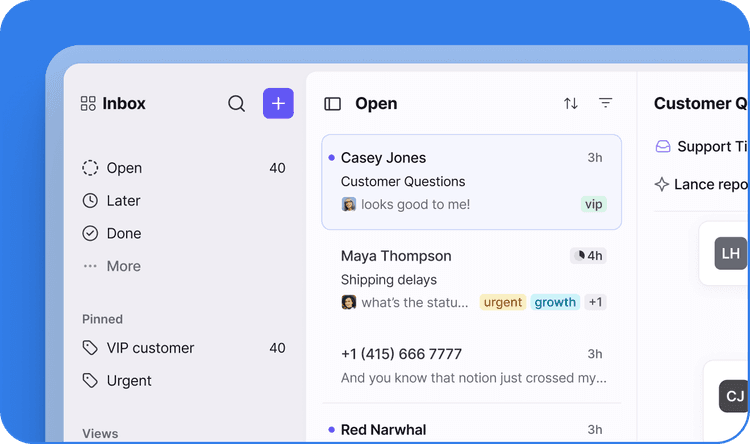
B2B support teams don’t have the luxury of a queue full of simple tickets. They manage relationships, revenue, edge cases, and high-stakes decisions that stack up fast. Front was built for that reality. It connects every conversation, workflow, and teammate so the whole operation moves with clarity. AI handles routing and prioritization and surfaces customer context, allowing agents to focus on solving problems and keeping conversations clear and human.
For your customers, getting help feels like a familiar, one-on-one conversation, whether it’s over email, SMS, social media, or another channel.
2. Zendesk
Zendesk is worth considering if you’re looking to build a help desk for IT support and other customer queries. It offers an app marketplace to help you customize your service desk and build integrations with third-party software. It also features a number of self-service solutions, such as community answers and a searchable knowledge base, to help lessen your support agents’ workloads. That said, Zendesk can be complex to configure and may require technical support to get the most value.
3. Freshdesk
If you’re interested in implementing more automation, Freshdesk has plenty to offer. Its Freddy AI chatbot can handle most run-of-the-mill queries, freeing up your team to focus on the more complex queries and building relationships with customers. The platform also includes several team collaboration features, like in-app messaging and the ability to tag coworkers to assign ownership or ask questions. However, its automation features can feel siloed if you’re managing multiple channels or teams.
4. Zoho Desk
Zoho Desk provides automation options via its Zia AI assistant. It can route queries based on custom rules, suggest replies, analyze customer sentiment, and more. Since Zoho Desk integrates with Zoho CRM, it’s a solid choice for Zoho users—but less ideal if you want a system purpose-built for support.
5. TeamSupport
Built specifically for B2B support teams, TeamSupport offers a ticket management system that’s easy to use and gives your agents the information they need to support customers quickly. The platform also facilitates the building of a knowledge base and self-service options, and features a collection of automation tools to streamline your workflow. Just note that some users report a steeper learning curve for advanced functionality.
6. ProProfs Help Desk
With ProProfs Help Desk, your agents can save time by using AI to summarize issues or use suggested responses. It integrates well with other tools, such as Salesforce, and includes a useful dashboard that helps you manage all customer communication in one place. This lightweight tool is a decent option for smaller teams, but it may not scale well with growing complexity.
7. AzureDesk
AzureDesk lets you automatically convert mail sent to company email addresses into support tickets. It supports unlimited mailboxes and includes a ticket management system to help you see issues through to resolution. It can be a good option for small businesses looking for a solution that’s easy to implement. But that simplicity may come at the cost of deeper collaboration or visibility features.
8. Tidio
Tidio is a customer service platform that combines live chat, help desk ticketing, and AI support tools for small and medium-sized businesses. One of its core features, Lyro AI, uses verified data to generate conversational responses and automate a large share of customer inquiries. The platform also includes automation workflows called Flows, which can help businesses capture leads, answer questions, and support customers outside business hours.
How to choose the right help desk solution for your team
The wrong help desk solution could slow down your support teams, leave customers frustrated, or have you paying far more than you need to. Since picking the right tool for your business and industry is so important, we’ve laid out a few steps to follow that’ll help you shop with confidence.
Map your current pain points
Before browsing help desk systems, start by asking how you currently provide customer support. What’s your help desk workflow, and what do you need to improve about the process? The answers to these questions will help you find the best solution for your needs.
Evaluate collaboration options
Collaboration is essential for any service desk. While ticket management is important, the main thing your team needs to do is communicate with customers and each other to resolve issues quickly. Look for a solution that makes collaboration easy and intuitive.
Look for automation that feels natural
AI can help you speed up your responses and provide powerful self-service options, but you don’t want to lose the human element of your support. Look for help desk software that offers automation and AI-powered processes, but make sure your customers won’t feel like they’re talking to a machine.
Consider adoption and scalability
Overhauling your help desk setup can be a complicated task, so look for platforms that’ll help you get up and running quickly. Small or medium-sized businesses don’t need complicated and expensive enterprise systems, but you don’t want to adopt a solution you’ll quickly outgrow. Pick a solution that fits the stage your business is at right now, but that also scales alongside your business.
Keep support fast, collaborative, and human with Front’s help desk platform
Speed matters — but that’s not the whole story. In B2B support, what really sets teams apart is collaboration, automation that adapts, and conversations that feel human, no matter where they take place.
Front goes beyond ticket management. The platform improves collaboration and visibility, while Front AI keeps your team fast, confident, and in control.
Book a demo to see how Front can help keep your team aligned and your customers happy.
FAQs
What are the different types of help desks?
Help desks can be internal or external — supporting either employees or customers — and can serve both B2B and B2C audiences. There are ticketing systems for IT help desks, internal help desks, HR help desks, and many more, each built to handle different types of requests and workflows. Front is purpose-built for customer-facing teams, especially in complex B2B environments where collaboration and visibility are critical.
How much does a help desk solution cost?
Help desk software costs vary depending on the provider and the number of features included. A good starting point for small teams is to look for basic services at around $25 per user per month, with more advanced features increasing the total price.
What’s a SaaS help desk?
A software as a service (SaaS) help desk, also known as a web help desk, is a cloud-based ticket management and customer communication system. Most help desk solutions run on a SaaS model, with regular updates and easy access from any device with an internet connection.