



Compare the best email management software and turn every message into action through shared inboxes and AI-powered collaboration with Front in 2026.
Personal messages. Promotions. Nonstop support conversations. If you work in customer support, this is just a normal Tuesday.
Without the right systems, that volume leads to missed emails, slower collaboration, and wasted hours.
That’s where email management software comes in — turning chaos into coordinated action.
Turn email from a personal chore into a team advantage
Every business relies on email, yet most inboxes are still built for individuals. That’s where team productivity breaks down.
The best email manager solves for visibility, speed, and shared ownership, turning email into a connected system for collaboration and better-aligned teams.
Top 8 tools for effective team email management
The internet has its fair share of “best email software management” lists, so we’re focusing on what actually matters: how these tools help teams collaborate, stay aligned, and respond faster.
Here are our top eight picks and their best features.
1. Front
If you’re tired of chasing lost messages, switching tabs, and piecing together a customer’s history like a paperback mystery, Front solves that.
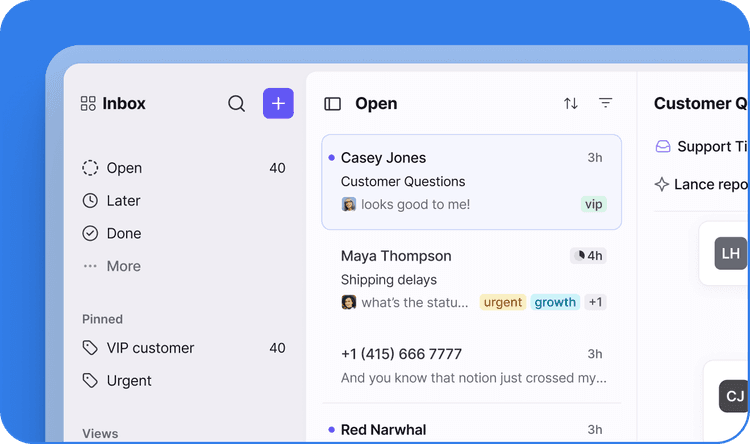
It brings your messages, teammates, and customer context into one workspace, so you can collaborate faster and respond with the full picture.
Key features:
Shared inbox: Manage emails, social media, chat, SMS, and WhatsApp from a single inbox, so the end-to-end customer journey lives in a single workspace.
AI automation: Front’s AI learns from conversations, automates routine tasks, and customizes replies based on your brand voice.
Easy collaboration: Comment directly in threads, tag teammates, and access past conversations without digging. Drafts are automatically shared with all teammates who have access to the conversation. You get instant input or feedback on drafts, and customers get accurate answers the first time.
Best fit:
Front is purpose-built for B2B teams with complex operations. Smaller teams focused on high-volume ticket deflection may not need its full collaboration suite.
2. Superhuman
Superhuman is built for individual power users who live in Gmail or Outlook and want to move faster. AI handles email drafting, auto-tagging, and follow-up reminders.
It’s not a team collaboration tool — there’s no shared inbox or multi-channel unification — but for solo productivity, Superhuman is hard to beat.
Key features:
Split inbox: Built for email management teams buried in daily messages, Superhuman’s Split Inbox automatically sorts emails into priority buckets so you can tackle what matters first. It’s a fast way to stay focused without sifting through the noise.
AI automation: Superhuman AI turns a few phrases into full emails, sets follow-up reminders, and drafts replies that match your brand’s tone. It’s built to take the busywork out of emailing.
3. Shortwave
Shortwave is an email productivity and inbox management tool that streamlines your inbox with AI that organizes, labels, writes, and even searches emails while connecting to your workflow tools.
While Shortwave’s reliance on Gmail and limited multi-language support can feel restrictive for larger teams, it’s another good option for individuals looking to take control of their own inboxes.
Key features:
Bulk triage: Don’t let the promotions, newsletters, and updates get in your way. Use bulk triage to zero in on what actually matters.
To-do lists: With inbox-powered to-dos, you can group, rename, prioritize, and add notes to turn overflowing emails into actionable checklists.
4. Missive
Missive brings email, social channels, SMS, and WhatsApp into a single shared inbox, with plenty of customization for teams that like to tinker. Some teamwork (like tagging or pinging teammates or departments) still happens outside the app, which can slow teams with heavier workflows. But Missive is well-suited for lightweight collaboration and automation.
Key features:
Internal team chat: Facilitate discussions and collaboration in real time with team inboxes, task assignment, and collaborative drafting.
Task management: You can create tasks and track the status of what your teammates are working on.
5. Hiver
Hiver qualifies as email management software, layering shared inboxes, assignments, and automations on top of Gmail. While it brings structure to email-based support, users report issues like missed assignments and weak formatting. For organizations looking to scale, it’s a starting point — but not always the destination.
Key features:
Shared inbox: Manage multiple accounts, integrate with other apps, and share notes with teammates — all without leaving your inbox. Complex setups, however, may still require extra coordination.
Team collaboration: Collaborate on drafts, use AI to categorize emails, and track key metrics to keep everyone accountable.
6. Zendesk
Zendesk brings decades of experience (from in-depth integrations to an extensive tool stack) as a legacy tool. It lacks in the collaboration department — email is treated more like a ticket than a conversation — but for teams focused on traditional support workflows, it can be a familiar and structured option.
Key features:
Mature ecosystem: Zendesk lets you integrate email management into your existing stack, and its mature ecosystem means the third-party tools your team uses are already compatible.
Native mobile app: Your agents can respond to emails and monitor their status even when they’re away from their desks.
7. LiveAgent
LiveAgent is a lightweight help desk and live chat tool with universal inboxes, automated ticketing, and a knowledge base. It includes a mobile app, though some users note that navigation requires extra steps, which can slow things down when time matters most.
Key features:
Service level agreement (SLA) rules: Emails and tickets can be automatically prioritized and routed based on SLA rules.
Universal inbox: Emails, calls, social media, and chats are centralized in one dashboard, letting you route tickets, chat internally, and integrate CRM tools.
8. Freshdesk Omni
Freshdesk is a simple, cloud-based ticketing solution, and its companion, Omni, adds AI workflows, a unified workspace, and email analytics. Just keep in mind that duplicate tickets can slow communication, and costly pricing (plus essential features locked behind higher-tier plans) put limits on its overall value.
Key features:
Conditional email templates: Save time by automatically suggesting or applying email templates and customizing them with CSS editor based on ticket properties.
Workflow automation: With AI-powered automation, you can auto-reply, auto-resolve, and auto-assign emails to team members.
The right tool fits your workflow, not the other way around
Email management isn’t just about clearing your inbox — it’s about making sure your team can collaborate without friction. When evaluating tools, focus on these questions:
Does it give everyone visibility into shared conversations?
Does it connect to the tools where decisions happen?
Can it scale without breaking structure or focus?
Will it help the team respond faster and smarter?
Remember that email isn’t always the problem, but a disconnected workflow is.
Build clarity and collaboration into every inbox with Front
The best email management software doesn’t shrink your inbox. It turns unread, missed, and unsent emails into an organized, accountable system where nothing falls through the cracks.
Front brings your messages, teammates, and customer context into one workspace, so every response is fast, accurate, and backed by the full picture.
Hootsuite uses Front to manage thousands of customer accounts without duplicated work or endless Slack threads. With shared visibility and in-thread collaboration, their team responds faster, escalates smoothly, and stays aligned — without the chaos.
See how Front works. Book a demo today.
FAQs
Is Outlook an email management system?
Outlook is primarily an email client, not a full email management system. For more advanced features, paid or free email management software can help teams organize, track, and collaborate on messages.
What’s the best way to manage emails?
The best way to manage emails depends on visibility, collaboration, and scalable workflows — not just speed. When teams have shared access to conversations, can collaborate behind the scenes, and automate repetitive tasks, email becomes a powerful channel for customer service. The right tools will help your whole team stay aligned, in control, and focused on what matters most: delivering a great customer experience.
Can email management software work with existing email providers?
Yes, most email management software is designed to work alongside popular providers like Gmail or Outlook. These tools don’t replace your inbox; they enhance it with features like shared visibility, workflow automation, and better team collaboration. The goal isn’t to change where you send email, but how your team handles it together.