


If you flip on a commercial light fixture, power up a data center, or adjust an HVAC system, there’s a good chance a wire harness from Flex-Tec is inside, quietly doing its job.
For nearly four decades, Flex-Tec has built custom wire harnesses to exact customer specifications, serving leading OEMs across lighting, refrigeration, robotics, and data centers. Founded in 1985 and headquartered in Georgia, the company operates behind the scenes and at massive scale.
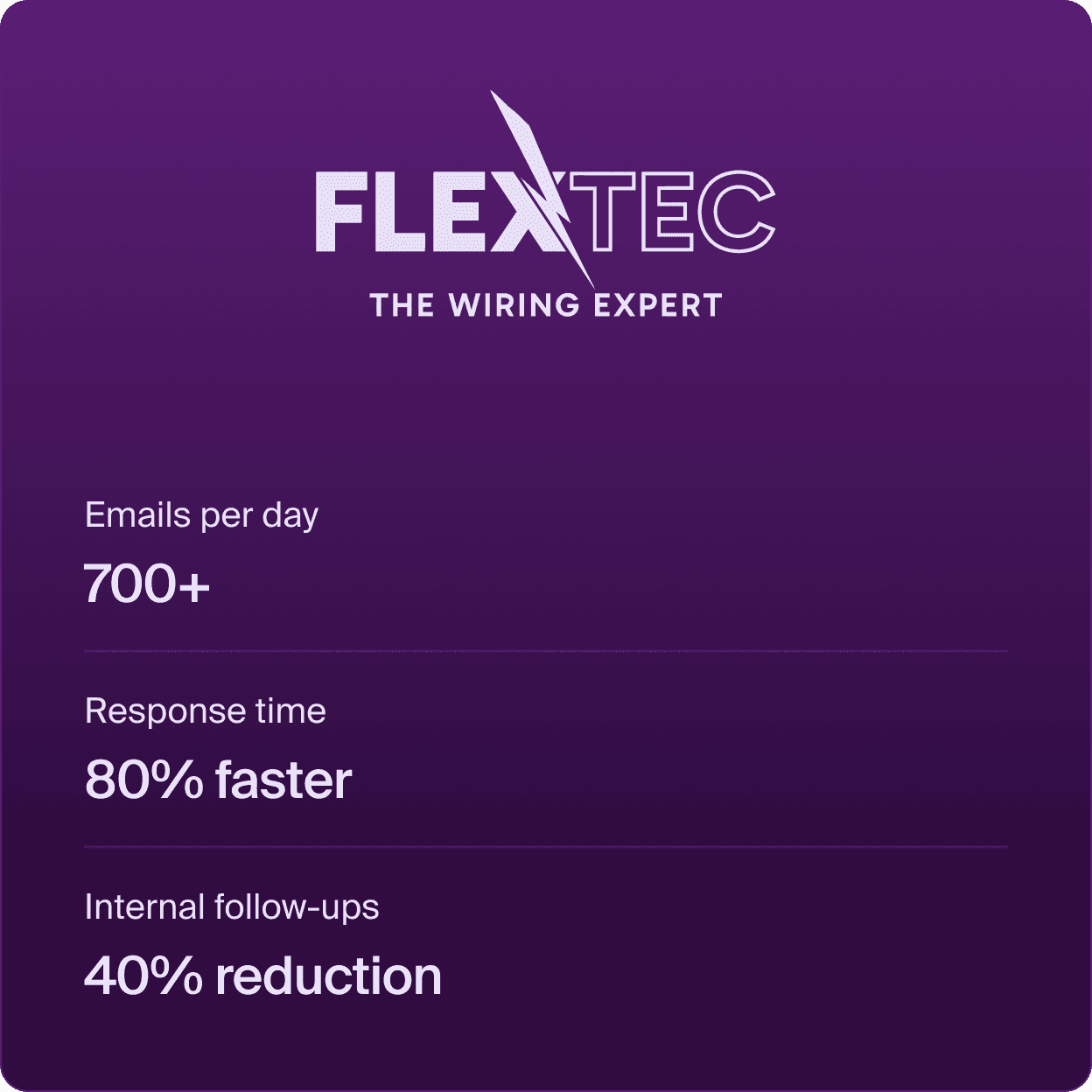
Today, Flex-Tec supports many of the top lighting manufacturers in the United States and globally, while continuing to expand into new verticals. With multiple facilities and a growing customer base, operational complexity has increased alongside opportunity. To manage that growth, Flex-Tec uses Front to consolidate customer communication, sync cross-functional teams, and create shared visibility across more than 700 incoming emails per day.
“Before Front, we reacted. Now we manage customer communication intentionally.”
Challenge
Email volume outpaced operational structure
As Flex-Tec grew, inbound messages arrived faster than the systems supporting it. “We were getting over 700 incoming emails a day company-wide,” says Jakari Robinson, who’s been with Flex-Tec since 2017 and now serves as Director of Business Development.
At lower volumes, individual inbox management worked. But as traffic increased across facilities, there was no centralized way to triage, prioritize, or redistribute workload. Response times depended heavily on individual capacity rather than a coordinated system. High volume exposed the absence of a scalable workflow.
Customer communication was fragmented across tools
Customer service representatives handle order entry, purchasing coordination, production alignment, and vendor correspondence, often within the same hour. But those conversations didn’t live in the same place.
Outlook managed customer emails. Microsoft Teams housed internal chats. WhatsApp was common for Mexico-based messages. Other updates were captured in handwritten notes or personal task lists. “We were using five or six different apps to manage customer communications,” says Jakari.
When someone needed context, they had to ask for it. Conversations were siloed, visibility across locations was limited, and response times slowed as teams searched for information across platforms. “The left hand didn’t know what the right hand was doing,” Jakari says.
Ownership and accountability were unclear
Because customer relationships were distributed across individual inboxes, accountability depended on manual coordination. A message sent to multiple contacts often required internal clarification before anyone responded. And without centralized coverage, even routine absences introduced delays.
Leadership lacked a unified view of service levels, response times, and workload distribution. “As you add more facilities, managing growth through back-and-forth emails just doesn’t scale,” Jakari says.
“Front showed us exactly what the left hand was doing and what the right hand was doing. Now we’re not just aware — we’re aligned and working together.”
Solution
Building infrastructure for scale
By implementing Front as a shared workspace rather than a collection of individual inboxes, the company introduced structure around how messages are received, assigned, and resolved. Instead of reacting to volume, teams now triage, distribute, and track communication systematically.
Leadership gained insight into workload distribution and response performance across facilities, making it possible to scale service without increasing internal friction. What once felt like inbox overload is now a manageable, trackable workflow.
Consolidating communication into one shared platform
Instead of juggling Outlook, Teams, and messaging apps, Flex-Tec teams now operate within shared inboxes that provide real-time visibility into message ownership, internal comments alongside customer threads, centralized history across facilities, and clear accountability for responses. “The biggest thing Front empowered us to do is consolidate our communication,” Jakari says.
Now, when a message arrives, the owner is assigned in real time, removing the need for internal clarification. Customers experience shorter response times and seamless coverage, even during handoffs or absences.
Driving adoption through hands-on enablement
To overcome any initial hesitation to use Front, Flex-Tec focused their onboarding on interactive demonstrations of the platform. “Once you go through a single session and show someone what Front can do, they’re blown away,” Jakari says. Employees quickly realized that Front replaced multiple tools they were previously using, and any fear of change shifted into momentum for improvement.
Flex-Tec estimates they’ll increase Front utilization to 25–30% within the next year. “Front has already completely changed the way we work,” says Jakari.
“Front has already completely changed the way we work.”
Results
Response times reduced from 10+ hours to 2
Before Front, average response times hovered around 10 hours — and sometimes stretched longer depending on volume and coverage. Today, Flex-Tec averages closer to two hours.
Teams no longer rely on individual inboxes to manage shared customers. Ownership is transparent, and context lives inside the thread. Internal follow-ups like “Did you respond?” have largely disappeared because the answer is already visible.
“With Front, we know what’s happening,” Jakari says. “That’s a big step forward.” Teams now triage messages intentionally, balance capacity across facilities, and monitor response performance in real time instead of reconstructing it after the fact. What once depended on individual habits is now organized into one system
Internal follow-ups reduced by more than 40%
Shared ownership and transparent workflows significantly reduce internal clarification loops. Flex-Tec estimates internal follow-up traffic dropped by more than 40%, even before full company-wide adoption.
Instead of chasing status updates, teams focus on resolution. Customers noticed the difference early, offering positive feedback in the first few months after implementation. Escalations also declined as issues are now addressed more quickly and consistently.
“Major companies have actually asked us what we use and how we leverage the tool [Front],” Jakari says. “Even our parent company, Electrical Components International, wanted in, significantly expanding our Front deployment.”
Onboarding time shortened by roughly one week
Front also streamlined ramp time for new customer service representatives. What previously took two to four weeks now takes roughly a week less, depending on role complexity. Context no longer lives in individual inboxes, but inside the workflow, making it easier for new team members to understand history, ownership, and expectations from day one.
Positioned for full organizational rollout in 2026
Front is now expanding beyond customer service into additional functional teams, with automated assignment rules routing emails to the right owners without manual triage. “At first, we thought we’d just have customer service in Front,” Jakari says. “Now we want to get everybody in the organization involved.”
With a full rollout planned for 2026, Flex-Tec is standardizing how manufacturing work moves across facilities, ensuring growth doesn’t recreate the inefficiencies of the past.