



Global’s media footprint is hard to miss. From the radio stations people listen to each morning to the digital screens and roadside posters they pass throughout the day, Global reaches 51 million individuals across the UK every week. Their outdoor advertising business alone spans more than 253,000 sites, reaching over 95% of the population.
Behind that scale is a complex operational engine. Every campaign requires coordination between customers, commercial teams, creative agencies, and multiple internal specialists to confirm availability, book inventory, review artwork, and ensure campaigns go live on time. Speed and accuracy are critical, and delays can mean losing inventory altogether.
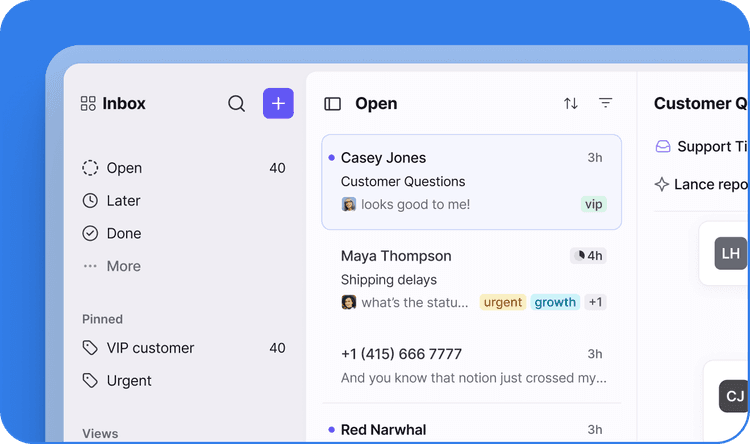
To manage this complexity, Commercial Outdoor Operations Director Amélie Leroy and her team uses Front as the central hub for customer and internal communication. Across Global, seven operations teams work from shared inboxes in Front, using automated routing, tagging, collaboration, and reporting to manage roughly 30,000 emails and deliver around 3,000 campaigns each month.
“Front has been one of the most transformative operational shifts we’ve ever delivered.”
Challenge
Operating without ownership or real-time insight
Before Front, Global’s Operations team worked across Outlook and ServiceNow. “There was no clear view of volume, ownership, or performance,” says Amélie. “I felt like I was operating without any visibility.”
At any given moment, leadership couldn’t see where work sat once it arrived. There was no reliable way to understand which requests were actively being handled, which were stalled, or where pressure was building across teams.
As a result, they made resourcing and prioritization decisions without real-time insight, often discovering issues only after they missed deadlines — or worse, only once customers followed up.
Managers as traffic controllers
That lack of visibility reshaped the manager role day to day. Without automated routing, managers had to manually read and distribute emails as they arrived.
With roughly 30,000 emails a month, this consumed hours of managerial time. Instead of coaching teams, reviewing quality, or improving processes, managers spent their days directing traffic between inboxes.
Workload distribution depended heavily on individual behavior. “You’d see some people constantly taking on new requests,” Amélie says. “Others might be waiting, but we couldn’t balance that in real time.”
When something went wrong — a missed email, a delayed response, an attachment that hadn’t gone through — managers had no single system to trace what happened or where responsibility sat.
Collaboration spread across tools
To resolve customer requests, Global’s teams regularly need to collaborate across planning, digital, classic operations, and commercial stakeholders. Before Front, conversations moved between Outlook, Microsoft Teams chats, screenshots, and forwarded emails. Context was frequently lost, and managers had limited visibility into how decisions were made.
“If someone was on holiday or unavailable, it could be very hard to piece together what had already been discussed,” Amélie says. “Nothing was truly centralized.”
They couldn’t backup feedback with data
The impact of these limitations became most visible in customer feedback. Surveys regularly highlighted slow response times and lack of flexibility, but the team struggled to validate or respond to that feedback with confidence.
“There was no real data,” Amélie says. “The only thing I could do was manually sample emails once a month and check timestamps.” Without consistent metrics, the team couldn’t reliably demonstrate improvement, set shared service expectations, or explain performance trends to senior leadership. “We knew service mattered, but we couldn’t measure it in a way that helped us improve.”
Solution
The ‘Queens of Front onboarding’ roll out the red (service) carpet
Global selected Front after evaluating several email management platforms against a clear checklist: ease of use, customer-friendly communication, automation, analytics, and the ability to send and receive large creative files without limits or failures.
Before the first inbox went live, Amélie and Tracey Wilson, Head of Outdoor Planning & Service, went down the “Front rabbit hole,” a shorthand for two weeks spent mapping inboxes, building automation rules, and pressure-testing setups.
They onboarded managers first and gave them two weeks to complete training, configure inboxes, and work through real-life scenarios. By the time they onboarded the second wave of users, Amélie and Tracey were leading the rollout internally, known across the department as the “Queens of Front onboarding.”
“As soon as the team realized how much friction Front removed from their daily work, the momentum really built,” Amélie says. The phased rollout created consistency across teams and gave the Operations team a stable foundation before expanding Front to additional departments across Global. Importantly, this change aligned with Global’s focus on simplicity, shared ownership, and collaboration — principles that guide how teams work as the business scales.
Automating routing and ownership at scale
Front now sits at the center of Global’s Operations teams. Each team works from shared inboxes organized by workflow or channel. Incoming emails are automatically routed and assigned using rules tailored to each team’s needs.
“That one change alone saved our managers around 20% of their time,” Amélie says. “They’re no longer manually triaging emails. Front handles that reliably.”
Load balancing ensures work is distributed evenly, while specialized rules route high-value customers or specific request types to dedicated team members. Ownership is clear from the moment an email arrives.
Standardizing collaboration in one place
Front replaced fragmented collaboration with a single, shared workspace tied directly to each conversation. Team members use internal notes and @mentions to pull in colleagues across departments without leaving the inbox.
“If our Planning and Service team receives a late digital booking, they can @mention an experienced Digital team member directly inside the email,” Amélie says. “Once artwork is confirmed, the campaign can be booked immediately.”
All collaboration is visible and traceable, giving managers context and confidence in decision-making. Front also removed the need to chase information across tools when a team member is unavailable.
Building quality control into daily workflows
Front is a structured training and quality assurance tool for Global. Automated rules add senior team members to conversations assigned to new hires, ensuring real-time coaching and review before responses are sent.
“Overall, we’ve built around 70 active rules, all designed to create efficiency, reduce errors, and maintain high service standards,” says Amélie “And we continue to review and question our workflows to identify where new rules or improvements could make us even more efficient.
Tags further reinforce consistency. Every email receives automated tags that help teams understand request types at a glance. Some tags trigger additional safeguards, such as adding experienced reviewers to copy approvals.
“Front makes onboarding more supportive and far more reliable,” Amélie says. “It protects the customer experience while helping people build confidence faster.”
Turning data into daily management practice
Within the first month of rolling out Front, Global’sOperations leadership team defined clear service standards for the first time. Using Front’s reporting and live dashboards, the team set response and resolution targets aligned to the pace of the advertising market.
Planning and Service teams committed to responding to 90% of emails within two hours. Classic and Digital Operations set a four-hour response target, with all teams aiming to resolve requests within 12 hours. “For a servicing team, clear targets are essential,” says Amélie. “Front made that level of visibility possible.”
Managers track workload, response times, and trends in real time, reviewing performance weekly. Each month, the department produces a standardized performance pack for senior leadership, giving transparency into volumes, service levels, risks, and areas for improvement.
The data shifts conversations from anecdotal feedback to measurable performance, enabling earlier intervention and more consistent service delivery across teams. “Without this data from Front, we simply couldn’t manage performance at this level,” Amélie says.
Identifying risk early through sentiment tagging
As service volumes increased, Amélie also looked for ways to spot issues before they escalated. Using Front’s AI sentiment tagging, she defined what positive, neutral, and negative tone looked like for Global’s industry and communication style.
Front analyzed a sample of historical emails and incorporated Amélie’s feedback to refine the model. Once live, the rule automatically applies a negative sentiment tag when incoming messages carry a critical or frustrated tone and notifies Amélie in real time. “When a customer is unhappy or a commercial conversation is starting to escalate, I can step in immediately and support the team,” she says.
Beyond early alerts, sentiment tagging replaces subjective assessments with objective data. The team now reviews tone trends over time, identifies patterns, and uses that insight for targeted coaching and quality improvement. “It’s improved visibility and the quality of our communication without adding extra work for the teams,” says Amélie.
“Front’s AI capabilities allow us to see what’s happening in real time and manage service proactively, not reactively.”
Results
Faster responses and higher service ratings
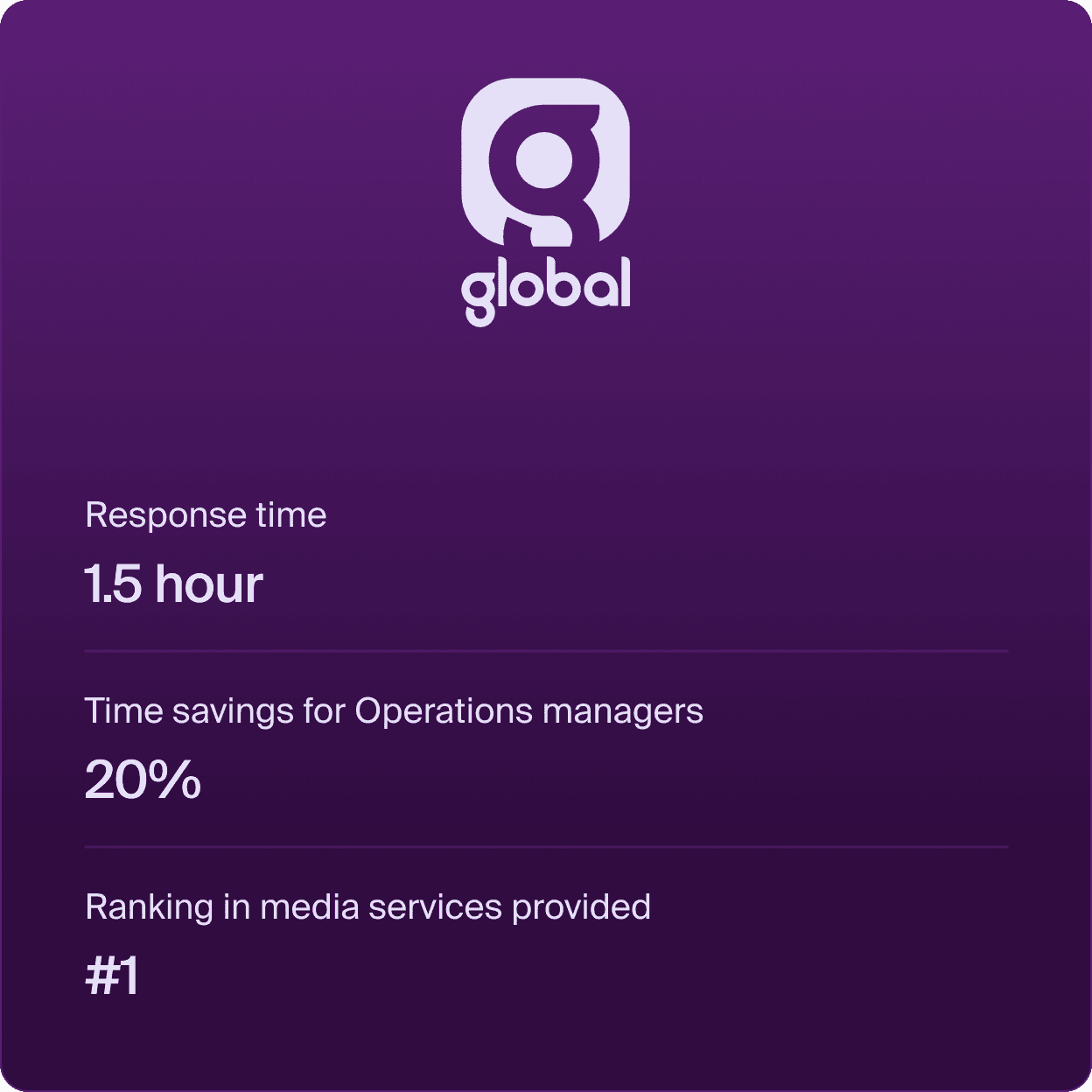
Since adopting Front, Global’s Operations team averages a response time of one hour and 30 minutes during business hours. That improvement is reflected directly in customer feedback.
In Global’s most recent key customer survey, service scores increased from 3.8 to 4.1 in a single year, an uplift of nearly 8%. Global was also ranked the number-one media owner for “Service Provided,” a position it had never achieved before. “Our customers don’t know we changed platforms,” Amélie says. “They just see better service.”
Visibility that supports scale and growth
Internally, managers now have real-time visibility into workload, performance, and risk. High performers are no longer overloaded by default, and leaders can intervene earlier when issues arise.
By the end of 2025, what stood out most to Amélie was not just adoption, but consistency in how teams described the impact. “When I asked the department which change had made the biggest difference to their day-to-day work, the answer was the same across teams,” she says. “Front came up every time.” The team feedback pointed to fewer handoffs, clearer collaboration, and less time spent chasing context across tools:
“Many departments moving to Front and being able to collaborate easier, with a reduction of emails back and forth.”
“There have been so many improvements, but the changeover felt really smooth, and it’s benefitted the department massively.”
“Front — I love it!”
For Amélie, these responses validate the decision to treat Front as an operational redesign rather than a simple platform swap. The combination of preparation, phased rollout, and clear ownership meant teams were able to absorb change without slowing delivery.
“The feedback has been unanimous: no one wants to go back to the old way. Front has fundamentally changed how our people work every single day.”