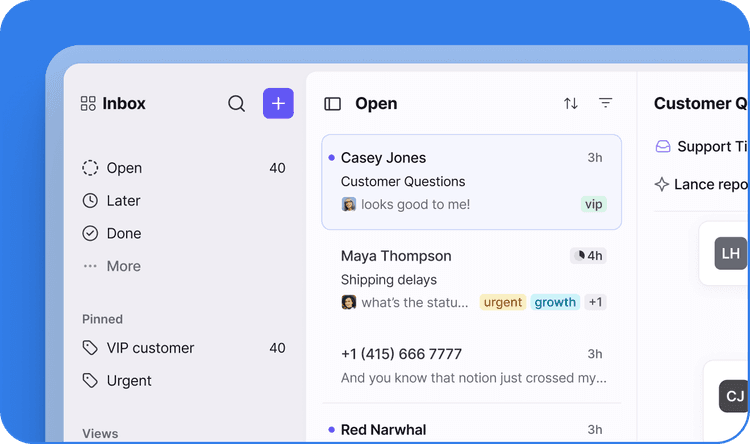



Customer relationship
Organizations need to manage customer relationships carefully because they affect both short-term revenue and long-term profitability. Weak relationships risk lost accounts and reputational damage, while strong ones reinforce trust and can generate new opportunities.
Positive customer relations are especially vital in B2B, where businesses often depend on long-term contracts.
What is a customer relationship?
A customer relationship refers to how an organization and a customer interact with and perceive one another. It includes everything from individual transactions to long-term engagements.
In B2B environments, customer relationships are more complex than B2C due to multiple stakeholders, connected workflows, and higher operational stakes. Organizations succeed when they take a comprehensive approach to B2B customer relations — meaning they reinforce value and communicate proactively across all touchpoints, from support requests to executive conversations.
Why do customer relationships matter in B2B operations?
The importance of customer relationships is even greater in B2B environments, where the benefits of strong relationships (and the consequences of weak ones) are often magnified.
Here’s why customer relations matter in B2B:
- Acquisition costs are high, and customer retention protects these investments.
- Contracts are long-term and often high-stakes.
- Churn undermines the entire business model.
- Trust is a major differentiator, and losing it is costly.
- Strong, open communication leads to faster decision cycles and less friction.
- Visibility into a client’s internal context provides strategic insight.
- Relationships can expand over time, increasing lifetime value.
What strengthens customer relationships?
Strong B2B connections are earned through continuous operational discipline rather than appeals to sentiment. Success hinges on how well teams manage customer interactions and workflows over time, across hundreds or even thousands of interactions.
Here’s how to manage customer relationships in B2B:
- Focus on structured account governance: Maintain a predictable cadence of quarterly business reviews and executive check-ins so risks surface early and teams stay aligned on strategy and desired outcomes.
- Build coordinated, cross-functional workflows: Make sure sales, support, product, and implementation teams share context and work from the same customer data. This enables clean handoffs and avoids conflicting messages.
- Pursue proactive issue management: Use monitoring, scoring, and early warning signals to identify vulnerabilities before the customer experiences them, reducing escalations and churn risk.
- Manage and track all interactions: Record all commitments, decisions, and action items across every touchpoint. This keeps each interaction contextual and moves the customer forward rather than forcing them to repeat themselves.
Internally, these practices reduce operational friction and stabilize revenue streams over time. Plus, stakeholders collaborate more efficiently and stay focused on shared goals. It’s more than just providing good service or being friendly in customer conversations. Companies that excel in B2B customer relations treat relationship management as a structured operating system that guides support every day.
Other resources
- Customer relationship marketing
Understand customer relationship marketing, why it matters for retention, and how consistent communication and follow-up nurtures lasting relationships.
- Customer retention
Discover what customer retention is, which metrics B2B companies use to track it, and proven ways to improve long-term customer relationships.
- Customer loyalty
Learn what customer loyalty is, why it matters, and the operational strategies that help B2B teams improve long-term customer relationships.
- Customer lifetime value
Customer lifetime value (CLV) measures long-term customer revenue. Learn how to calculate it, why it matters, and how retention and support factor in.
- Monthly recurring revenue
Learn what monthly recurring revenue (MRR) measures, how to calculate it, and why it matters for retention, B2B customer operations, and business growth.
- Customer service
Learn what good customer service is and how strong customer support improves satisfaction, trust, and the long-term customer experience.
- Customer engagement
What is customer engagement? Find out how to use reliable techniques, like proactive check-ins and data analysis, to build loyalty and strengthen retention.
- Customer profile
Learn what a B2B customer profile is and how this account context gives teams the clarity they need to support customers throughout the relationship.