


Customer service quality assurance gives B2B teams a repeatable way to score real conversations, calibrate reviews, and act on quality gaps as volume grows.
As a business scales, support volume climbs, new channels get added, and more people touch the same customer journey. All of these extra hands add complexity that makes coordination more difficult and service quality harder to control.
In B2B, the impact of inconsistent quality shows up fast: Resolutions feel uneven. The same customers circle back with the same question. Coaching stalls because nobody agrees on what “good” looks like. That’s why customer service quality assurance (QA) is necessary. Without a repeatable way to measure customer service quality, you can’t see where standards are slipping or where teams need support.
But measurement alone isn’t enough. Teams must use that insight to raise the quality of support. Around 67% of B2B customers say they’d pay more for exceptional support. That’s revenue left on the table when you don’t use QA data to improve coaching or fix workflows.
No two QA programs look exactly the same, but every growing B2B team needs one built for how the business actually runs. Here’s how to build a program your team can use day to day.
What is quality assurance in customer service?
Customer service quality assurance (QA) is the practice of reviewing real customer conversations against clear standards of great support. Teams score interactions using a consistent scorecard, so quality is measured the same way, every time.
It’s different than someone’s subjective judgment, vague “feedback,” or ad hoc review process. QA creates a shared definition of “good” support and applies it consistently across channels and agents.
Many teams assume customer satisfaction score (CSAT) or Net Promoter Score (NPS) do this more easily: Just trigger a survey and you’re done. But CSAT and NPS only capture how customers felt. QA shows what actually happened inside the conversation and why the outcome landed the way it did. Consistency makes QA operational while giving leaders control over quality as complexity increases.
Why is quality assurance critical in customer service?
It takes just three bad experiences — or fewer — for 59% of customers to end their contract.
And when quality varies, bad experiences become more frequent: Answers contradict each other. Follow-through slips. The same issues keep resurfacing. No matter how strong your product is, a handful of support misses can affect retention and trigger churn.
QA keeps standards consistent as volume grows, so small quality slips don’t stack into repeat experiences that push customers to leave.
Benefits of quality assurance in customer service
QA gives you visibility into how support actually performs at scale by reviewing real customer interactions against clear standards. Here’s how those insights improve both daily operations and customer sentiment:
Turns subjective feedback into measurable performance data: Consistent scoring replaces subjective, opinion-based feedback, so performance reviews provide specific next steps.
Catches quality drift before it shows up in CSAT or renewals: QA catches early signals of declining quality, giving teams time to proactively fix issues before they lead to bad customer experiences.
Aligns the entire team on what great service actually looks like: QA defines shared standards, which means consistent answers, accurate first resolutions, and less variability across response channels and handoffs.
Makes coaching more effective by grounding it in real conversations: Instead of vague examples, QA uses actual customer interactions to pinpoint exact moments for improvement. Specific quality scorecards save time while making team development easier to track.
These benefits don’t happen automatically. You don’t need to review every customer interaction, but you do need scorecards and shared standards to make QA work at scale.
What it takes to run customer service quality assurance at B2B scale
Running QA at scale in B2B means moving beyond one-off reviews. You need a way to aggregate conversations into an internal quality signal — often called an Internal Quality Score (IQS) — to accurately measure performance across the team.
IQS tracks quality trends over time, but because it’s an internal signal, you need to read it alongside CSAT and NPS to get a complete picture of service quality.
Here are three phases teams go through to build a scalable QA program.
Phase 1: Define the standard
Without a shared definition of “good,” a QA system has nothing to measure against. This phase is about creating that shared definition so quality can be measured and improved consistently.
Set standards for what great support looks like in your business
Every team has different priorities. Before you build a scorecard, define what “great” support looks like for your team.
Set expectations for response times, tone, and handoffs. Clear standards make it easier to grade conversations consistently and create a baseline you can adjust as customer needs or business priorities evolve.
Build a customer service quality assurance checklist that reflects those standards
A QA scorecard (or rubric) is the foundation for quality evaluation. It translates your standards for great support — accuracy, tone, clarity, and issue resolution — into rating categories that you use to evaluate a representative sample of real customer conversations.
For example, “accuracy” might become a scored criterion like “correct root cause identified,” while “clarity” could become “next steps clearly outlined.” Each conversation is then evaluated against these criteria.
Over time, those scores roll up into your IQS — which is where coaching gaps, process issues, and product friction start to show themselves.
Phase 2: Run the reviews
Once the standards are set, it’s time to start sampling conversations for review.
Choose the right conversations to review
Not every conversation needs to go through the QA process. A clear sampling strategy helps you pick the right conversations to get more meaningful insights.
To reveal root causes of quality issues, such as inaccurate answers, analyze conversations that:
Reached a resolution
Include at least two agent replies
Occurred recently (e.g., within the last two weeks)
Exclude conversations that don’t meet those criteria, then check your sample for blind spots. If you only review escalations or only one channel, you’ll get a skewed picture of how the team is actually performing.
Calibrate scoring so reviews stay consistent across evaluators
Involving multiple reviewers might lead to varied interpretations of standards. One evaluator may be stricter on tone, while another may give more credit to accuracy. Without calibration, these differences can lead to bias, inconsistent ratings, and unreliable QA data.
Avoid this by integrating regular calibration sessions to the QA system. These sessions establish clear guidelines for reviewers, keep scoring consistent across evaluators, and help update quality criteria or rating scales as needed.
Phase 3: Act on findings
Insights only matter when they lead to change. Phase three turns analysis into practical improvements that strengthen both your team and the customer experience.
Turn quality assurance findings into operational improvements
Individual coaching helps, but it won’t turn QA findings into real improvements on its own. That requires structure and ownership. Define who reviews which conversations, how often they’re scored, and how findings are captured so patterns don’t get lost in one-off feedback.
When the same analysts or team leads handle reviews consistently, recurring issues surface faster. That’s when QA moves beyond a scoring exercise and drives real impact by informing training updates, process fixes, and product feedback.
Bring those insights into a biweekly or monthly team review. Instead of dissecting one-off interactions, focus on trends, align on standards, and agree on specific actions that turn QA findings into visible, system-level improvements.
Close the loop so the team sees quality assurance as support, not surveillance
QA only works when it leads to action. If findings stay stuck in dashboards and one-on-one coaching, feedback starts to feel like a list of mistakes instead of a clear path to improvement.
Use what QA surfaces to drive better outcomes. Update training materials, fix the broken button, or add in-app guidance where users get stuck. Make the changes visible and communicate them clearly, so agents see QA as support, not surveillance.
Expand quality assurance coverage with AI when manual reviews hit a ceiling
Even an efficient manual QA process eventually hits a ceiling. Reviewers can only sample a fraction of conversations. Jumping between channels slows them down. And as volume grows, patterns get harder to spot. The whole system starts to run a step behind.
AI can help expand coverage. It can review every interaction across different channels, surface highest-impact conversations, and automate which interactions get routed to human reviewers, so evaluators spend time where it matters.
Feed customer service quality assurance into your system with Front
QA is how teams keep customer service standards consistent as volume, channels, and coordination load grow. Front is purpose-built for the complexities of B2B environments and keeps QA workable by aligning every team, tool, and conversation.
Front feeds customer service QA directly into the systems your agents already use. Here’s how:
Smart QA: Use it to generate auto-scored scorecards that roll up into filterable reports so you can track internal quality over time.
Collaboration: Mention team members in comments and exchange customer history in threads for better collaboration and more context-aware resolutions.
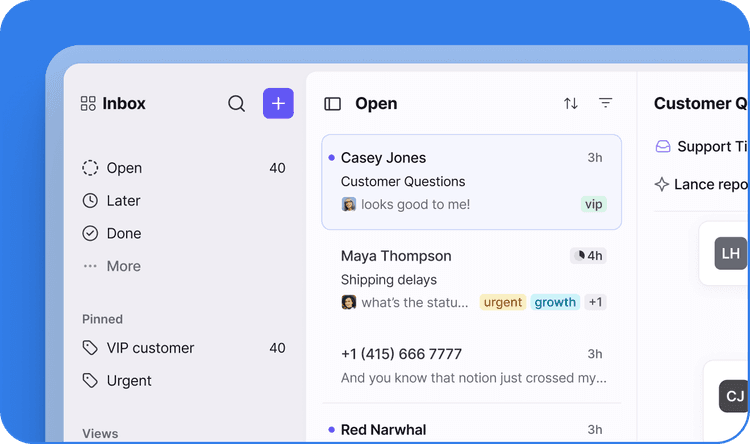
Conversation visibility: Keep every conversation across SMS, email, and chat in a unified workspace so nothing falls through the cracks.
See how Front supports customer service QA for scaling businesses. Try it today.
FAQ
What are some examples of quality assurance in B2B customer service?
Examples of quality assurance in B2B customer service include scoring support conversations against a rubric, reviewing onboarding calls for compliance and clarity, auditing escalations, and evaluating how well agents follow defined resolution standards across channels.
What’s the difference between QA scores and customer satisfaction scores?
QA scores measure how well a support conversation met internal quality standards. Customer satisfaction scores reflect how the customer felt about the service experience.
What are common pitfalls when scaling B2B customer service workflows?
Teams often scale tools before establishing strong processes, which creates fragmented ownership across teams, unclear escalation paths, inconsistent data between systems, and over-automation that fails complex accounts. Strong B2B customer service examples show the opposite: clearly defined SLAs, shared customer context, and structured human escalation points for high-value clients.