



Improve agent productivity without making speed the only goal. Reduce rework, keep context intact, and help B2B teams resolve issues accurately at scale.
Faster replies. More tickets closed. Higher output per hour. That’s how most customer support and service teams define human agent productivity. But in B2B environments, where every account carries meaningful revenue and complexity builds quickly, those metrics can be misleading.
Handling higher volume without increasing headcount doesn’t create a truly productive team—especially when customer experience and customer satisfaction drive revenue. Research shows 78% of customers stay loyal to brands when they trust the customer service, which makes the stakes clear: Beyond sheer output, true productivity is about delivering accurate, confidence-building resolutions that earn loyalty.
When productivity erodes, the people on the front lines face burnout, teams miss service-level agreements (SLAs), and customer service suffers. Often, these issues appear as individual performance gaps but actually stem from systemic failures. They come with a price tag most teams never calculate and are rarely tracked in any dashboard. The typical B2B company spends nearly 3 hours coordinating for every hour actually solving customer problems. Unfortunately, this coordination tax usually appears when the damage is already done in the form of attrition or contracts that don’t renew.
Human agents can’t fix these systemic problems on their own. And waiting until friction is visible risks damaging customer satisfaction.
This article shows what teams can actually do to improve agent productivity, drive efficiency, and enhance customer experience—without burning out your people or creating extra reporting work.
Why teams often misjudge agent productivity
The agent who closes 50 tickets quickly while creating 20 follow-ups isn’t more productive than the agent who resolves 30 tickets correctly the first time. Yet, teams often misread agent effectiveness this way. Rewarding speed without taking accuracy into account leads to duplicated work disguised as efficiency.
True productivity hinges less on individual effort and more on whether context travels cleanly from one interaction to the next. As volume rises, agents rarely solve isolated issues; they step into ongoing conversations layered with history, nuance, and revenue impact.
When agents have to re-triage issues that were already routed, re-answer questions because context disappeared, or redo work because verified information isn’t accessible, productivity suffers. These challenges aren’t caused by lack of skill, but by systemic gaps.
Trust takes a hit, too. In fact, 49% of customers report they stay loyal to brands that deliver accurate, knowledgeable solutions. It’s clear that correctness and reliability—not speed alone—drive customer satisfaction. The rest disengage or even end contracts.
Treating agent productivity as a system outcome is the next step. When context stays intact and handoffs stay seamless, agents resolve issues right the first time and complexity stops slowing them down.
7 ways to improve agent productivity in B2B operations
Most teams already take steps to support agent productivity, but in scattered and inconsistent ways. They treat initiatives as separate rather than part of a single connected system. Fragmented systems slow agents, and productivity suffers.
Here are seven ways to improve agent efficiency and overall customer experience.
If agents can’t find information
Stop making agents hunt for context across tools
When account details live in one tool and conversation history in another, agents waste time tracking information—or make decisions without the full picture. That’s when mistakes slip through, responses lose nuance, and follow-ups multiply.
What breaks is more than velocity; it’s accuracy and continuity. And in B2B, when continuity breaks, customer churn soon follows.
Make customer history visible during conversations
When agents can’t see prior interactions, customers repeat themselves and agent credibility erodes.
Conversations feel disjointed, escalations multiply, and tickets get reopened because no one has the full story. Every resolution becomes more difficult and expensive.
Give agents knowledge they can trust
Outdated or conflicting knowledge bases turn simple answers into investigations. Agents double-check elsewhere or make judgment calls they’re not confident about.
When the source of truth isn’t reliable, hesitation creeps in. Confidence drops, escalation rises, and decision quality suffers. Productivity stalls, and customer satisfaction declines.
When tickets go to the wrong person
Route work to the right agent the first time
When tickets are assigned incorrectly, agents spend extra time re-routing work that’s already been touched. Every extra handoff takes time and increases the chance that something gets lost in translation.
Customers feel the lag, but internally, planning also breaks. Forecasting gets messy, workloads become uneven, and productivity drops in ways that often don’t show up clearly in standard agent productivity reports. These reports typically focus on volume and speed, not the underlying friction or rework driving inefficiency.
Design handoffs that retain context
When context disappears between agents or teams, the next agent has to retrace the conversation and start over. Questions get repeated, timelines stretch, and simple issues become multi-touch threads.
To the customer, it signals misalignment. Internally, it drains capacity: Senior agents step in to fix confusion and scaling becomes harder.
See how Front keeps context intact across teams:
When problems with quality create rework
Build QA that catches mistakes early
If quality issues only surface through customer complaints or occasional spot-checks, you miss the opportunity to stay ahead and set a higher standard.
By the time a manager reviews a thread, the same mistake has likely been repeated across dozens of accounts. What could have been a quick correction turns into a pattern baked into your operation.
Proactive quality assurance (QA) changes the economics of agent productivity. Instead of retroactive coaching, teams get early signals: incomplete answers, policy misinterpretations, tone drift, and missed upsell cues. Small corrections happen before they snowball into churn risks or compliance problems.
Without this layer, leaders lack timely visibility into recurring issues, and coaching relies on limited examples rather than real-time patterns. High performers burn time cleaning up preventable errors. Performance data gets distorted because reopened tickets and repeat contacts artificially inflate volume.
QA protects capacity. Catch issues early, and you protect time, trust, and consistency at scale.
Use AI for routine work, not complex decisions
AI drives productivity when it handles predictable, high-frequency work: password resets, status checks, standard policy explanations, or non-technical FAQs. These are pattern-based tasks that drain frontline support staff time but don’t require nuanced judgment.
Problems arise when teams use AI for pricing exceptions, renewal negotiations, edge-case escalations, and sensitive account issues. In B2B, those moments carry revenue and relationship weight. When automation misfires, support team members inherit the cleanup and accountability: apologizing, clarifying, and rebuilding trust.
But used correctly, customer service automation and AI-powered tools free cognitive bandwidth for complex problem-solving and strategic conversations. Used carelessly, it erodes credibility and increases hidden workload.
Productivity for human support teams doesn’t improve through isolated fixes—a better knowledge base here, smarter routing there.
It improves when QA, automation, and context management work together. When information flows cleanly and routine work is automated responsibly, human support teams can scale without sacrificing quality.
Enable agents to deliver accurate answers with Front
Pushing agents to move faster doesn’t increase productivity. On the contrary, it creates pressure—and pressure breeds shortcuts, errors, and disengagement from work.
In B2B environments, where a single mishandled ticket can impact renewals and expansions, speed without structure becomes a liability.
Human agents perform best when they have full account context at a glance, real-time visibility into prior conversations across channels, and seamless collaboration paths with product, marketing, or customer success teams. They need routing that sends issues to the right expert and access to a reliable knowledge base or self-service resources to resolve questions efficiently.
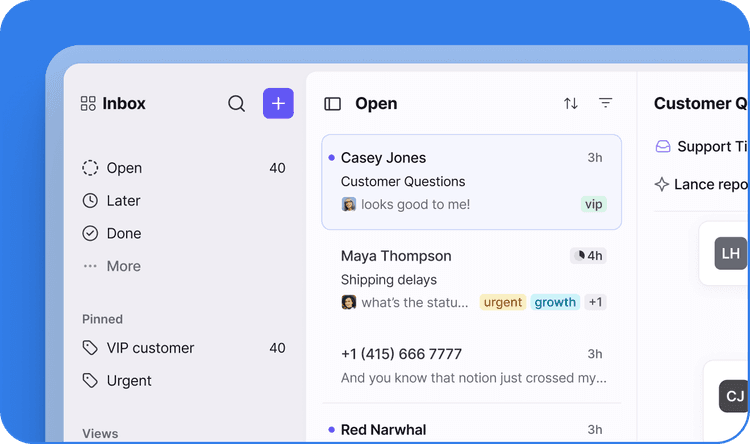
That’s where Front comes in. By keeping conversations, context, collaboration, routing, and customer history in one place, Front eliminates tool switching and context hunting. Agents resolve issues accurately the first time, boosting productivity and customer service.
As operations scale and complexity increase, that alignment becomes a competitive advantage. Add AI to handle predictable, high-volume tasks, and human agents can focus on nuanced problems that drive real impact.
See how Front helps deliver precise, confident customer support at scale. Try it today.
FAQs
How is agent productivity measured?
Teams measure human agent productivity using a mix of efficiency and effectiveness metrics, including resolution time, first contact resolution, ticket volume handled, SLA adherence, and QA scores. In B2B environments, measurement should go further—factoring in accuracy, context retention, customer satisfaction scores, and the impact on retention or expansion revenue.
Who is responsible for improving agent productivity?
Improving agent productivity is a shared responsibility across support leadership, operations, and enablement teams. Success depends on designing the right processes, routing logic, knowledge management, automation, and tooling infrastructure to remove friction and enable agents to perform at their best.