



See what AI customer experience means today, including how AI agents support service quality, personalization, and coordination across teams.
Can AI improve customer service? The data says yes — 58% of customers already believe it can.
The challenge isn’t the technology. It’s the range of customer expectations across your accounts. Some customers expect fast, automated self-service, while others require human-led coordination for complex, multi-stakeholder issues.
In B2B, delivering an AI customer experience that works for everyone isn’t about more automation, but about the right automation for each customer.
Explore how AI can improve customer experience, the benefits of using it in B2B environments, and common use cases for AI across industries.
What is AI customer experience?
In a B2B environment, AI customer experience doesn’t just mean having AI agents answer routine questions to deflect them from human agents. That model works well for B2C companies, where many requests are simple and repetitive, but B2B customer service is more complex and requires a broader approach.
Because B2B customer requests are often more nuanced, involving multiple stakeholders and extensive context, AI customer experience in B2B needs to operate across three layers:
Automate: An AI agent like Front’s Autopilot or an external agent connected from elsewhere handles routine conversations and automatically prioritizes and routes tickets to the appropriate team member.
Assist: Generative AI tools like Copilot let team members work faster by offering summaries, drafting replies, and drawing on insights from past conversations, whether that AI is native to the platform or an external agent already in use.
Analyze: AI-powered tools provide real-time analytics to measure performance and identify patterns across conversations. Front’s Smart QA and Smart CSAT tools automatically review all interactions to measure team performance and customer satisfaction.
Getting this right also means personalizing the experience to each customer’s context, not just automating faster. A logistics customer expecting a quick status update needs a different response path than a financial services customer navigating a compliance-sensitive issue. And because B2B requests often cross multiple teams, AI customer experience depends on agents and team members sharing the same context as a conversation moves between them, not losing it at each handoff.
In that sense, AI customer experience differs from AI customer service, which is just one part of the customer journey. Customer experience is the broader relationship customers have with your business across multiple touchpoints and channels. And AI customer experience is the operational model that connects AI tools and human teams across the full customer relationship.
The role of AI in customer experience today
In 2026, AI’s role in customer experience is no longer experimental. AI-powered tools are now a core part of customer operations: As interactions grow in volume and complexity, AI lets your team respond at scale without sacrificing quality. It handles what doesn’t require human judgment, so human agents can focus on the work that does.
Meanwhile, customer expectations vary widely depending on their experience and comfort with AI. Customers broadly fall into three categories: adopters, dabblers, and traditionalists. Each group has a different idea of what good AI-powered service looks like.
Your customer base probably includes all three groups, often within the same organization. That’s why applying the same AI approach to every customer falls short. You need a flexible solution that uses AI-powered tools without removing human judgment.
Benefits of AI in customer experience
When used right, AI tools enhance the customer experience while making service delivery more scalable and consistent for your team.
Here are the main benefits for customers:
Faster resolution: AI improves operational efficiency by routing conversations intelligently and handling simple requests instantly, leading to faster issue resolution for customers.
Greater consistency: The customer experience becomes more consistent across channels and agents because AI supports standard messaging, context retention, and smoother handoffs.
Less repetition: AI systems help the team access conversation history and relevant context across touchpoints so customers don’t have to repeat themselves.
Here’s how your team benefits from AI use:
Scalable support: The team handles increased volume without proportional headcount growth, thanks to automated workflows and time-saving, AI-powered tools.
Better visibility: Automated analytics give you real-time insights into interaction patterns and quality issues.
More consistent execution: AI assistants narrow gaps between agents’ performance by suggesting appropriate wording, surfacing context, and automating QA to maintain service quality.
To enjoy these benefits, design your AI tools around real customer needs and set up strong workflows, with clear boundaries between automated tasks and those handled by human agents.
How can AI improve customer experience? 4 key applications
AI is most effective in customer experience when it goes beyond task automation and supports coordination across teams and systems. Here are four key uses.
1. Intelligent routing and triage
As volumes grow, manually reviewing every customer message, prioritizing it, and routing it to the right person becomes time-consuming and resource-heavy. AI chatbots take on this basic triage automatically. They analyze customer messages for intent, sentiment, and urgency, then use that data to assign conversations to appropriate human agents. This saves the team time and ensures customers reach the right owner faster, improving response times.
2. AI-powered automation for handling routine requests at scale
Routine queries can easily overwhelm support teams in fast-growing companies. AI handles these repetitive requests end-to-end, freeing human agents to focus on work that needs their judgment. And as you introduce more customer service automation, teams become more productive and customers get faster answers.
3. Human-AI collaboration with omnichannel context
High conversation volumes across multiple channels often lead to lost messages or fragmented context. Generative AI for customer experience supports human agents with suggested replies, summaries, and relevant context, helping them manage conversations more efficiently while still reviewing messages before sending. The result is more consistent service in a complex, multi-channel B2B environment.
4. AI-driven QA and CSAT
Manual quality audits take time, and results come days or weeks later. AI customer experience tools score every interaction automatically, revealing quality issues in real time across large volumes of conversations. Acting on these findings leads to noticeable improvements in customer satisfaction.
These four key capabilities reinforce each other, so when you make improvements in one area, you’ll also see benefits in others. To succeed with AI in customer experience, connect these capabilities across your workflows instead of deploying them in isolation.
AI customer experience in action: B2B examples by industry
What good AI customer experience looks like varies by industry and customer needs. Here are some B2B use cases that show how AI improves customer experience in different sectors.
Logistics
In the logistics industry, customers expect quick, accurate answers to questions about the status of shipments. They’re typically operating under time pressure, and they need reliable information without having to wait.
AI customer experience in this industry is about pulling data from different systems to give real-time status updates so they don’t have to log into different portals or contact support. Better still, teams can shift from reactive responses to proactive communication — for example, use AI tools to automatically detect delays and notify customers before they ask.
Financial services
Financial services customers have large amounts of money at stake, along with sensitive data and strict compliance rules. The key here is precision.
Improve the customer experience by using AI to categorize issues reliably and route them precisely, with a fast, clear path to human agents for anything sensitive. Security of customer data is paramount, and every conversation must be logged and kept for compliance purposes.
Professional services
In the professional services industry, customers often bring multi-layered challenges that require context, continuity, and precise guidance. AI tools help by making those interactions more consistent and accurate and centralizing them in one place.
For example, a consulting client may reach out when a major transformation project has stalled and they need clarity on risks and next steps across multiple workstreams. AI support tools would pull together the full history of the engagement and suggest accurate, context-aware responses. Agents quickly understand the issue, verify the AI-generated information, and deliver an informed response.
Boundless Immigration uses Front’s automation and routing capabilities to save over 10,000 hours every quarter and improve their customer experience through AI tools, live chat workflows, and an AI-powered knowledge base.
How Front supports AI-powered customer operations
With varying customer expectations of AI-powered service, the teams that get AI customer experience right are the ones that give people and AI agents a shared, coordinated place to work, not a patchwork of disconnected tools.
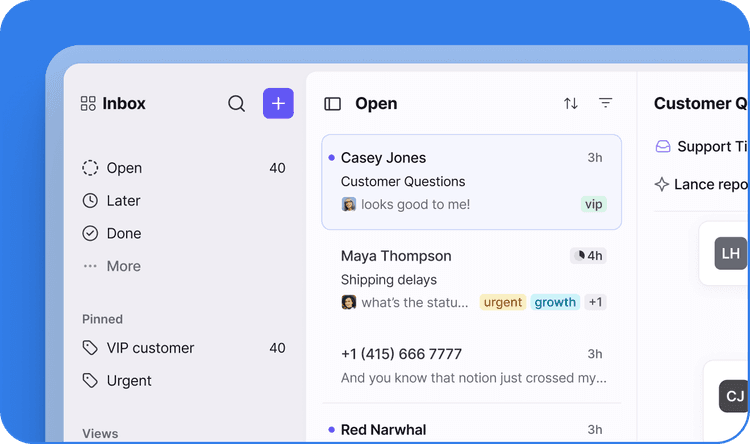
Front is the open platform for that. Configure custom Autopilot agents for the workflows you know best, like Autopilot for routine requests and Copilot for real-time assistance, or connect external agents your team already trusts. Topics analyzes conversation history to improve routing, Smart QA elevates service quality, and Smart CSAT tracks satisfaction in real time, across every conversation, human or AI.
Book a demo to explore how Front can help your team build an AI-powered customer experience that balances automation, insight, and human expertise.
FAQ
What are the biggest risks of using AI with customers?
The biggest risks include data privacy issues, inaccurate information, and lack of human empathy in interactions. Front’s research shows that 63% of financial services customers feel AI-led customer service needs to improve in protecting their personal data.
How do I measure the ROI of AI in customer experience?
Before you implement AI in customer experience, establish a baseline for key customer support metrics like churn rate and cost per ticket. Then measure the change after you introduce AI-powered tools, and compare the benefits against the cost of the tools.