


Learn what live chat is, how it works behind the scenes, and how teams use it to deliver fast, personal support across channels at scale.
If you’ve ever tracked a package or checked an order status through live chat, you know the appeal: instant answers, no phone holds, zero email delays. That same expectation has reached B2B. With 55% of B2B customers citing fast response times as a top service quality, operations teams can’t treat live chat as optional anymore. This core infrastructure manages complex, multi-stakeholder workflows in real time.
Live chat brings in human judgment for complex issues that need context, coordination, or multi-step problem-solving. Most teams use a mix of chatbots and live chat, with automation deflecting routine volume and live agents stepping in where expertise matters.
In this guide, we’ll explore what live chat actually is — not just the interface, but the infrastructure behind it. We’ll break down how it works, how to run it well, and how platforms like Front use AI to help deliver consistent, high-quality support at scale.
What is live chat software?
Live chat is an instant communication channel that lets customers connect directly with your support team through a chat widget on your website or app. It delivers faster responses and more conversational interactions than email or phone — which is why teams focused on quality customer experience rely on it to meet today’s expectations.
But live chat isn’t just a widget you embed and forget. It’s a full support channel that depends on responsive teammates, shared context, and tight coordination behind the scenes. And when paired with AI agents that handle simple, repetitive requests, live chat becomes even more powerful, helping teams scale real support without sacrificing speed or service quality.
How does live chat work?
Here’s a little more detail about how things operate in live chat, from the moment a customer reaches out to the final resolution.
Step 1: Customers initiate a live chat
Customers start a live chat by clicking a widget on your website or mobile app. A chat box appears instantly, allowing them to ask their question without interrupting their workflow or repeating information across channels.
Before routing to your team, many live chat systems offer automated deflection. This may include presenting relevant help articles, FAQs, or chatbot responses that might resolve simpler inquiries immediately. For routine questions like shipment tracking or account access, this instant deflection keeps customers moving without requiring team intervention.
More complex requests bypass deflection and route directly to the right team member’s inbox. The entire interaction is designed to minimize friction and reduce response times, helping customers get what they need without leaving the page.
Step 2: Live chat routes and assigns conversations
Every live chat message needs to land in the right hands, fast. That’s where routing and assignment come in. When a website visitor submits a message, the system uses routing rules like topic, keyword, or page URL to identify the right queue. From there, conversations are assigned based on factors like availability, workload, or team ownership.
From billing questions to product bugs, live chat software makes sure each request is automatically directed to the right support rep — no manual triage needed, and no time lost.
Step 3: Support teams triage the hard questions
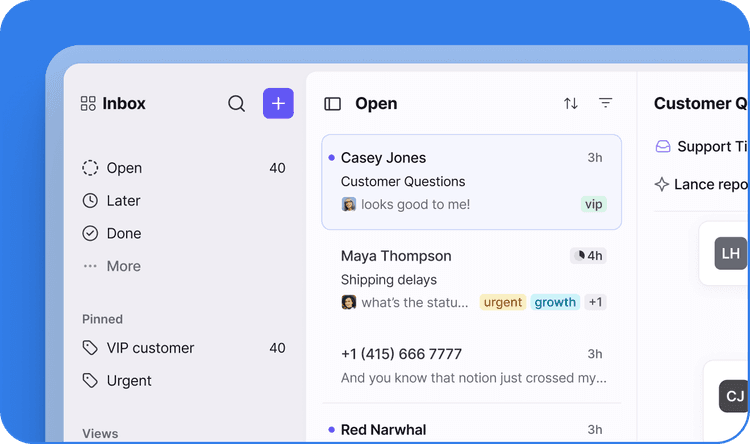
Once a conversation reaches your team through bypassed deflection or chatbot escalation, support reps manage it from a central dashboard. From here, they can see full customer histories, use templated responses to reply faster, and collaborate internally without disrupting the flow of the conversation.
That’s the advantage of live chat over automated chatbots. Customer service chatbots follow scripts and work well for routine questions, but live chat brings human judgment to complex issues, frustrated customers, and situations that need real problem-solving instead of scripted responses. Whether it’s coordinating a freight delay across warehouse and account teams, or managing an underwriting question that needs input from compliance, live chat keeps everyone aligned on solving the actual problem.
Benefits of using live chat for customer support
Live chat is convenient for customers, but it’s also a strategic advantage for today’s customer support teams. Here are the top operational benefits of live chat.
Faster responses in real time
Unlike email that can take hours for a response, using live chat means customers don’t have to wait. Questions show up instantly in a shared queue, letting your team jump right in and reply immediately to resolve issues or concerns. This visibility makes triage faster, giving your support team more confidence in their upcoming tasks.
Lower friction for customers
Creating a smooth experience reduces friction for your customers and your team. When individuals reach out through live chat support, they don’t have to switch tabs, hunt for an email address, or repeat themselves across different channels. Making a solution available at the click of a button creates a user experience your customers will remember for the right reasons.
Better context for support reps
Every live chat conversation comes with helpful context, like shipment status, account standing, open compliance reviews, and cross-departmental conversation history. This info gives your team the full picture before they even say hello.
With the help of saved responses, prefilled data, and AI that surfaces relevant context, support teams can answer faster without sounding robotic, and they don’t have to ask customers to repeat what they’ve already shared.
Reduced team workload through automation
Live chat works hand in hand with automation to keep your team focused on conversations that need human judgment. Chatbots can handle repetitive questions about things like business hours or order status, while smart routing ensures more complex issues go to the right teammate.
Front AI takes automation even further, automatically tagging, routing, and summarizing chats so reps can stay in flow without manual busywork. For example, Remedy Meds uses Front to automate routing and conversation assignments, giving their support teams more time to focus on meaningful customer interactions.
How to run live chat that works for your team and your customers
Follow these best practices to help your team deliver fast, consistent, and personal chat support at scale.
Set clear expectations
Let customers know when your team is available and how quickly they can expect a response. This transparency lets website visitors choose the right channel and reduces frustration when wait times vary.
Clear expectations also give your team space to prioritize and triage efficiently, rather than reacting to every new message as an urgent request.
Use saved replies and a consistent tone
Saved replies (sometimes called canned responses or templated responses) are reusable message templates that let your team respond to frequent questions instantly while personalizing each response. They help teams move quickly, especially in live chat, where customers expect instant replies. But speed can’t come at the cost of sounding robotic; saved replies should read like something a real person would say.
Consistency matters, too. In fast-moving conversations, multiple teammates may jump in, or AI tools might assist with drafting. A shared tone that is clear, helpful, and human keeps the customer experience smooth, even as people and tools behind the scenes change.
Balance automation with human judgment
Speed matters for high-volume live chats, but so does quality. Chatbots handle routine questions instantly while freeing your team to focus on complex, high-stakes conversations.
For everything in between, tools like Front’s Copilot can surface relevant knowledge articles or suggest draft replies based on past conversations, but your team decides what actually gets sent. The ultimate goal is to automate the busywork without losing the personalized support that builds trust with B2B customers.
Keep the team aligned with shared context
When everyone knows what’s already been said and what needs to happen next, collaboration becomes second nature. Internal comments, assignments, and conversation history keep your team in sync and reduce duplicate work. This shared visibility makes handoffs smooth, escalations clear, and support more consistent across the board.
Track performance and improve over time
Live chat moves fast and so should your feedback loop. Track key metrics like response times, queue health, automation success rates, and where handoffs happen. These insights help you refine workflows, train more effectively, and give your team a clearer playbook for future conversations. The result is a better customer experience and a more confident, aligned support team.
Keep the conversation going with Front
Managing live chat, automation, deflection, email, SMS, and social messages in real time is hard, especially when teams are scattered across tools and losing context with every handoff. Conversations splinter, details get missed, and your team spends more time coordinating internally than actually helping customers.
Front brings conversations from every channel into one shared workspace, giving your team the full picture before they reply. Our AI Copilot helps your team handle the unpredictable by drafting replies, surfacing relevant info, and summarizing threads to keep your team working faster without losing control. Plus, Front’s Autopilot frees up your teams by automating customer responses, identifying conversation topics, and handling routine questions.
Some apps just chat. Front can run the business. It’s the customer service platform built for complex, multi-team support. Book a demo today to see how Front keeps every live chat conversation in sync.
FAQs
How do companies use data from live chat interactions?
Support teams use live chat transcripts and trends to identify recurring issues, improve workflows, and inform updates to product and documentation. These insights help support reps respond faster and give leadership a clearer picture of customer needs. In platforms like Front, this data is always connected to the full customer history — not siloed in a separate tool.
What are the disadvantages of live chat?
Live chat is fast, but it still depends on people. During peak times, response delays can happen, and communicating over text can limit nuance or clarity for more complex issues. That’s why many teams use live chat as one part of a broader support strategy, not the only channel.
Is live chat with a real person?
Yes, live chat connects customers with real people. Some teams also use chatbots or conversational AI to handle simple requests.