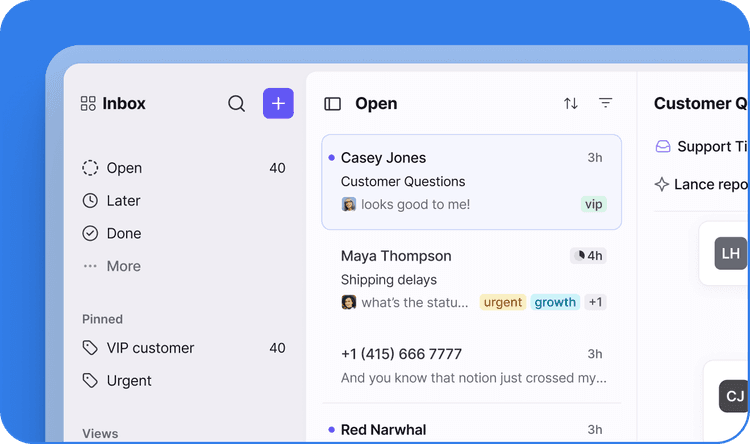





5 proven B2B customer experience strategies for scaling teams, covering coordination, context, and ownership that keep CX consistent.
In a B2B environment, the customer experience (CX) is less about branding or perception and more about operational efficiency. As inbound volumes rise and complexity increases, the foundation of a strong CX is the ability to deliver coordinated, reliable service that keeps every interaction running smoothly.
Support and operations leaders see this pressure daily: more channels, more handoffs, and more stakeholders involved in each customer journey. The challenge is managing every touchpoint in real time while having a grip on the overall customer relationship.
A strong B2B CX strategy isn’t just focused on the customer-facing moment. It’s built in the coordination behind it — the handoffs, the context, and the ownership that keeps every conversation on track.
In this article, we’ll define what B2B CX actually means, explain how it differs from B2C, and show why it matters for outcomes like retention, loyalty, and recurring revenue. We’ll also look at five practical strategies teams can use to improve CX under real-world operational constraints.
What is B2B customer experience?
B2B CX covers every interaction a customer has with your company, from the first conversation to renewal and beyond. What makes or breaks it isn’t any single moment, but how well your teams stay coordinated, keep context intact, and follow through on what they’ve promised.
B2B CX isn’t complicated in concept — it’s hard in practice. Customers want accurate answers and predictable outcomes. Delivering that consistently means getting the operational layer right: clear ownership, shared context, and handoffs that don’t drop the ball.
B2B vs. B2C CX: What are the key differences?
There are major differences between B2B and B2C CX and the operational realities behind them. Here’s a summary.
Because of these operational differences, consumer-inspired CX tactics often fail in B2B. If ownership is unclear, context is fragmented, or handoffs are ineffective, customers notice — and not in a good way. Effective B2B CX management leans into complexity and builds the coordination to match.
Why B2B CX matters in modern businesses
It doesn’t matter if you have a stellar product or an outstanding service offering. Dropped threads, lost context, unclear ownership, or lack of follow-through lead to an unstable, inefficient experience.
Reliable operations and consistent customer service, on the other hand, produce a predictable experience and build trust. Here are the main reasons to focus on B2B CX in your business.
Close the gap between what you promise and what you deliver
For B2B companies, renewals and expansions are rarely the result of a single positive interaction. Instead, they depend on consistently showing up for your customers every step of the way.
A strong CX built on operational excellence ensures you meet commitments, respect timelines, and preserve context at every stage of the customer journey. That’s the foundation for successful customer relationships and long-term growth.
Scale operations without losing efficiency
Scale poses challenges to CX. As volume and complexity increase, customer work often becomes fragmented, and escalations increase.
Scalable CX clears the operational roadblocks that compound as volume grows. The focus may be on the customer’s experience, but the real work happens internally — in how teams hand off work, share context, and maintain accountability across complex, multi-step workflows.
For example, when a financial services team receives a compliance inquiry that spans legal, operations, and client services, a structured handoff process ensures each team picks up exactly where the last left off. No repeated questions, no dropped context, no delays from unclear ownership. The customer only sees a coordinated response (as they should).
Build trust through reliable customer relationships
Trust develops over time. Every interaction is an opportunity to strengthen the customer relationship. Clear, honest communication matters, but B2B CX statistics consistently show that actually delivering on commitments is what drives retention, with 55% of customers saying they feel more loyal to brands that respond quickly and attentively. Speed and attentiveness are table stakes; what builds lasting relationships is doing it consistently, across every team and every touchpoint.
A good way to build loyalty is to gather meaningful customer feedback through voice of the customer surveys and use the insights to improve operations and the customer experience. Trust, efficiency, and retention all depend on how well you coordinate customer-facing work across multiple teams.
How to improve B2B customer experience: 5 strategies
Good intentions don’t scale. Operational discipline does. Use these five strategies as operational principles to manage complexity and keep delivering a strong CX as your business grows.
1. Centralize customer conversations across channels
When conversations become fragmented across multiple channels, teams risk losing context, duplicating work, and dropping the ball on customer requests. The first step in improving CX is creating a unified operational view of customer communication across every channel.
Use a dedicated B2B CX platform that supports omnichannel communication and lets the team see every customer interaction in one place. With centralized interactions, teams can have all the context at their fingertips to do their best work.
2. Establish clear ownership and accountability
B2B interactions are often complex, requiring multiple teams to work together to solve customer issues. That’s why unclear ownership is one of the fastest ways CX breaks down. When there’s no clarity or accountability, this preventable confusion comes at a high cost to the customer.
To solve this problem, teams should understand what they’re responsible for and when. That means no messages fall through the cracks because the right person receives it at the right time and has the context to know exactly what to do. Good customer service software makes it easy to route to the right owner, prevent duplicative work, and guarantee follow-through.
3. Maintain shared context across teams
B2B operational complexity often leads to lost context. Handoffs between teams are a common point of failure in B2B workflows, and loss of context leads to inconsistent answers, frequent escalations, and duplicated work.
Overcome this challenge and maintain high-quality customer service by implementing structured handoffs, leaning on AI to summarize long threads and quickly surface action items. Ensure all knowledge sources are easily accessible and take advantage of templates to ensure consistent and accurate responses.
Use software that gives all your teams shared visibility into conversation history and decisions, even if it’s spread across several systems, for smoother handoffs. Shared context speeds up your team’s responses, even during a surge in customer inquiries.
4. Monitor operations in real time to catch breakdowns early
To improve CX, be proactive and act on insights early. Monitor operational data in real time, tracking interactions at different touchpoints and at various stages of the customer journey. Analyze customer feedback, both for individual customers and on a wider basis, and use the insights to identify patterns and fix operational problems.
Visibility and prompt action are key here. Proactive intervention reduces escalations and protects your customer relationships. The goal is to catch operational breakdowns before they threaten the CX.
5. Design workflows that scale with complexity
As volume increases, even the most dedicated team members can’t maintain a good CX through individual heroics alone. The risk is that no one has the full story, teams don’t communicate effectively, and CX breaks down.
That’s why scalable workflows are the backbone of reliable B2B CX management. Use processes that are clear and repeatable to give you full control over operations, no matter the volumes you’re dealing with. This is where automation and self-service options can really save the day for your routine CX needs.
Use these five CX strategies as a unified system, not as isolated tactics. Put them together and enforce them consistently over time, and you’ll see measurable benefits.
B2B CX in practice: How Front keeps teams in sync
For B2B companies, CX depends on the operational layer behind customer conversations. That means getting the details right at every stage: who owns what, what context travels with each handoff, and how quickly teams can close the loop when something goes wrong.
One of the best examples of B2B CX improvement is Uber Freight, which improved response times by 50% by using Front to centralize all its customer communication. Uber Freight’s new approach improved visibility, reduced bumpy handoffs, and clarified ownership, creating a dramatic improvement in CX.
Front’s customer operations platform is built for B2B complexity, helping teams work in lockstep at scale. Book a demo to explore how Front can enhance your B2B CX.
FAQs
How do B2B companies measure customer experience beyond the Net Promoter Score (NPS) index?
B2B companies measure CX using a mix of satisfaction, operational, and relationship metrics. Other common B2B customer experience metrics include customer satisfaction, customer effort score, first contact resolution, customer retention, and customer lifetime value.
How do you measure customer experience when conversations span multiple channels and teams?
Measure customer experience by centralizing conversations across channels, tracking handoffs and resolution quality, linking sentiment metrics to shared KPIs, and assigning clear ownership for outcomes.
What defines a customer-facing experience in B2B environments?
A customer-facing experience encompasses any interaction a customer has with a company across touchpoints in the customer journey. It also includes indirect experiences, such as seamless onboarding, clear reporting, or accurate billing.