



Voice of the customer turns real conversations into operational signals. See how B2B teams collect, prioritize, and act on feedback across workflows.
Every customer conversation, onboarding session, and quarterly business review (QBR) signals what customers expect next. The challenge is that these signals are scattered across channels and tools, while your team is already overwhelmed with daily operations.
A structured voice of the customer (VoC) process turns that scattered input into predictable systems. Without it, teams end up reacting to what’s already happened instead of proactively planning for what’s coming.
And when you use VoC, the impact on loyalty is clear: 44% of customers return to brands that listen to feedback and use it to create better customer experiences.
Turn scattered conversations into strategic insight by learning what VoC is, why it’s particularly valuable to complex, B2B businesses, and how to systematically collect and implement customer feedback without adding operational overhead.
What is the voice of the customer?
VoC is the process of capturing what your customers say, do, and struggle with, and turning those signals into operational improvements to the customer journey and overall customer experience.
Whether it’s customers repeatedly asking the support team for the same workaround, sales hearing the same competitor mentioned in late-stage deals, or product noticing enterprise accounts using a feature differently than mid-market accounts, it’s all VoC. VoC represents customers’ sentiments about the business, collected across channels and interactions.
How VoC gives operations teams navigate complexity
VoC identifies patterns and feeds them back into product, support, and go-to market decisions, so customer insight isn’t stuck in one inbox. Here’s how VoC helps operations teams identify often-overlooked areas of improvement:
Exposes operational friction points: VoC surfaces patterns in customer conversations that reveal breakdowns in handoffs and service delivery before they turn into missed service-level agreements (SLAs), escalations, or churn risks.
Turns customer conversations into a performance signal: Consolidate feedback across channels into a single operational truth that reflects customer sentiment and helps teams make confident, data-backed adjustments with VoC.
Standardizes decisions across complex, multi-team workflows: VoC highlights where teams interpret policies differently or respond out of sync, reducing inconsistency across the customer journey.
Connects customer impact directly to process design: VoC links recurring complaints and requests to specific workflow gaps, helping teams prioritize fixes that reduce operational load and address underlying pain points.
Supports scaling without losing control: VoC provides a continuous view of customer needs across channels so operations can scale without sacrificing visibility, consistency, or customer experience.
Why traditional VoC is too simple for B2B operations
Traditional VoC programs collect feedback periodically via surveys, QBRs, or customer satisfaction scores. These methods can be useful, but in complex, multi-team B2B environments, they fall short due to:
Timing mismatch: Feedback arrives long after the interaction, making it harder to prevent escalations, repeat contacts, or missed SLAs.
Workflow disconnect: Insights live in separate tools and reports, while operations and support make decisions inside inboxes, handoffs, and exception workflows. The feedback rarely reaches where action happens.
Ownership gap: Feedback is reviewed, but rarely assigned to someone who can change process, routing, or policy to fix the underlying issue.
Signal quality: Surveys and scores capture customer sentiment, but they often miss the “why” or the specific breakdowns across channels and handoffs.
VoC collection methods rooted in real customer conversations
With customers expecting faster, error-free, and fully fact-checked responses, you need to change the way you gather and validate feedback.
Relying on a single VoC survey or a quarterly check-in isn’t enough when insight lives in call transcripts, product usage data, and executive emails. To truly realize the meaning of VoC, you need multiple inputs to work together.
Here are four practical ways to collect customer feedback and turn everyday interactions into actionable insight without waiting for survey results:
Analyze live customer conversations across channels
Your customers are always telling you what’s broken: on sales calls, in missed onboarding milestones, or through support conversations. The key to customer satisfaction is listening—and doing it at scale. Reviewing real client conversations turns scattered comments into clear signals about trust gaps, product confusion, or positioning misses.
For example, when three enterprise prospects ask whether your SOC 2 covers a specific workflow, it’s not a coincidence. It’s a pattern you must recognize and address to turn prospects into paying customers. If several are asking about your SOC 2, chances are that many other customers wonder. Make that information clearer to improve the customer experience.
Tag and trend contact reasons tied to workflows
Tagging and categorizing contacts makes voice of customer analysis easier. When teams consistently log why customers reach out and you trend those reasons over time, patterns start pointing to specific process flaws.
If single sign-on (SSO) setup questions spike at the end of every quarter, don’t write it off as a minor setback. It’s more likely an onboarding workflow problem. Tagging these issues turns recurring friction points into visible data so you can prioritize fixes with the most impact.
Review escalations and exception paths
Escalations are customer feedback amplified. When an executive emails your VP because their integration stalled, that’s VoC at full volume.
If the same issue keeps jumping the queue or needs higher-level intervention, it’s likely not about urgency. It’s an exception path signaling a broken handoff in your standard workflow. Review escalations and exceptions to identify the systemic pain points behind what look like “one-off” emergencies.
Monitor volume patterns and operational load by contact type
Customers don’t necessarily say, “this release is confusing,” but they show you through their actions. A sudden spike in API-related queries after a product update is customer feedback in numbers.
Watch volume by contract type to reveal friction points at scale. Such monitoring helps you spot rising operational load early and act before SLAs slip or customer success managers (CSMs) start fielding renewal concerns.
5 steps to build a VoC program that reduces operational load
If your VoC program only shows up in quarterly decks, it won’t drive meaningful operational change. The goal isn’t to “collect more customer feedback,” either, but to surface insights teams can act on.
VoC exists to prevent repeat issues, protect renewals, and eliminate the friction that’s quietly draining your team’s time. Build it right with these five steps:
Step 1. Define VoC as an operational signal instead of a listening exercise
Stop treating customer feedback like optional commentary and start treating it like performance data. When five customers flag confusion about usage limits, recognize it immediately as a design flaw or messaging gap. Shift from asking, “How do customers feel?” to “What is this issue telling us to fix in our workflow, policy, or product?”
Step 2. Centralize it where work already happens
If VoC lives in a separate survey dashboard, it’s likely to die there. Customer signals should sit inside support queues, customer relationship management (CRM) timelines, and onboarding analytics — the systems teams already use to make decisions. When a CSM reviews a renewal account, they should instantly see recurring contact reasons and past friction without digging through notes across five different tools.
Step 3. Structure around contact reasons and process stages
A “billing issue” during onboarding indicates setup confusion, while a “billing issue” at renewal signals trust risk. Structuring the VoC around both the contact reason and journey stage provides context that teams need to act correctly. Without this structure, you might fix the symptom in one stage, but the root cause keeps generating volume elsewhere.
Step 4. Prioritize issues based on operational impact, not volume alone
The loudest problem isn’t always the most expensive. Fifty password resets won’t hurt you like three enterprise escalations tied to bugs. Focus on what the problem is costing you operationally, and prioritize issue resolution based on SLA risk, revenue exposure, and rework created across teams.
Step 5. Assign ownership and close the loop inside existing workflows
Insight without ownership only creates backlog. If integration complaints trend upward, someone must own both the fix and the customer update. Build follow-ups into existing workflows, such as product review meetings, sprint planning, and renewal prep. Closing the loop should be part of how work gets done, not an extra task that gets lost.
Turn conversations into operational visibility with Front
The real voice of the customer is in conversations, not in isolated surveys, Net Promoter Scores, or focus groups. When VoC isn’t built into your operations, it just “describes” feedback without driving changes to product or process.
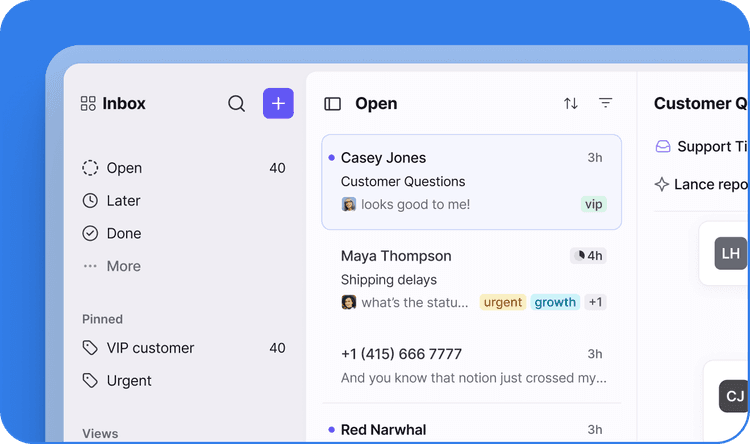
Front turns that description into execution. Every customer conversation across chat, SMS, email, and other channels lives in a unified workspace, giving teams a single source of truth.
Analytics highlight contact reasons, recurring issues, and process breakdowns before they impact SLAs or the customer experience. With customer feedback clearly visible, you can easily act on the insight and close the loop by communicating what changed.
Make VoC part of how you operate. Let Front do the operational heavy lifting. Try it today.
FAQ
What is the difference between VoC and VoB?
Voice of the customer (VoC) captures what customers say, do, and struggle with across conversations, usage, and feedback. Voice of the business (VoB) reflects internal priorities like revenue targets, cost control, and operational efficiency. In B2B, VoC tells you where customers experience friction, while VoB tells you what the company needs to optimize. Strong operators align both to drive sustainable growth.
What is VoC data?
VoC data is the structured collection of customer signals across support tickets, sales calls, onboarding notes, surveys, product usage, and escalations. It includes contact reasons, recurring complaints, feature requests, churn feedback, and conversation trends.