



Learn what a customer profile is, why it matters for B2B customer operations, and how profile data supports better prioritization and service delivery.
Most B2B teams build customer profiles to win deals. But a customer profile is more than a marketing artifact or a sales enablement slide: It’s a running record of who your customer is, how they use your product, what they care about, and where the relationship is headed.
Profiling usually starts in sales and marketing, but its real power shows up after the deal closes. In complex, multi-stakeholder B2B environments, accurate customer context is what helps teams route requests to the right people, set the right priorities, and resolve issues quickly.
This article explains what a customer profile is, why it matters beyond acquisition, and how the right customer profile data helps teams deliver better, faster service delivery.
What is a customer profile and why does it matter?
A buyer persona describes a hypothetical decision-maker. A customer profile, on the other hand, reflects a real account with real activity and a real impact on your business.
It’s a unified record of a customer account that brings together information about:
What an account is: Company details, like industry, size, and revenue
How it behaves: Behavioral data, like product usage, engagement patterns, and support history
What it needs from you: Relationship details like key contacts, contract value, and service tier
As customer operations grow more complex, profiles give customer support and operations teams the context they need to prioritize the right work, route it to the right people, and deliver service that matches each account’s value and expectations.
What is customer profiling?
Customer profiling is the process of collecting, organizing, and maintaining customer data to offer teams a clear, consistent view of every account. It turns scattered information from different systems into a single record that anyone on the team can act on without hunting for context.
Profiles work only when they’re accurate, easy to access, and built into the tools teams already use — not buried in a system no one checks. While marketing often kicks off the profiling process, these records become essential for support and operations teams that depend on good data to prioritize work, meet service-level agreements (SLAs), and make decisions without guesswork.
4 benefits of customer profiling for complex operations
Customer profiles shape how teams route, prioritize, escalate, and resolve requests every day. Here are four benefits of creating customer profiles for complex operations:
1. Clearer routing and prioritization
When profile data includes service tier, contract value, and product mix, routing doesn’t require guesswork, and requests reach the right team faster. Anyone can immediately distinguish high-touch accounts from standard ones.
High-value or at-risk accounts get fast-tracked to senior teams, while technical questions move straight to specialists. Teams prioritize work based on business impact and complexity instead of queue order, so they resolve the most consequential issues first.
2. Consistent service delivery, even as volume grows
As request volume increases, inconsistency tends to creep in. Customer profiles anchor service to defined tiers, SLAs, and expectations by giving every agent the same view of an account.
When everyone works from the same context and standards, delivery stays predictable and resolution quality stays even. That’s how you scale operations without losing accountability or compromising quality.
3. Better cross-functional coordination
Support, sales, and operations all touch the same accounts, but they often do so with different pieces of information. Shared profiles eliminate context gaps and duplicate work. Everyone sees the same stakeholders, history, and account status, so there’s less friction and more aligned decision-making.
4. Earlier visibility into risk signals and account health
Profiles consolidate interaction history, usage trends, and escalation patterns in one place, giving teams a clearer view of how an account is trending. That visibility makes it easier to spot churn risk and operational bottlenecks before they become critical issues. Teams can then pull in specialists or reallocate resources to stabilize the account.
How to create a customer profile: 5 key components
Knowing what goes into a customer profile helps operations and support teams spot missing information, push for better inputs from sales and marketing, and build workflows that reflect real customer value.
Here are five components that make a B2B customer profile operationally useful:
1. Company and account-level data
This is the foundation: company size, industry, and market segment. A 50-person SaaS startup in Austin doesn’t operate like a global bank with offices across three continents.
These details, also called firmographics, shape routing logic, compliance requirements, and even communication style. This foundation tells teams what kind of organization they’re dealing with before they even read the customer’s message.
2. Customer value and strategic importance
Profiles should include annual contract value (ACV), expansion potential, contract type (self-serve vs enterprise), renewal date, and churn risk level. Not all accounts carry the same weight, and this information determines what gets prioritized.
For example, a high-ACV enterprise account with a renewal coming up next month reporting a performance issue shouldn’t sit in the same queue — or wait the same amount of time — as a low-tier trial user. Profiles make these distinctions visible and actionable.
3. Behavioral and engagement data
Product usage patterns, feature adoption, login frequency, communication history, and past support interactions all contribute to account health. This is where customer profiles become dynamic, because this data changes over time.
Behavioral signals reveal whether a customer has suddenly dropped off or frequently escalates issues, or actively engages with your webinars. This data helps teams interpret requests in context rather than in isolation — showing whether a message reflects a shift in behavior or a recurring pattern.
4. Operational requirements and constraints
B2B customers often have defined service terms that directly affect how their requests are handled. Profiles should capture SLAs, uptime guarantees, dedicated support models, compliance obligations, and formal escalation paths.
If an account has a four-hour response SLA or requires communication through a specific procurement portal, that constraint must be visible immediately. Otherwise, teams risk breaching agreements without realizing it.
5. Relationship context
B2B customer service involves multiple stakeholders and parallel conversations, so profiles should clearly outline the people and account history behind each account. List key contacts, decision-makers, technical stakeholders, and executive sponsors, along with any past decisions that affect how the account operates today.
This context shows whether a customer previously escalated to leadership, is in the middle of an expansion discussion, or has had procurement push back on pricing. These details prevent tone-deaf responses and spare customers from repeating themselves.
When these components come together, a customer profile becomes an operational blueprint that helps teams act with precision instead of assumptions.
How customer profile data improves consistency and quality
Consistency and quality don’t happen by accident. They come from having the right context the moment work starts, so teams can respond accurately and uphold commitments tied to each account.
Today’s B2B landscape demands more than surface-level personalization. Adding a first name to an email isn’t personalized customer service. Real personalization means applying the right context at the right moment — then acting on it to create better customer experiences.
Customer profiles make that possible by:
Adjusting prioritization and response expectations: When teams instantly see account tier, SLA, contract value, and risk status, they can match urgency and response times to customer expectations — instead of treating every account the same way.
Routing conversations to the right people: Profiles ensure that requests from different account types — like complex enterprise accounts, multi-product customers, and customers in regulated industries — are routed to the right experts the first time.
Maintaining consistent tone and service levels: Service expectations differ by customer segment. Profiles guide how formal, proactive, or consultative communication should be, removing the need for teams to make judgment calls in the moment and keeping the tone aligned with the relationship.
Anticipating needs based on history and value: Renewal dates, past escalations, and usage trends help teams proactively address friction before it escalates.
Bring customer profile data into your workflow with Front
Customer profiles are the backbone of effective customer operations. They capture the context teams need to make smart decisions: account history, life cycle stage, product usage, contract value, and past issues.
But profile data that just sits in a CRM, disconnected from daily conversations, slows teams down and frustrates customers. That’s where Front comes in.
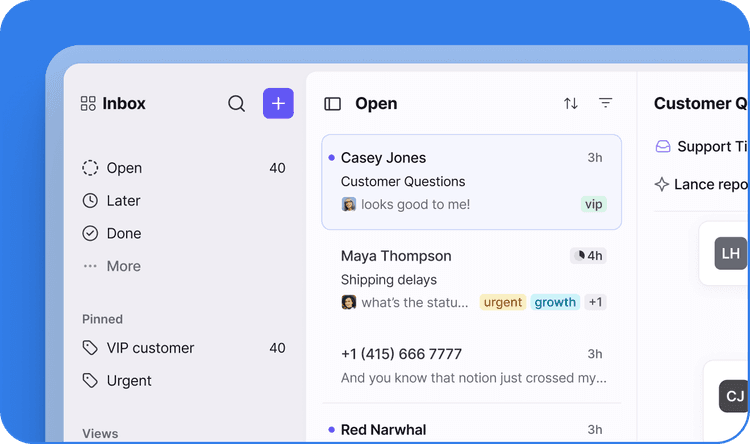
Front is a customer operations platform built to bring profile data into your daily workflow. Every conversation lives in a shared workspace with full customer context visible the moment a message comes in. Teams instantly see who the customer is, what they’ve purchased, and what’s happened before.
Analytics surface patterns and signals across interactions, while AI-powered tools help prioritize and draft responses with consistency. The result: context, conversations, and workflows, all in sync.
Ready for customer profile data to show up in the work, explore how Front makes it happen. Try it today for free.