



Measuring customer experience tells you what changed. See where the evidence actually lives, so you know why it changed and which team should fix it.
In B2B operations, a customer’s experience is everything. Their relationship with your business isn’t just a temporary benchmark; it actively influences retention, renewals, and expansion.
But to influence customer experience (CX), a company needs to understand what’s working and what isn’t. That’s where the voice of their customer comes in. It’s the feedback and insights customers share about their experiences and what they value. When teams actively listen and act upon this feedback, they can transform daily interactions into valuable insight around customer pain points.
But with 80% of customers saying customer service defines their perception of a brand, companies need a deeper understanding of CX. That means measuring CX can’t be limited to high-level key performance indicators (KPIs) in a dashboard or quarterly slide deck. KPIs and dashboards can tell you what changed, but they rarely explain why it happened or which teams need to act to fix it.
That’s where a CX measurement framework comes in. It connects KPIs — like customer satisfaction (CSAT) score, Net Promoter Score (NPS), and customer effort score (CES) — with operational signals like resolution quality, rework, and escalations. It gives teams a consistent way to review historical interactions, analyze trends, and connect insights back to business outcomes.
This article breaks down the CX metrics that matter and shows how a measurement framework turns them into evidence of operational improvement.
What measuring customer experience means in B2B operations
B2B operations are inherently complex, often spanning multiple stakeholders, long buying cycles, and layered approvals. Customer-reported metrics add another challenge: They don’t provide a complete picture of the experience you’re delivering. You must validate those metrics against real customer behavior by looking at adoption, usage depth, and renewal patterns.
To measure experience at scale, you also need a repeatable process that assigns ownership of the outcomes and verifies whether any changes actually improved the experience. And because B2B environments move fast and shift often, accurately understanding CX also requires a long, documented timeline that shows how the experience evolves over time. A “great” support interaction can lead to downstream friction, rework, or churn risk weeks later if the underlying problem isn’t completely resolved.
For example, a customer might have an excellent support call where an agent quickly fixes an invoice with the wrong billing contact. But if the root cause — a misconfigured billing profile — isn’t corrected, the next invoice will have the same error, forcing the customer to reopen tickets and eroding trust over time. Measuring CX helps you recognize these patterns over time, and across teams and handoffs.
It’s also important to separate subjective perceptions from tangible outcomes. CX metrics capture how customers feel about interactions, which means they should be viewed as inputs, not end results. The true value of these metrics lies in what they prompt teams to investigate, prioritize, and fix.
6 customer experience KPIs: What each metric proves
CX KPIs are customer-reported metrics that measure how customers perceive and interact with a brand. They’re popular in B2B because they’re measurable, comparable over time, and easy to report to leadership.
Here are the six most common KPIs B2B organizations use, and their limitations.
1. CSAT score
CSAT score measures a customer’s satisfaction with a specific interaction through a post-interaction survey, typically on a scale of 1–5 or 1–10. Teams usually collect CSAT after a support conversation, onboarding milestone, or customer service touchpoint. It’s useful for B2B teams because it captures immediate sentiment, making it easier to spot workflow breakdowns and hold teams accountable for support quality.
However, CSAT doesn’t reveal the downstream impact of an interaction. A high score doesn’t guarantee adoption or long-term loyalty, and a low score doesn’t tell you whether the issue was systemic, process-related, or a one-off error.
Meaningful root-cause analysis requires context. To understand what needs to be fixed, interpret the CSAT score alongside conversation logs, handoff records, or product usage data.
2. NPS
NPS measures how likely a customer is to recommend your product or service to other people. It’s a simple one-question survey that asks customers to rate the likelihood on a scale of 1–10.
NPS is a loyalty indicator that shows sentiment trends across accounts and segments, and gives executives visibility into account health at scale. But it doesn’t tell you which team or workflow led to a customer’s loyalty (or frustration).
A promoter may give a high score while still struggling with onboarding issues. Similarly, a detractor may score low not because of the product, but because of billing or procurement friction. Without operational context, NPS can’t diagnose what’s working and what’s failing.
3. CES
CES measures how easy it is for a customer to complete a task or resolve an issue. In B2B environments with layered approvals and multiple stakeholders, high effort often signals process complexity and workflow inefficiencies that compound over time.
But CES doesn’t explain where the friction originates. Was high effort due to product design, internal handoffs, or unclear documentation? Without examining real interactions and internal processes, CES highlights the level of customer effort but not the operational factors driving it.
4. First-contact resolution (FCR)
FCR measures the percentage of customer issues resolved in the first interaction without follow-ups or escalations. B2B customers expect both expertise and speed, and FCR indicates whether frontline teams are delivering those outcomes.
High FCR usually reflects operational effectiveness. It means agents have the context, authority, and tools needed to resolve issues correctly the first time. But it doesn’t guarantee quality: Some conversations marked “resolved” still lead to rework later if the issue resurfaces.
FCR also doesn’t apply to complex, multi-step issues that require cross-team collaboration or internal reviews.
5. Customer churn and retention rate
Churn is how many customers you lose within a given period, while retention rate indicates how many stay. Together, these metrics reflect whether your CX, product value, and operational delivery are strong enough to sustain revenue.
The challenge is that churn is a lagging indicator. By the time it becomes a problem, the damage is already done. Meanwhile, customer retention often hides silent dissatisfaction, stalled adoption, or early signs of renewal risk.
Without linking these metrics to interaction data or usage trends, you end up reacting to outcomes instead of managing indicators that signal account health.
6. Customer lifetime value (CLV)
CLV estimates the total revenue a customer is expected to generate over the duration of their relationship with your company. It connects CX to revenue impact and reveals which segments justify deeper investment and where operational improvements can increase expansion and renewal value.
However, CLV isn’t a behavior insight. It doesn’t tell you why some accounts expand while others stagnate. Tie it to adoption patterns, support quality, and real customer interactions to understand what’s shaping long-term value and where accounts need support.
How to measure customer experience: Where the evidence comes from
As outlined above, KPIs alone don’t reveal where CX is failing. KPIs are a helpful way to summarize the shifts in sentiment over time, but they don’t explain why those shifts happened or who needs to act on them.
To understand what’s influencing the behavior behind the numbers — and to give teams something concrete to act on — you need to analyze the interactions that shape the CX. Supplement metrics with insights from these three sources to see where teams can improve.
1. Surveys
In-app and custom surveys are among the most popular CX measurement tools. They add context to CSAT, NPS, and CES by capturing the customer’s direct voice. Surveys look beyond these scores to reveal:
Open-text feedback themes
Role-based sentiment (admin vs. end user)
Account-level response gaps
Shifts in perception over time
2. Behavioral analytics
Behavioral data tracks feature adoption, time-to-value, and drop-off points in key workflows. It either validates or challenges what KPIs suggest.
For example, if NPS drops but adoption is rising, it means customers are using the product but not enjoying the experience. When you look closely at how customers use the product, the behavioral data can show you where they’re getting stuck.
These behavioral patterns often surface in real product conversations. The same “how to” questions or recurring errors explain the customer sentiment behind why NPS scores don’t align with adoption.
3. Conversation and support work analysis
This is the operational layer behind CSAT, NPS, CES, and FCR. Conversation and support work analysis shows what actually happened inside customer interactions. You should examine:
Reopen rates to see where issue weren’t fully resolved
Escalation patterns to see where frontline teams aren’t equipped to resolve issues
Handoff volume to see where handoffs happened due to unclear ownership or knowledge gaps
Resolution quality to see if the problem was solved or just closed
These signals show where friction occurs and why scores change. When teams understand the root causes, they can fix the underlying operational gaps, instead of just chasing better scores.
CX measurement framework: Turn signals into ownership
A CX measurement framework connects KPI scores to real workflows: what happened inside conversations, where handoffs broke down, and whether follow-through occurred. To operationalize the framework, anchor it in a repeatable process.
Start by defining standards: What “good” looks like in a support conversation, onboarding call, or escalation. Calibrate how you’ll measure it through QA reviews and shared scorecards. Then assign clear owners: support fixes macros, enablement updates training, and product addresses recurring friction. Finally, re-measure to confirm impact: Are customers reporting easy adoption of the features? Is there a spike in CSAT?
This loop also makes experience improvement visible, accountable, and repeatable.
Common customer experience measurement pitfalls
CX measurement fails when teams track scores but lose sight of the work driving them. Here are three common pitfalls to look out for:
Measuring outcomes without measuring the work that produces them: Teams track CSAT but ignore reopen rates, escalations, and resolution quality. That’s when scores slip: teams can’t see what went wrong or who should own the fix.
Chasing industry benchmarks without calibrating for your operations: Importing “good” CSAT or FCR targets without factoring in case complexity, handoffs, and workflow definitions directs team effort toward goals that don’t fit actual operations.
Measuring customer sentiment without measuring internal conditions: When team context, workload, and tooling aren’t properly measured, operational strain grows unnoticed and CX degrades behind the scenes. By the time the scores fall, the operational issues have been building for weeks.
Keep CX metrics tied to real customer work with Front
CX measurement only works when you pair what customers say with what teams observe, then route insights to dedicated owners.
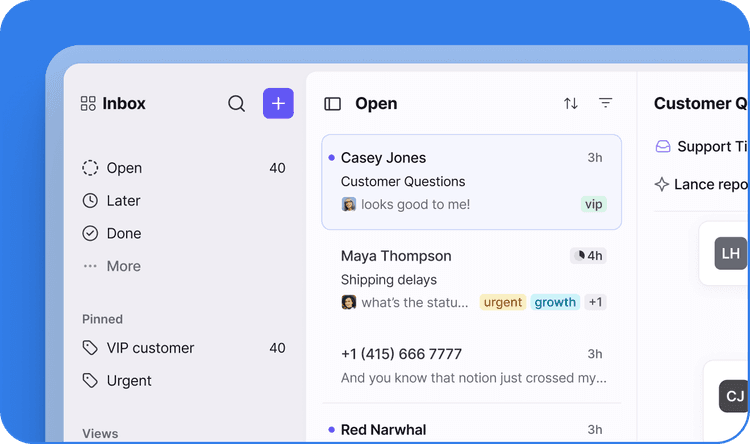
Front manages B2B complexity by keeping all teams, tools, and customer conversations in sync as companies scale. By keeping conversations and handoffs visible across channels, Front anchors CX evidence in real customer interactions. Ownership stays clear through collaboration, and analytics and AI detect drift early so teams know what to focus on next.
See how Front makes CX measurement actionable. Book a demo today.
FAQ
What are customer experience metrics?
Customer experience metrics are measurable indicators that show how customers feel about their interactions with your business. They translate subjective experiences into data that you can use to improve customer journeys, loyalty, and retention.
How do you measure customer experience when conversations span multiple channels and teams?
Measure customer experience by centralizing conversations across channels, tracking handoffs and resolution quality, linking sentiment metrics to shared KPIs, and assigning clear ownership for outcomes.
Should measuring customer experience include internal team performance or just customer feedback?
Both. Customer feedback captures the customer’s experience, while internal performance metrics explain the operational reasons behind those feelings. Together, they help you see what’s happening, why, and how to improve it.