



NPS in B2B rarely moves because of the survey. See how fixing handoffs, context, and follow-up across teams actually moves the score.
You’re already measuring your net promoter score (NPS) — tracking it in meetings, reviewing it in decks, and analyzing every uptick and dip, but finding ways to improve it is the real challenge.
In a B2B environment, NPS doesn’t improve through survey tweaks or one-off fixes alone. It improves when day-to-day execution gets better across teams.
In logistics, that looks like coordinating with carriers and keeping tracking accurate before issues escalate. In financial services, it’s routing accounts or underwriting inquiries to the right experts immediately, with full context, so customers never have to repeat themselves.
The pattern is simple: Get conversations to the right people quickly, preserve context across every handoff, and follow up consistently before issues snowball.
This article explores how to improve NPS by fixing the workflows that actually drive change — because real gains come from how your teams operate every day, not just how you measure performance.
Why NPS works best within a broader customer experience system
NPS is a signal. It reflects the cumulative impact of dozens of interactions over time, but on its own, it doesn’t show you root causes. It tells you whether customers would recommend you — but not why. The real driver is execution: Issues are owned, follow-up happens, and nothing falls through the cracks between teams.
In travel management, that’s the difference between a seamless booking modification with proactive traveler support versus a frustrated client chasing updates across vendors.
A similar conflict is at play in professional services: Client communication and project coordination stay tight or drift, forcing clients to repeat themselves and chase progress.
These breakdowns add up fast. In fact, 59% of customers will end their contracts after three or fewer bad experiences. Missed handoffs, repeat contacts, inconsistent follow-through quickly move from being small gaps to imminent voluntary churn risk.
The bottom line is that leaders already see these symptoms. NPS response rates become useful only when tied to the system behind the experience: your workflows.
6 best practices for improving NPS in B2B environments
If NPS reflects execution, improving it means changing how the work moves. That’s why low NPS is rarely a survey problem, and taking a short-term view on “fixing” the survey is a recipe for failure.
Below are six NPS best practices to redesign workflows and create better experiences, so teams can consistently deliver customer success.
1. Create clear ownership for NPS survey feedback
No single team owns the customer experience — or the score that reflects it. Shared responsibility matters, but clear ownership is what turns feedback into action.
Here’s how to operationalize accountability and take ownership:
Assign a central survey owner: Identify a single point of contact responsible for survey logistics, design, and ensuring consistent delivery.
Establish a “closed loop” team: Assign people specifically to respond to feedback — especially from detractors (those who are dissatisfied and unlikely to recommend your business).
Define actionable roles and automate routing: Define who gets real-time access to customer feedback first, identify feedback trends to inform the product team, and leaders who mentor teams.
Segment by customer journey: Assign departments to own NPS trends at specific touchpoints — like onboarding, renewal, or post-support, so accountability maps to the experience.
Use regular review sessions: Conduct regular, executive-level meetings to analyze NPS feedback trends and identify necessary strategic investments.
The NPS and customer satisfaction connection becomes more visible when a clear ownership system is in place.
2. Close the loop with customers consistently
Capturing customer sentiment in the moment is valuable — but closing the feedback loop is even more impactful, because it shows customers that their input went somewhere.
Once you gather the NPS survey feedback, address what hasn’t been working, and communicate the changes to customers, the customer feedback loop is effectively closed. A collaborative structure also ensures every team stays connected to what customers are actually experiencing.
Take Front’s round-robin approach to NPS, for example. Follow-up tasks are assigned evenly across the team, so everyone engages with both promoters and detractors — sharing what’s working, listening to concerns, and flagging issues to the right people.
When you close the loop consistently, you prevent churn before it happens and surface upsell and renewal opportunities without extra resources.
3. Separate signal from noise in NPS survey responses
Although an NPS is a good way to measure the changes in customer attitude, it tends to oversimplify customer loyalty by reducing complex customer sentiment into a single numeric value.
It can hide the “why” behind customer attitudes, gloss over the complexity of B2B relationships, and confuse intent to recommend with actual satisfaction and future behavior.
But there’s a way to prevent oversimplification: Separate signals from noise and know which responses deserve more weight.
One way to achieve this is grouping responses into categories, which are usually compliments, opinions, and commitments. Once you have distinct groups, it’s best to pay close attention to the language used in the feedback.
If a response mentions past friction, shifting priorities, or future intentions, that’s direct evidence of why a customer might pull back — or stay.
It’s also better if this evidence is connected to business objectives like churn rate, expansion revenue, customer retention rate, or onboarding completion.
4. Use NPS survey feedback to improve day-to-day execution
Putting feedback to work is harder than it sounds. Beyond following up with customers, teams need to address the root communication breakdowns that caused poor scores in the first place.
Without that, teams end up working in silos. The engineering team feels left out. The product team blames missed deadlines. Marketing hands off leads without the context sales needs to close them.
Real collaboration means teams pass full customer context — not just tasks — so nothing important gets lost between handoffs.
5. Make NPS visible across teams without over-indexing
Treating NPS as the definitive truth about your customer relationships misses the point. It’s one signal among many — useful, but incomplete on its own.
The score is only one piece of a complex customer picture and it needs to be visible across teams to surface trends and be connected to business outcomes.
To achieve this, share the story behind the score (who the customer is, what problem they faced, and what the team did) rather than just the raw number. Segment dashboards based on teams or product areas to identify trends and make closing the loop visible. If the team resolves a concern, share that story internally and on social media.
6. Review and refine your NPS process over time
NPS is rarely static, so your review and action process shouldn’t be fixed either. Move beyond generic surveys to more targeted approaches — like sending a quick pulse survey after resolving a support interaction or running quarterly relational surveys with key accounts.
Keep the core question neutral and consistent, and review patterns over time with trend charts or other tools to determine if changes in NPS are statistically significant.
Remember that these practices only work when they operate as one workflow system, not as scattered initiatives or one-off fixes.
When ownership is unclear, follow-through slips and feedback fails to translate into action — causing NPS and customer satisfaction to stagnate.
Put NPS feedback to work with Front
Sustainable NPS improvement requires consistent ownership, follow-through, and feedback.
But this is where most teams break: They understand what needs to change, but struggle to make changes stick when customer conversations span multiple channels, teams, and stakeholders.
Front closes this gap by supporting these workflow changes as volume and complexity increase.
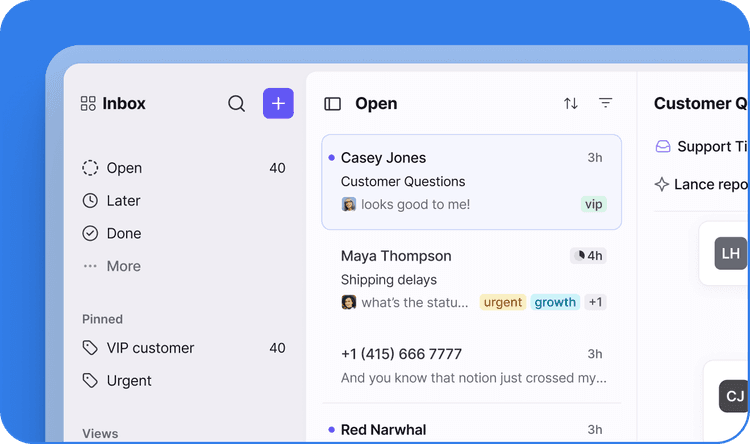
It’s not a native NPS survey tool, but Front is built to manage the follow-up workflows that actually move scores — keeping conversations, context, and ownership in sync across your team, so NPS feedback reliably turns into action.
Try it with your team today to experience these workflows firsthand.
FAQs
What affects NPS score?
NPS is driven by a customer’s overall experience, specifically while using your product, after a support interaction, and brand perception. The speed, accuracy, and human judgment, as well as reliability of product and effectively closing the customer feedback loop, influence the score.
What is a good NPS score?
A good score depends on your industry. For example, B2C usually has a higher average score than B2B. The best benchmark would be comparing your score against your direct competitors rather than a universal standard. That said, the average NPS score for B2B software-as-a-service companies is typically between 30 and 40 (out of 100).
What are customer experience metrics?
Customer experience metrics are measurable indicators that show how customers feel about their interactions with your business, such as CSAT, NPS, and CLV. They translate subjective experiences into data that you can use to improve customer journeys, loyalty, and retention.
How do you measure customer experience when conversations span multiple channels and teams?
Measure customer experience by centralizing conversations across channels, tracking handoffs and resolution quality, linking sentiment metrics to shared KPIs, and assigning clear ownership for outcomes.