



Build a customer feedback loop that turns input into action across teams. See 4 practical steps, real examples, and how to close the loop with customers.
Nearly half of all customers return to brands that actively use their feedback to create better experiences. That’s a major edge for any company willing to do the work.
Building a strong customer feedback loop is one of the most effective ways to uncover the root causes of poor customer experiences and make meaningful improvements. While many teams collect feedback, far fewer know how to close the loops and turn those insights into action.
In this guide, you’ll learn how a customer feedback loop works in practice, why closing it matters, and see real examples of companies that get it right.
What is a feedback loop?
A customer feedback loop is the process of gathering input from customers, using it to improve your product and overall customer experience, and then following up once changes are made. Once you address the issue and communicate the improvements, you effectively “close the feedback loop.”
Feedback can come from anywhere — surveys, support calls, social media, chat — but it’s most useful when you capture it in context. Tools like Net Promoter Score (NPS) or customer satisfaction surveys, in-app prompts, and support conversations usually surface customer sentiment in the moment — whether a user is satisfied or frustrated.
5 reasons to implement a customer feedback loop
A customer feedback loop gives you a firsthand view into how customers experience your product. Instead of sending a generic thank-you message, actually acting on feedback — and letting customers know what you did — will make them feel heard and prioritized.
Here are five reasons companies should implement a customer feedback loop:
Prevent churn before it happens: Monitor customer sentiment through NPS scores, surveys, and direct feedback to identify friction points. Then, respond proactively before disengagement occurs to keep churn manageable.
Turn happy customers into advocates: Act on feedback to show customers you’re invested in their long-term success, building loyalty that outlasts pricing changes and competitors.
Boost retention over time: Continuously improve features customers rely on most, so contract renewals become opportunities to increase revenue and retention rate.
Grow accounts without adding staff: Leverage feedback insights to surface upsell and cross-sell opportunities at the right moment, expanding accounts without adding headcount.
Strengthen brand perception: Share positive customer feedback and success stories everywhere you can — social media, community forums, case studies, and review sites).
A well-executed feedback loop strengthens relationships and drives measurable growth, supporting both your customers and your business.
Examples of a positive feedback loop
When a new feature surfaces user needs
Event: Your team launches a new reporting feature, and power users start using it right away.
The feedback loop steps:
Observe how users interact with the new feature and note any friction points.
Trigger an in-app micro-survey after a few uses to ask what’s working and what’s missing
Identify common gaps — for example, multiple users request custom export filters.
Prioritize improvements that address these gaps and ship updates quickly.
Close the loop by notifying users who requested enhancements and sharing updates with the broader audience.
When a customer loves your product
Event: A customer success manager (CSM) notices high engagement from a mid-market account ahead of renewal.
The feedback loop steps:
Send a short check-in survey to capture satisfaction and highlight what’s resonating.
Analyze the results to identify strengths, such as onboarding or support responsiveness.
Collect testimonials and document proof points (with the customer’s permission).
Share insights with marketing and product teams to inform messaging and improvements.
Leverage these proof points during renewal or expansion discussions to strengthen the relationship.
Examples of a negative feedback loop
When your product has a frequent performance issue
Problem: Enterprise customers report slow application programming interface (API) performance during peak usage.
The feedback loop steps:
Gather and organize all complaints from support tickets and account manager notes.
Quantify the frequency of issues and potential revenue impact.
Escalate findings to engineering with detailed customer-impact data.
Release performance improvements and run thorough testing at scale.
Proactively notify affected accounts and confirm that the issue is resolved.
When customers perceive less value than the price
Problem: NPS drops after a pricing update, with feedback citing unclear value.
The feedback loop steps:
Group detractor comments by theme, such as pricing transparency, feature gating, or return on investment (ROI) confusion.
Conduct follow-up interviews with select detractors to gather deeper insights.
Update pricing page messaging and add in-product value prompts that highlight value.
Equip customer success and sales teams with clearer ROI positioning.
Re-measure NPS and monitor renewal objection rates to track improvements.
Close the feedback loop with these 4 steps
When customers take time out of their day to share their thoughts, they deserve more than a canned “thanks for your feedback” reply.
Here’s how to make sure their input leads to real change.
Step 1: Collect feedback from every channel
Every feedback loop starts with listening. There isn’t a one-size-fits-all approach, but common methods include:
In-app surveys and third-party survey tools
Online review platforms (G2, Capterra, TrustPilot, etc.)
Live chat, call data, and email
Social media monitoring (Reddit, Twitter/X, LinkedIn, etc.)
The key is asking clear, focused questions that give actionable answers without drifting off course in the name of collecting more data.
Step 2: Identify trends, uncover patterns, and share insights
Once you have a good baseline of feedback, analyze it to identify trends and root causes. This process highlights recurring pain points, such as outdated help articles or confusing onboarding steps.
The next step is communicating these patterns and insights to the right teams. If onboarding is unclear, share the findings with your customer service and support teams. If a feature is malfunctioning, escalate it to the development team.
Step 3: Turn insights into product and process changes
After reviewing the patterns in your feedback, it’s time to take action.
A/B testing the copy and steps of your onboarding process shows where things get complicated. A new video tutorial or rewrite of help articles can quickly fix the outdated information.
A strong customer feedback strategy also asks for additional feedback during this stage to address customers’ actual needs. Remember that most of these improvements require cross-functional collaboration, so internal alignment is more than necessary.
Step 4: Follow up with the customer and show what changed
This is when you officially “close the loop.” If a customer’s feedback led to product or process changes, send a personalized follow-up that highlights their impact on your team.
This can also be a powerful opportunity to say, “We heard you and made these changes.” Publicly acknowledging feedback-driven improvements reinforces trust with existing customers and signals to prospects that you listen, adapt, and continuously improve based on real user input.
Turn feedback into action with Front
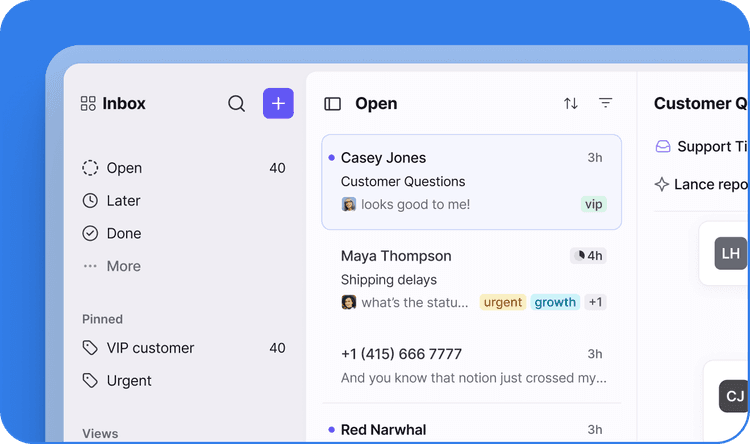
Without a system that brings every customer conversation together, closing the feedback loop can feel like guesswork. Front keeps feedback, context and team collaboration in one place so insights don’t get lost between tools and handoffs.
With a shared workspace, internal comments and threaded conversations, your team can spot patterns, align on next steps and follow through — all without leaving the platform.
See how your team can act on feedback with Front.
FAQs
What are the four components of a customer feedback loop in B2B operations?
A customer feedback loop has four key components: collecting feedback, analyzing insights, taking action, and closing the loop with customers. In B2B operations, this process links customer support, product, sales, and customer success teams and drives measurable outcomes like retention and expansion.
What is an example of closed-loop feedback across multiple teams?
Closed-loop feedback happens when multiple teams act on customer input in a coordinated way. For example: support logs recurring complaints, product delivers a fix, customer success notifies affected accounts, and marketing updates messaging. This ensures customers see the tangible results of their feedback.
How do feedback loops prevent churn in B2B customer relationships?
Customer feedback loops prevent churn by identifying friction points early, triggering proactive outreach, and resolving systemic issues before they impact renewals or long-term contract value.