



Learn what a B2B customer service strategy is, why it matters, what poor service costs, and how to build a service strategy that scales with your business.
Every B2B company — whether an early-stage startup or an enterprise leader — has a customer service strategy, even if it isn’t formally labeled as one.
The problem is that most strategies only work in ideal conditions. As customers and volumes increase, so do channels, handoffs, and internal dependencies, quickly exposing the gaps in service strategy. What works for 100 customers rarely works for 1,000, much less tens of thousands.
With 67% of B2B customers willing to pay more for exceptional customer support, a strategy that can’t scale puts both team performance and revenue at risk as expectations rise. Here are five practical steps B2B teams are using to run customer service that stays coordinated and manageable, even as volume and complexity increase.
What is a customer service strategy for B2B businesses?
At its core, a customer service strategy is the set of decisions that governs how customer conversations are captured, routed, and resolved end-to-end. It’s not just about handling complaints. It’s the full chain of customer interactions where teams provide clarity, resolution, and confirmation across multiple stakeholders.
Defining a customer service strategy gives teams a shared baseline and a clear picture of what success looks like. When this operating layer is unclear, the impact shows up fast in missed handoffs and slow responses.
Why a customer service strategy matters at scale
A friendly “Hey, [name]” in an email or live chat can’t offset the frustration of repeating the same issue to an agent who has no context from prior conversations. At scale, this kind of surface-level personalization indicates breakdowns in ownership and continuity. And the impact is substantial: 59% of customers say they’ll leave a brand (or advocate for leaving) after three or fewer bad customer experiences.
In B2B, these “bad customer experiences” often look like this: fragmented chat conversations, inconsistent handoffs, and agents responding without context. Nearly two-thirds of B2B companies experienced at least one customer-facing coordination failure in the past three months. That’s because the typical B2B company spends nearly 3 hours coordinating for every hour actually solving customer problems. Each breakdown chips away at trust, often making customers second-guess doing more business with that company.
That’s why a customer service strategy matters. Even small moments — like a repeated question following an AI-to-agent handoff — become signals that customers use to judge whether the relationship will hold up over time. Having a system that scales with conversation volume, channels, and coordination demands has a lower operational cost and results in higher satisfaction.
Build an effective customer service strategy in 5 steps
You already have the team and the workflows in place. The question is whether your customer service strategy can handle more volume, more cross-team collaboration, and more complexity.
These five steps help strengthen the operating model behind your service.
1. Identify customer needs at each step of their journey
An effective service strategy ties support needs to stages of the B2B customer journey. Customers in your onboarding flow will need fast answers and guided setup, while long-term accounts depend on continuity, historical context, and coordinated responses across customer support and success. Renewal-stage customers often signal risk indirectly through tone or repeated questions long before they churn.
Your strategy needs to handle each of these moments differently, meaning different routing, urgency, and ownership.
A new customer’s question may be handled by frontline support with standard educational resources. But the same query from a long-term or enterprise account should trigger senior agent involvement and account owner visibility. It may also require proactive outreach to understand whether it signals broader adoption issues or churn risk.
2. Set clear standards and the metrics behind them
Tracking metrics isn’t the same as defining service standards.
High-volume teams often measure response time and customer satisfaction score (CSAT), but these metrics only work when they’re anchored to clear standards. Without shared expectations for how issues should be handled and progressed — Who owns the first response? When does an issue escalate? What qualifies as “resolved” in multi-stakeholder accounts? — metrics have nothing meaningful to measure performance against.
Setting clear standards makes service expectations explicit. For example, rules might dictate that enterprise accounts get a human-first response within one hour, escalations must be acknowledged (not solved) within four hours, and ownership never changes without confirmation.
Metrics then show whether those standards are being met, but they can’t replace the standards.
3. Keep conversations connected with an omnichannel strategy
B2B customers don’t experience communication channels separately — they experience one ongoing relationship.
When conversations are split across email, chat, calls, and internal notes, teams lose context and customers end up repeating themselves. As volume grows, this leads to inconsistent answers, resolution delays, and a gradual loss of trust.
An omnichannel customer service strategy ensures that conversations follow the customers, not the channel. This means if a customer escalates an issue via email after a stalled chat, the responding agent shouldn’t reset the conversation. They should pick up exactly where the last exchange ended, with full visibility into earlier interactions and context.
4. Use workflow automation for consistent routing and handoffs at scale
Manual coordination works at low volume, but it may not hold up as the customer base and support team expand. Informal rules like “send this to Tier 2” or “loop in Product when it feels urgent” eventually become failure points. To avoid that, define clear rules for routing and handoffs before automating anything. Otherwise, automation simply scales the inconsistent handling and, as volume grows, ad hoc decisions turn into slower responses and uneven customer experiences.
With the right rules in place, workflow automation enforces consistency at scale. For example, a billing issue from an enterprise account can automatically route to a specialized queue, notify the account owner, and flag the conversation if it remains unresolved beyond a defined threshold, without relying on agent memory or manual escalation.
5. Use the right CX tools and AI to reduce routine load, keep control, and improve over time
AI can’t own outcomes or accountability, but it can reduce repetitive work so humans can focus on decisions that matter.
In experienced customer support teams, AI assists with tasks like drafting responses, summarizing conversations, and tagging issues, giving agents more time for work that requires judgment and context. It also handles high-volume, repetitive questions — such as password resets or order-status checks — so humans can focus on more nuanced conversations. Prioritization and relationship management stay firmly in human hands. The goal isn’t automation for its own sake, but freeing experienced agents to focus on complex, high-impact conversations instead of repetitive tasks.
A strong setup also includes a simple feedback loop. Each interaction should feed insights to the team about what customers struggle with, what’s unclear, and where processes break, so service improves over time.
Most teams don’t have one. Customer Support Specialist at Front Suzy Falvey describes what having one looked like from the inside:
“I was brainstorming with my manager, this is how we do things in support, but could we change how we react to an incident? So that was feedback on internal processes and feedback on product, really early on in my tenure. I don’t think every support team does that. A lot of the time you’re answering customers and tickets four, six, eight hours a day, without any feedback going to product, to management, or anywhere else.”
Success stories: customer service strategy examples from leading operations teams
High-context, multi-stakeholder workflows, continuity across channels, and the pressure of managing risked accounts and metrics increase the operational load on B2B support teams. An omnichannel customer service strategy helps handle this load, not just in theory but in actual day-to-day operations.
Check out these two examples of companies that implemented omnichannel strategies and saw incredible results.
1. Uber Freight
Uber Freight is the quiet force behind the world’s busiest supply chains — the digital logistics platform that brings fresh produce from farms to shelves and holiday gifts from warehouses to doorsteps. Its operations team coordinates thousands of loads and supports customers to keep every shipment moving with speed and accuracy.
But as the company scaled, its communication setup couldn’t keep up with the volume and complexity of work. Shared inboxes slowed systems down, triggered crashes, and led to lost messages, with no trail or metrics to understand performance. Uber Freight needed a platform that could evolve with the company and support its commitment to exceptional customer outcomes.
Front provided the solution. Before, teams spent more than half their day in email with no visibility into the type or quality of work being handled. By leveraging Front’s integrations, Uber Freight created a unified workspace, reliable shared inboxes, and analytics that revealed where teams were spending time and how to improve. With Analytics and Workflow Automation features, like tagging and auto-assignment, teams cut response times in half even as email volume increased.
2. Branch
As an insurance company focused on removing friction for its customers, Branch faced friction of its own, mainly due to Zendesk’s limitations with SMS integration. They wanted outbound messages and alerts to flow seamlessly into inbound conversations, with human judgment at the center of every response.
Front bridged that gap. By using Front’s Trello integration, Branch centralized and customized chat communications, which allowed the team to handle thousands of customer messages instead of addressing one SMS at a time. This not only improved efficiency but also helped drive new customer acquisition.
Joe Emison, CTO and co-founder at Branch, reported a 40% increase in team productivity thanks to Front’s unifying workspace. Response times dropped from 5.5 hours to 1.4 hours, enabling faster, more reliable service.
Support your customer service strategy better with Front
Teams often fail to see that their customer service strategy is a collection of disconnected initiatives when it should be the operating layer that keeps customer conversations moving. Without that layer, even the best intentions break down into silos and delays that customers feel immediately, especially as volume, channels, and coordination demands grow.
That’s where Front comes in. Built for B2B complexity, Front is a customer operation platform that keeps every team, tool, and conversation in sync, so teams can scale without losing connection.
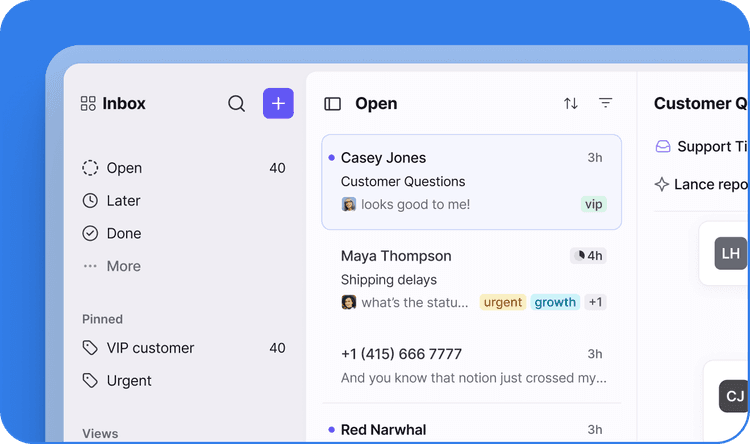
While most tools focus on customer-facing touchpoints, Front runs the operational layer behind them with a unified omnichannel inbox, automated workflows for routing and assignments, and collaboration that protects context during handoffs. Plus, AI assistance for chat and email reduces routine work while keeping humans in control where judgment matters.
Explore Front to see how this operational layer works in practice.
FAQ
How do you measure whether your customer service strategy is working?
Track metrics like customer satisfaction score (CSAT), first response time, resolution time, and ticket backlog, then link them to business outcomes such as retention, renewals, and expansion. Consistent improvement across both operational and revenue indicators shows the strategy is effective.
Who owns the customer service strategy in a B2B organization?
Ownership typically sits with a customer experience, customer support, or operations leader, depending on structure. Cross-functional alignment with product, sales, and success teams ensures the strategy scales with growth and complexity.