


Learn how B2B teams use omnichannel customer support to improve resolution rates, coordinate multi-team operations, and scale efficiently.
B2B customer conversations rarely stay in one place. They jump between live chat, email, phone calls, and apps, leaving context scattered and responses delayed. This is prime real estate for operational gaps that slow teams and frustrate customers. It’s no wonder that the typical B2B company spends nearly 3 hours coordinating for every hour actually solving customer problems. The chance of losing context between handoffs and having customers repeat themselves across channels is high. Nearly two-thirds of B2B companies reported at least one customer-facing coordination failure in the past three months.
Omnichannel customer support fills that gap by bringing every interaction into a single, connected conversation. Giving teams this clarity and control ensures every interaction starts with context and meets customer needs.
In this article, we’ll show how high-performing B2B teams combine multiple communication channels to gain an operational edge and deliver faster, more consistent service.
What is omnichannel customer service?
Despite what the name might suggest, omnichannel service is not about being everywhere at once. It’s about connecting the channels you already use so support shows up consistently, and customer interactions actually move work forward.
When done right, seamless multi-channel customer support helps teams like yours deliver:
Faster issue resolution and reduced ticket backlog: Centralized context and fewer duplicate touches shorten response and resolution times while keeping backlog and service level agreement (SLA) breaches under control.
Clear ownership and smooth handoffs across customer workflows: Defined routing and shared visibility ensure tickets move between teams without delays, dropped context, or accountability gaps.
More consistent service across channels and teams: Unified workflows and standards reduce variability in response times, customer service quality, and SLA performance, no matter where the conversation starts.
Better visibility and reporting for leadership: Cross-channel data gives leaders real-time insight into volume, performance trends, bottlenecks, and team capacity for smarter operational decisions.
These benefits create a streamlined, measurable support operation, keeping teams and customers fully aligned.
Omnichannel vs. multichannel customer support
Multichannel support offers customers several communication channels — live chat, email, phone, and apps — but each channel often operates in isolation. Rules, SLAs, and scripts exist in parallel, creating fragmented workflows and slower resolution.
Omnichannel support connects these channels into a single, coordinated system. Customer context travels with every interaction, tickets follow clear ownership rules, and teams work together to address issues efficiently. At its core, an omnichannel customer service strategy ensures issues progress no matter where they appear.
For support and ops teams, this means fewer process failures and one continuous, consistent customer relationship.
How to build omnichannel support and maintain operational control
Every support channel brings its own strengths and operational tradeoffs:
Live chat is fast but reactive.
Email handles complex, multi-stakeholder issues but can obscure ticket volume and slow response times.
Phone calls and meetings add nuance but pull team members away from other tasks.
Social and in-app messaging offer immediacy and context but require structured oversight.
The key is aligning teams around shared workflows, prioritizing tasks strategically, and maintaining visibility across the full customer experience. This is particularly important in B2B environments, where customer issues are more complex and require multiple teams to solve them.
When considering a strategy, remember that channel selection is a leadership decision, not just a tooling choice. The right mix ensures escalation paths are clear and avoids disconnected queues. When multiple channels are integrated effectively, omnichannel support becomes a true operational strategy that drives efficiency, cross-team collaboration, and measurable impact.
Below are some examples of how popular B2B channels handle high-volume, complex work.
Email is where complex, documentation-heavy, or multi-stakeholder issues often land. It’s slower than live chat, but better suited for trackable, process-based resolution. It’s a key channel for queue management, SLA tracking, and ownership clarity.
Here’s how it plays out in practice: A procurement contact emails about contract access limits while a technical admin is CC’d on integration errors. Support routes the issue into a shared inbox with internal notes, enabling billing and technical teams to coordinate without fragmenting the conversation. Leaders gain visibility into backlog and SLA risk before it escalates.
Live chat
Live chat has a powerful sense of immediacy, but treating every message as urgent can quickly create chaos. This channel mainly focuses on triage rules, routing logic, and escalation thresholds.
Let’s say a customer opens a chat about a dashboard loading issue. Triage tags it as a potential product bug, linking similar chats into a shared view. Support resolves simple cases, while confirmed patterns are escalated to the product with context intact. Leaders see emerging trends in real time instead of after delayed escalations.
Today, live chat can be staffed by support reps, AI agents, or a combination of both. AI can handle routine inquiries instantly, while human agents focus on complex issues, creating a more efficient support experience.
Phone
Phone calls often involve sensitive, urgent issues or multiple stakeholders. To keep these conversations from becoming siloed, it’s important to integrate them into your broader workflow.
Here’s an example: A customer’s operations lead calls about a failed deployment before launch. The call notes, decisions, and action items are logged into the same workflow as written channels so that engineering and success teams have full context and visibility.
Leaders can then track escalations that start on calls and follow up across channels.
Social
Social channels can amplify issues, making fast acknowledgement, ownership clarity, and internal escalation critical.
Here’s how that plays out in a B2B setting: A customer posts about downtime affecting their team, tagging your product, on LinkedIn. Support first responds publicly, then pulls the conversation into internal workflows so product and account teams can coordinate the response.
In-app messaging
In-app messaging captures issues right at the moment users encounter friction and connects them to broader workflows.
For instance, if multiple users request help from a reporting feature, these interactions are grouped and tagged to highlight spikes tied to a recent update.
The support team resolves individual questions, while the product team receives structured feedback tied to usage behavior. Leaders, on the other hand, see how product changes directly impact support demand and workload.
Omnichannel technology: Platform requirements for B2B teams
At scale, omnichannel communication for customer service only works when technology acts as the operational backbone. The platform connects conversations, teams, and workflows so work moves predictably instead of getting lost between tools.
But the system can’t replace people. Specialized teams still handle day-to-day execution, design processes, manage escalation logic, and oversee governance using their human judgment. The platform’s job is to give them shared context, visibility, and structure, so decisions stick and outcomes are measurable.
To build a similar foundation with the platform you’ve chosen, there are two key factors you should consider: Key technology categories and critical capabilities for leadership evaluation. Let’s look at both.
Key technology categories
These technology categories represent the core system layers that capture conversations, move work between teams, apply intelligence, and give leaders visibility into operational performance.
Ticketing systems: These systems centralize conversations from multiple channels into one shared workspace to reduce context loss while giving teams a single operational source of truth. For B2B organizations, this supports stronger cross-team ownership and accountability.
Workflow automation: This automation standardizes routing, prioritization, and handoffs, ensuring work flows according to defined rules rather than relying on informal knowledge or individual memory. It reduces escalation delays and keeps SLAs predictable as volume increases.
AI: When applied to workflows, AI strengthens operational control. Routing and triage direct issues to the right teams, AI-assisted responses reduce handle time, and automated quality assurance and sentiment analysis support consistent quality.
Analytics and reporting: Cross-channel reporting gives leaders visibility into backlog, SLA performance, bottlenecks, and workload distribution, showing how the entire operation performs.
Integrations: Connections to customer relationship management, issue tracking, billing, and product tools ensure customer data and internal workflows stay aligned. This is critical for B2B environments where customer support teams rarely resolve issues alone.
These systems create the foundation for scalable and well-coordinated customer operations.
Critical capabilities for leadership evaluation
When evaluating platforms, you should first and foremost focus on operational outcomes. Focus your due diligence on these six capabilities:
Unified conversation timeline: A complete, cross-channel history prevents repeated explanations and supports smooth handoffs across teams.
Contextual routing: Routing based on customer data, issue type, or urgency ensures the right expertise handles the issue early, protecting SLAs and reducing escalations.
Enterprise-grade security and compliance: This is critical for protecting customer data and supporting governance requirements across teams.
Scalability and customization: The system should support new teams, channels, and workflows without forcing process workarounds.
Actionable reporting and analytics: Leaders need real-time visibility into performance trends, capacity, and operational risk more than they need raw ticket counts.
Strategic vendor partnership: Enterprise-level customer support, roadmap alignment, API extensibility, and integration depth matter as much as product capabilities.
B2B teams often evaluate vendors such as Front, Kustomer, and Freshdesk in this space, assessing each platform’s features, scalability, and ease of integration to determine the best fit.
Keep teams, tools, and conversations in sync with Front
At scale, omnichannel customer service is both a channel challenge and an operational one. Adding in-app chat or voice can improve responsiveness, but it also introduces new complexity.
Urgent bugs and billing issues start competing in the same queues, pulling agents away from SLA-bound work and creating friction across teams.
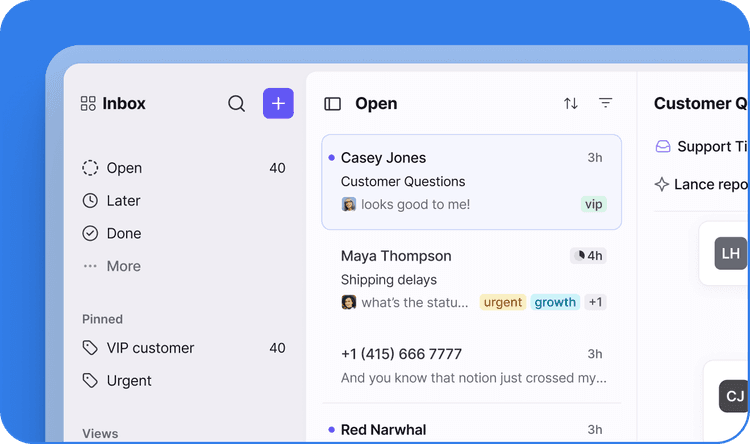
Front solves this by unifying email, live chat, voice, and more in a single workspace. Conversations stay connected to the right people and systems, handoffs are seamless, and leaders gain clear visibility into performance and outcomes.
Rather than forcing support and client-facing teams into separate tools, Front centers omnichannel support around the conversation itself. Context travels with each conversation, collaboration happens naturally, and accountability is clear.
Explore Front’s omnichannel capabilities and see how teams stay aligned and scale across every channel.
FAQs
What are the common challenges in omnichannel support?
Even with measurable benefits, omnichannel workflows can introduce challenges that impact consistency, reliability, and visibility. Common risks include complex product workflows, gaps in digital transformation and pricing visibility, siloed teams managing cross-channel work, and the need for ongoing training to support high-value interactions.
Can omnichannel support work without technology upgrades?
Not at scale. Manual coordination across channels leads to lost context, slower resolutions, and limited visibility, which makes consistent, cross-team support harder to sustain.