


Compare the top customer engagement software and tools for B2B teams, and see how to choose the right one for real operational complexity.
Customer engagement doesn’t happen on its own. Every message, reply, and follow-up shapes how customers feel about working with you — and whether they stick around.
That kind of consistency starts with a clear strategy and a shared playbook for how and when to reach out. But as communication spreads across email, social media, and support channels, staying consistent gets harder. Without the right systems, even a strong plan falls apart once volume picks up.
That’s where customer engagement tools come in. They’re the systems that turn your engagement strategy into day-to-day action.
In this article, we’ll explain what customer engagement tools are, explore the main categories, and review the leading solutions for 2026.
What is customer engagement software?
Customer engagement software helps teams manage the conversations and touchpoints that build lasting customer relationships.
As businesses grow, new channels emerge and more teams start talking to customers. Without a centralized system, engagement breaks down: Teams lose shared context, data stays siloed, and even strong engagement strategies falter across scattered tools and workflows.
Customer engagement tools are the layer that connects strategy to execution — influencing how companies reach customers, from first contact to long-term relationships. The right software pulls interactions into one place and helps teams deliver on that strategy at scale.
Because every business engages customers differently, platforms vary in their approach. Some focus on messaging and lifecycle marketing; others are built around support-driven interactions. Whatever the model, these tools close the gap between planning and doing, so teams can show up consistently at every stage of the customer journey.
Types of customer engagement tools
Customer engagement tools are built on different ideas about what engagement really means, so each platform takes its own approach to managing customer communication.
Here’s a snapshot of the main types of customer engagement software:
Customer operations platforms: These tools help teams coordinate B2B workflows and handoffs across multiple channels. They treat every interaction as part of a bigger workflow, which can reshape how teams organize and complete their work. Still, they may feel over-engineered if you mostly run marketing campaigns or ticket queues.
Omnichannel engagement platforms: These pull communication from email, chat, and social media into one view, cutting down on fragmentation and giving teams a clearer picture of what’s happening. The trade-off: They usually lack deep CRM or ticketing capabilities.
Help desk/support engagement platforms: Originally ticket-driven, these tools now include features such as follow-ups, macros, and AI automation. They’re a strong fit for managing service requests and resolving issues, but they don’t always hold up well for proactive outreach or cross-team coordination.
CRM platforms with service engagement: CRMs such as Salesforce and HubSpot Service Hub weave engagement into broader sales or service infrastructure. They work well when engagement is tied to customer records and revenue outcomes, but they can feel rigid if your workflows are highly collaborative.
Workflow and collaboration engagement platforms: These platforms focus on operational coordination — assigning, tracking, and managing engagement tasks. They support intricate, multi-step processes but may require additional integrations to manage actual customer touchpoints, such as live chat or in-app notifications.
Keep in mind that these categories often overlap. A CRM might add workflow tools, or an omnichannel platform could include ticket management.
The right choice depends on how engagement works in your organization, whether it’s marketing-led, queue-driven, or coordination-heavy. Matching your day-to-day operations to a platform’s design matters more than comparing feature lists, because that alignment is what determines whether a tool can actually support engagement at scale.
Why do businesses invest in customer engagement tools?
Customer engagement gets harder as companies grow. What once worked through manual processes or patchwork software starts to buckle under higher volumes.
Businesses invest in website engagement tools because they bring structure to the growing complexity. Instead of relying on individual effort, teams gain systems that improve consistency and visibility.
Here are the main benefits of investing in customer engagement tools.
Keep teams aligned when engagement spreads across channels
Customers routinely move between email, live chat, and social media when they interact with a company. Without coordination, support teams end up duplicating outreach or losing important context.
Multichannel customer engagement software pulls conversations and customer data into one place so teams work from the same information and customers get a consistent experience.
Maintain service consistency without slowing down
As demand grows, manual processes make it harder to deliver fast, personalized service. Knowledge gaps and inconsistent workflows drag down response times. Customer engagement tools help teams standardize communication and keep conversation history intact so they can respond faster without sacrificing quality.
See customer insights in real-time
Leaders need a clear view of how engagement is playing out on a routine basis so they can spot bottlenecks and workload issues early.
Customer engagement software offers real-time insight into conversations, response times, and team activity — so managers can pinpoint opportunities to improve performance and make the most of their resources.
Scale engagement operations without scaling headcount
Purpose-built tools help your existing team handle more work while avoiding added overhead or resource strain. Without the right systems, quality slips while costs climb. Customer engagement platforms cut down on repetitive work through AI automation and shared workflows, helping teams handle higher volumes without scrambling to hire.
5 top customer engagement platforms in 2026
The platforms below are organized by operating model and the engagement strategies they support.
1. Front
Front is built to bring team communication together around shared customer conversations.
Type: Conversation-first customer operations platform.
Best for: B2B teams managing complex, multi-channel workflows where multiple departments interact with the same customers, such as account management, sales, and support.
Strengths: Centralizes email, live chat, and messaging; keeps conversation in context; improves cross-team visibility; and reduces duplicated work.
Limitations: Built for coordinating day-to-day workflows rather than campaign orchestration; marketing- or data-centric teams may need to integrate additional tools.
Why it matters: Provides the operational layer that keeps teams, tools, and conversations in sync, enabling consistent customer engagement with every interaction.
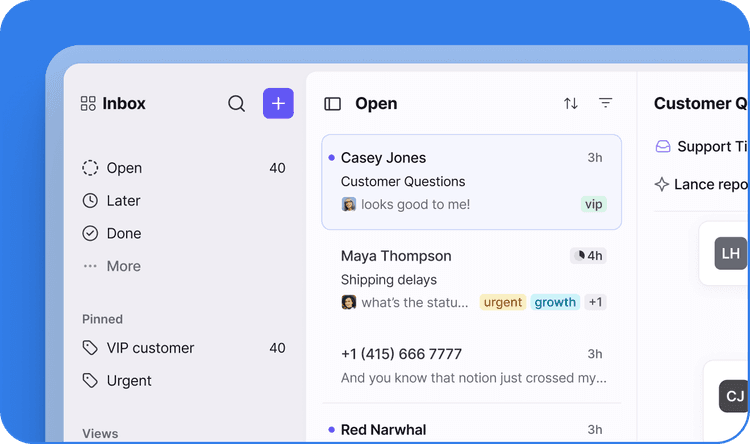
Here’s what Front looks like in day-to-day use:
2. Zendesk
Zendesk is designed to structure and scale customer support through a ticket-based system.
Type: Ticket-driven help desk and customer support.
Best for: Service teams handling high volumes of support requests while maintaining quality and response speed.
Strengths: Powerful ticket management, automated workflows, knowledge base integration, and reporting and analytics on response metrics.
Limitations: Less suited for proactive outreach, lifecycle marketing, and multi-team workflow coordination beyond standard support.
Why it matters: Turns customer service into a predictable, measurable engagement strategy that fuels resolution-driven interactions.
3. Intercom
Intercom focuses on proactive, personalized engagement across the customer lifecycle.
Type: Omnichannel engagement and lifecycle messaging.
Best for: Teams prioritizing proactive communication, in-app messaging, and personalized outreach in an omnichannel environment.
Strengths: Conversational AI, targeted messaging and AI-powered agents that automatically resolve queries and address customer needs.
Limitations: Workflow coordination is not designed for managing complex, multi-department processes.
Why it matters: Lets teams scale campaigns and outreach so they connect with customers at key points in their lifecycle.
4. Salesforce Service Cloud
Salesforce Service Cloud connects customer engagement directly to CRM data and revenue operations.
Type: Data-driven CRM with service engagement.
Best for: Teams that need engagement tightly integrated with customer records, revenue tracking, and account management.
Strengths: Deep CRM integration, automated workflows, robust analytics, and enterprise-grade customization.
Limitations: Time-consuming setup; less flexible for cross-team, non-sales coordination without extra tools.
Why it matters: Helps teams build engagement strategies that are anchored in customer history, account health, and lifecycle insights.
5. Kustomer
Kustomer is built to bring customer conversations together across teams within a single, unified timeline.
Type: Multi-team, collaboration engagement platform.
Best for: B2B and high-touch service teams that need to coordinate conversations across multiple channels, departments, and customer workflows.
Strengths: Centralizes email, live chat, and social media into a single timeline; automates repetitive tasks; and provides context-rich customer histories.
Limitations: Less capacity for campaign-driven engagement and requires integrations for advanced lifecycle campaigns or CRM-heavy workflows.
Why it matters: Makes coordinated engagement possible so teams can manage customer interactions without losing context or efficiency.
Choosing customer engagement tools that match how you work
The “right” customer engagement tool isn’t the one with the longest feature list or the flashiest marketing. It’s the one that matches how your organization actually engages with customers.
Even strong strategies can strain under growing customer volume, but choosing a tool that fits your daily reality is what makes engagement sustainable.
Here are a few key considerations when evaluating options:
Evaluate how teams collaborate on customer work: Does the software preserve context and make handoffs seamless? Or, does it leave teams in silos, forcing manual tracking and duplicated effort? The best tools help everyone stay in sync.
Assess the platform’s approach to complexity: Can it handle multi-channel workflows? Some platforms make coordination easy at scale, while others slow teams down.
Consider integration depth vs. integration breadth: Some tools connect deeply with a few systems; some offer lighter integrations across many. Decide which approach supports your current workflows best.
Understand the automation philosophy: Does the platform automate repetitive tasks without reducing flexibility, or does it enforce rigid processes that slow your team down? The right tools enable efficiency but don’t lock you into a fixed path.
Once you know how customer engagement should work in practice, it’s much easier to identify the right operational model and choose the tool that can execute it effectively.
Strengthen your customer engagement strategy with Front
Customer engagement is built through ongoing relationships, and the right tools help sustain those relationships under real-world conditions.
Front keeps teams, tools, and customer conversations aligned across multiple B2B workflows. Unlike software designed for marketing campaigns or support queues, Front treats engagement as an operational practice — one where channels and handoffs intersect every day. The result: faster response times, more robust context, and consistent service, even at scale.
For example, technology company Instructure used Front to unify its customer-facing and operations teams. The result was roughly 10 hours saved per employee each week. That was made possible by streamlining shared inbox workflows and automations — allowing teams to devote that time to higher‑impact customer engagement.
See how Front can simplify B2B engagement for your team. Request a demo today to see it in action.
FAQs
What role do AI assistants play in customer support?
AI assistants are a support team’s first line of defense; they give customers instant answers to simple FAQs and set the stage for human agents. That way, your team can bypass repetitive tasks and focus their energy on solving complex or time-sensitive problems.
How do customer engagement tools differ from help desk software?
Engagement tools are relationship builders. They help support teams deliver proactive, personalized communication throughout the customer journey. Help desk software is more reactive, stepping in only after a customer reaches out with a problem.
Can one tool handle both support and operations teams?
Yes. Modern customer engagement tools bring ticketing, automation, and collaboration together so support and operations teams can work from the same system — speeding up customer support and keeping internal tasks organized in one place.