



Compare the best email ticketing systems in 2026. See features, pricing, pros, cons, and use-case to choose the right solution for B2B support teams.
Companies don’t scale by simply putting in more hours. They scale by building smarter systems that turn everyday interactions into repeatable, high-quality outcomes.
In high-performing operations teams, clarity replaces chaos. They rely on shared visibility, clear ownership, and smooth handoffs that eliminate the need for late-night heroics.
For B2B organizations, an email ticketing system is a critical part of that foundation. Ticketing tools — whether a shared mailbox or a full plan like Zendesk — turn reactive service into coordinated action. When implemented well, these systems drive accountability, team alignment, and ultimately, business growth.
This guide compares the top email ticketing tools built for modern B2B teams, helping you scale support without sacrificing performance or control.
What makes an email ticketing system work for B2B operations?
An email ticketing system turns incoming requests into organized, trackable tickets. Instead of juggling multiple inboxes, it automatically captures messages, assigns ownership, and logs customer interactions in a centralized workspace.
These tools also route inquiries to the right team members and maintain a clear audit trail, so nothing gets buried and handoffs stay visible. Customers get faster, more relevant replies. Operations teams get accountability and clarity, even when workflows get complex.
Key B2B outcomes of implementing email ticketing include:
Greater visibility across support operations: Leaders can track workloads, response times, and resolution trends in real time.
Fewer bottlenecks: Replace messy inboxes with structured ticket management workflows.
Improved cross-functional alignment: Connect support, sales, and customer success teams inside one centralized system.
Stronger accountability and SLA performance: Automated routing and escalation rules to handle time-sensitive inquiries efficiently.
A consistent customer experience: Standardized processes ensure quality support that scales as ticket volume grows.
The right email ticketing system turns everyday email management into a strategic operational engine, helping B2B teams resolve requests faster and coordinate more effectively.
10 best email ticketing systems: Comparisons and reviews
Below, we break down the leading email ticketing systems for B2B teams — from full-scale customer operations platforms to enterprise help desks.
Customer operations platform
Front
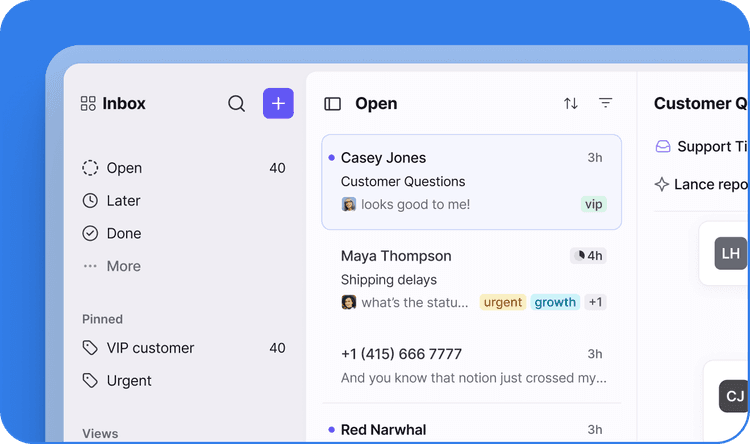
Front takes a different approach from traditional ticketing systems. While most platforms are built around ticket queues, Front works as a customer operations platform — keeping teams, tools, and customer conversations in sync.
Rather than simply tracking tickets, Front centralizes email, SMS, chat, and customer relationship management (CRM) data into collaborative workflows. The result? You can coordinate the entire operational layer behind customer relationships — not just manage a queue.
Key features:
Universal inboxes with internal commenting for real-time team collaboration
Workflow automation and intelligent routing rules
AI-assisted drafting, conversation summaries, and suggested replies
Pros:
Built for cross-team and cross-channel collaboration
Combines ticketing with deep account context for smarter support
Highly customizable workflows tailored to complex operations
Cons:
Search functionality could be stronger
Feature set may feel excessive for smaller B2C teams with simpler needs
Pricing: Paid plans starting at $25/seat/month
G2 rating: 4.7/5
Enterprise help desk software
Zendesk
Zendesk is built for high-volume, multi-department workflows. Beyond converting emails into trackable tickets, it automates routing, coordinates cross-team handoffs, and provides real-time visibility into who’s working on what. The depth of automation and reporting makes Zendesk a go-to choice for B2B teams that need control and scalability.
Key features:
AI-powered bots and self-service tools that reduce repetitive work
Extensive app marketplace for integrations across sales, support, and operations
Comprehensive reporting and analytics to track performance and workload
Pros:
Omnichannel routing and deep integrations
Highly customizable workflows and collaboration features
Scales well for global enterprises and complex operations
Cons:
Setup can be complicated and time-intensive
Pricing for advanced features isn’t always transparent
Pricing: Paid plans starting at $19/seat/month
G2 rating: 4.3/5
Salesforce Service Cloud
Salesforce Service Cloud connects ticket management with sales and account data so teams can see the full customer journey in one place. Instead of jumping between systems, everything from support cases to deal history lives within a shared view.
It’s a good fit for enterprises already using Salesforce, especially those that want automated routing and service-level agreement (SLA) tracking without losing sight of customer relationships.
Key features:
AI-powered case routing and workflow automation
Omnichannel support across email, chat, phone, and social channels
Advanced reporting dashboards for performance and operational insights
Pros:
Complete visibility across the entire customer lifecycle
Highly customizable to match complex workflows
Strong enterprise-level security and compliance
Cons:
Steep learning curve for new users
Interface can feel click-heavy and complex
Pricing: Paid plans starting at $25/seat/month
G2 rating: 4.4/5
ServiceNow
ServiceNow is built for IT service management and complex enterprise workflows. Its strength lies in managing large-scale, cross-functional operations with advanced automation, approvals, and reporting. That makes it ideal for organizations that need to coordinate internal teams and external stakeholders.
Key features:
IT-focused ticketing tools built for service management
Powerful workflow automation engine for approvals and process orchestration
Incident and problem management to track and resolve issues at scale
Pros:
Cloud-native platform with enterprise reliability
Scales across global operations and multiple teams
Highly configurable for specialized workflows
Cons:
Performance can be slow to load
Customization often requires specialized expertise
Pricing: Based on enterprise-level subscription model
G2 rating: 4.4/5
Freshdesk
Freshdesk is a flexible help desk solution that scales alongside growing enterprise teams. It balances an intuitive, user-friendly interface with strong automation tools for ticket routing, SLA management, and workflow orchestration. Teams using Freshdesk can coordinate work and share ticket ownership.
Key features:
Advanced AI (Freddy) for ticket triage and response suggestions
Centralized customer data across channels for connected support
Flexible ticketing and collaboration tools to match team workflows
Pros:
Intuitive interface that’s easy for new users
Competitive pricing for enterprise-scale operations
High feature density without added complexity
Cons:
Limited customization compared to more complex platforms
Integrations can feel clunky or restricted
Pricing: Paid plans starting at $19/seat/month
G2 rating: 4.4/5
Mid-market ticketing tools
Zoho Desk
Zoho Desk stands out for its context-aware AI (Zia), deep integration with the Zoho ecosystem, and “Blueprints” that guide teams through automated workflows. It acts as a multi-channel hub, giving teams full visibility into every support ticket while offering deep customization and affordable scaling for B2B operations.
Key features:
AI assistant (Zia) for ticket triage and insights
Blueprint workflow automation to standardize complex processes
Multichannel support and self-service options for customers
Pros:
Highly scalable and feature-rich for growing teams
Affordable option for small to midsize businesses
Built-in community forums to enhance self-service
Cons:
Noticeable learning curve for new users
Interface can feel cluttered with advanced features
Pricing: Paid plans starting at $14/seat/month
G2 rating: 4.4/5
Kustomer
Kustomer is an AI-native, omnichannel CRM platform that unifies customer data and context into a single, chronological timeline. Unlike traditional ticket-based systems, it’s organized around the customer — providing teams with full visibility into the entire journey and the ability to leverage AI for automated support across channels.
Key features:
Consolidated customer timeline for full context
AI-native architecture for smarter automation and insights
No-code/low-code workflow automation to streamline complex processes
Pros:
Strong omnichannel support across email, chat, SMS, and more
Flexible automation to adapt to diverse operational workflows
Highly customizable to meet specific B2B requirements
Cons:
Higher cost compared to alternatives
Performance can lag at very high scale
Pricing: Paid plans starting at $89/seat/month
G2 rating: 4.5/5
Jitbit
Jitbit offers a simple ticketing system with email-based workflows and flexible deployment options, including SaaS and on-premise. For self-hosted teams, it offers a one-time license with unlimited users, giving organizations greater control over their data and a no-fuss help desk experience.
Key features:
Cloud and self-hosted options to suit different team needs
AI-powered suggestions to improve ticket handling efficiency
More than 500 integrations for connecting with other business tools
Pros:
Intuitive, user-friendly interface
Built-in live chat for real-time customer support
Robust knowledge base to enable self-service
Cons:
Lacks the enterprise-level depth needed for large-scale operations
Reporting capabilities are limited compared to more robust platforms
Pricing: Paid plans starting at $29/seat/month
G2 rating: 4.3/5
Shared inbox solutions
Help Scout
Help Scout combines the familiarity of a traditional inbox with the structure B2B teams need to manage tickets and keep workflows organized. Its clean interface and self-service “Beacon” tool make it a solid choice for small to midsize teams that value thoughtful, customer-first service over metrics-driven ticketing.
Key features:
AI-powered drafting and summarization for faster responses
Live chat and embedded support widget for real-time assistance
Searchable self-service help center for fast, independent issue resolution
Pros:
Effective collaboration tools for small teams
Minimal training required to get started
Affordable option tailored for growing businesses
Cons:
Limited customization options
Mobile app can be buggy or inconsistent
Pricing: Paid plans starting at $25/seat/month
G2 rating: 4.4/5
Hiver
Hiver turns Gmail into a collaborative customer service hub, embedding ticket management directly within Google Workspace. Teams can assign and manage emails, chat, and phone interactions from a familiar interface, without learning a new system. Hiver is a solid option for B2B teams that want to collaborate within the tools they already use.
Key features:
Automated task assignment
Comprehensive analytics for tracking performance and response times
Customer feedback surveys to gather insights and improve service
Pros:
Quick onboarding with minimal learning curve
24/7 vendor support for reliability
SLA management to maintain service standards
Cons:
Limited functionality beyond email
Performance can lag at high ticket volumes
Pricing: Paid plans starting at $25/seat/month
G2 rating: 4.6/5
How to pick the best email ticketing system
As you evaluate different ticketing tools, look for platforms that can help you:
Centralize: Consolidate all emails, chats, and support requests in one place to prevent duplicate tickets and ensure no details get lost or overlooked.
Automate: Let the system handle the repetitive work — assigning tickets, flagging urgent requests, and sending canned responses to common questions.
Unify channels: Keep every interaction connected to the right account and request, no matter which channel your customer uses.
Collaborate: Use internal notes, tagging, and mentions to chat directly within tickets, keeping context intact while avoiding endless forwarded emails.
Track performance: Use dashboards and reports to monitor ticket volume and response times at a glance, helping you spot bottlenecks or recurring issues.
Scale: Choose a platform that can grow with your team — handling more tickets, more users, and more channels — without adding drag to operations.
The right email ticketing system serves as your team’s operational backbone, helping deliver faster and more consistent customer support as your business scales.
Why Front built a customer operations platform beyond email ticketing
Traditional email ticketing systems solve important baseline needs: They centralize inquiries, track requests, and support team collaboration.
But for B2B organizations with multi-stakeholder workflows, those tools quickly hit their limits. When customer issues span billing, fulfillment, and account management, you need a lot more than ticket tracking — you need operational orchestration.
That’s where Front comes in. Front’s customer operations platform combines ticketing with workflow automation so teams can manage B2B processes without losing context or efficiency.
With Front, your team can:
Catch up instantly on long message threads.
See ticket resolution metrics and team performance in real time.
Simplify ticket tracking with a centralized inbox.
Route messages automatically to the right person or team.
Front gives teams the tools they need to scale without chaos — keeping every conversation and task organized in one shared workspace.
Request a demo to see it in action.