



Discover key features to look for in complaints management software, compare the best options for 2026, and learn how to choose the right solution.
When customer complaints span teams and channels, knowing who owns what can get fuzzy. Context gets lost, and dropped follow-ups become almost inevitable. Complaints management software is designed to help you avoid these issues by pulling customer messages into a centralized platform.
Below, we’ll walk you through the features to look for in complaints management software, demonstrate how these platforms help you handle complex complaints with ease, and compare the best options on the market for 2026.
Top 8 complaints management software for 2026
Here’s how eight of the best complaint management software stack up.
1. Front
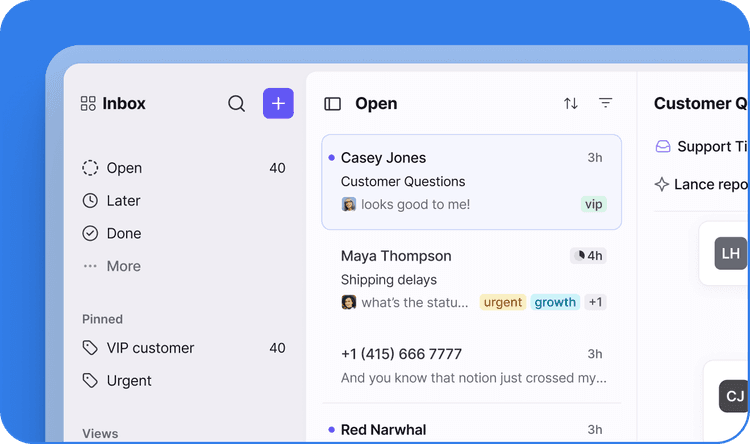
Front is a customer service platform that helps manage the high-stakes reality of B2B service, making it easy for teams to collaborate on customer conversations. It’s more than a ticketing solution — Front serves as a single, centralized hub for every team member, channel, and workflow, helping support reps turn complaints into action.
Pricing: The Starter plan targets single-channel support at $25/mo per seat. The Professional plan is designed around omnichannel support and automation, starting at $65/mo per seat. The Enterprise plan offers advanced AI tools and begins at $105/mo per seat.
Current G2 rating: 4.7/5 (2,406 reviews).
Best for: Mid-market B2B teams looking to combine team communication and customer support in one platform.
Key features: Shared inboxes for consistent context across channels, assignments for clear task ownership and collaboration, service-level agreements (SLAs) for quality responses, and AI Copilot for faster complaint responses.
2. Zendesk
Zendesk is a customer service and sales platform that unifies all communication channels in one dashboard. Its AI features manage workflows and evaluate agent performance. A customer service industry veteran, Zendesk includes a large app marketplace and extensive integrations.
Pricing: Plans range from $19/mo per agent to $169/mo per agent. Zendesk’s AI Copilot is an add-on, with bundle plans ranging from $155/mo per agent to $209/mo per agent.
Current G2 rating: 4.3/5 (6,683 reviews).
Best for: Enterprise teams that already use ticket-heavy workflows and are familiar with Zendesk’s ecosystem.
Key features: Unified ticketing, omnichannel customer support and CRM, and a self-service knowledge base.
3. Freshdesk
Freshdesk is an AI-powered customer service platform built to centralize support channels and ticketing. Its AI agents answer common queries, though Freshdesk’s main strength is traditional ticketing workflows.
Pricing: From $19–$89/mo per agent for customer service and from $9–$59/mo per user for the customer relationship management (CRM) tool.
Current G2 rating: 4.4/5 (3,632 reviews).
Best for: Small teams looking for a simple, ticket-based solution.
Key features: Freshdesk Command Center omnichannel dashboard, ticketing workflows, AI-powered replies, and handoffs for repeated queries.
4. Salesforce Service Cloud
Salesforce Service Cloud is a CRM platform that automates case routing and complaint responses and brings all communication together in a single workspace. The insights you gather from customer interactions can also be used to inform your sales pipeline.
Pricing: In addition to a free plan, Salesforce Service Cloud offers a Starter Suite plan, starting at $25/mo per user, and a Pro Suite plan, starting at $100/mo per user.
Current G2 rating: 4.4/5 (7,187 reviews).
Best for: Medium-to-large teams that handle large-volume complaint resolution requests and are comfortable with the enterprise-level complexity of the Salesforce ecosystem.
Key features: Incident detection and resolution, AI-powered automated responses, a shared workspace, and analytics support.
5. HappyFox
HappyFox is an AI-driven help and service desk platform that supports ticketing workflows and comes with its own knowledge base and SLA tracking capabilities, all in a unified interface.
Pricing: Agent-based pricing ranges from $21/mo to $89/mo per agent, while pricing with unlimited agents costs $1,599–$4,799/mo.
Current G2 rating: 4.5/5 (137 reviews).
Best for: Mid-market IT teams that want to automate operations without complex deployment.
Key features: Ticket management, task and workflow automation, and AI agents.
6. Zoho Desk
Zoho Desk offers omnichannel customer support, task automation, and full customer history to help agents work more productively. The platform’s AI handles complaints by auto-tagging, summarizing, and surfacing answers based on past tickets.
Pricing: Four different plans available, each based on company size and complexity and priced at $7/mo to $40/mo per user.
Current G2 rating: 4.4/5 (7,237 reviews).
Best for: Medium-to-large teams that need automated workflows and a deep integration stack.
Key features: AI agents, multiple support channels, accessibility controls, and feedback management.
7. TeamSupport
TeamSupport is a B2B customer success platform that focuses on omnichannel customer support and onboarding. Its knowledge base and self-service options help agents manage tasks more efficiently.
Pricing: The Starter plan is $45/mo for up to five users. The Professional plan is $65/mo for unlimited users. The Scale plan is $85/mo for unlimited users and supports automation.
Current G2 rating: 4.4/5 (885 reviews).
Best for: Growing B2B teams that need solid support essentials and room to scale.
Key features: Ticket management, AI agents, self-service support, and automated workflows.
8. ProProfs Help Desk
ProProfs Help Desk comes with shared inboxes that allow teams to use AI for faster ticket resolution. The platform also centralizes issues from multiple channels and allows support reps to easily generate reports to track efficiency.
Pricing: Free for up to two users. Paid plans are $19.99/mo per user.
Current G2 rating: 4.7/5 (18 reviews).
Best for: Small businesses that want to use simple complaint management system features without an enterprise-level price tag.
Key features: AI help desk, ticket management, and omnichannel support.
4 key complaints management features to look for
Not all complaints management software platforms are right for every organization, but there are a few features worth keeping an eye out for, no matter your business needs.
Clear ownership and escalation paths
When dealing with complaints, even a single slip-up can create chaos. Keeping track of who owns which customer messages keeps complaints from being left unassigned or getting lost between teams. Auto-escalation when SLAs are at risk is also a valuable feature, giving management direct visibility into case status.
Centralized complaint intake across channels
If teams can view all context in one place, regardless of where it originated (email, chat, SMS, and so on), they’re able to provide a better overall quality of care. Complaints management apps can avoid agents switching between platforms, leading to improved response times and more accurate reporting across all touchpoints.
Full conversation history and context
When support reps can see the entire conversation thread, they don’t have to worry about repeating themselves when ownership or channels change. Root cause analysis is handled far more efficiently, and new team members can get up to speed on complex queries quickly.
Structured follow-up and resolution confirmation
With structured follow-ups, you don’t have to worry about complaints reopening because someone forgot to confirm a resolution. Customers get a consistent experience while teams can prove issues were resolved to satisfaction. Your complaints software should collect and maintain detailed records while automating compliance documentation.
How AI helps teams stay coordinated on complex complaints
AI support isn’t a must-have for complaints tracking software, but it can seriously reduce the amount of legwork support agents have to do. Here are a few ways it helps.
Automatic complaint categorization
AI can analyze incoming complaints and identify the reasons a customer has reached out, whether it’s problems with billing, products and services, deliveries, or IT — then categorize them automatically. The result is faster triage, accurate routing to specialized teams, and analytics that surface trending issues.
Context-aware response drafting
AI speeds up repetitive work — and can even handle some of it entirely — freeing your team to focus on the complex complaints that need real attention. By generating responses based on conversation history, knowledge base content, and past resolutions of similar complaints, AI protects against agent burnout. Built-in protections still keep human oversight for complex situations that need an extra layer of judgment.
Quality assurance at scale
With brand guidelines in place, AI can check for tone, professionalism, and policy compliance. It can also help with early detection of problematic interactions, which can then be corrected by humans, who always have the final say.
Handle complex complaints and stay in synch with Front
Front’s three core capabilities keep teams compliant and resolutions coordinated. These are:
AI-powered organization (Topics and Copilot): Front’s Topics integration automatically categorizes complaints by contact reason and power routing rules, while Copilot drafts context-accurate responses for team review. Click here to see both in action.
Workflow automation: Automated routing based on complaint type, escalation rules for SLA management, and structured follow-up workflows prevent complaints from falling through the cracks.
Live chat and omnichannel support: Real-time complaint intake integrates with email, SMS, live chat, and other channels in a unified workspace, so context is never lost.
See how Front streamlines complaints management by requesting a demo today.
FAQs
What metrics should I track to measure complaint management performance?
Track resolution time, first response time, SLA compliance, and escalation rate to see how efficiently your complaint management software handles issues. You should also monitor customer satisfaction scores (CSAT), repeat complaint rate, and root cause trends to measure service quality and identify recurring problems your system should help reduce.
How can I prevent complaints from getting lost during team handoffs?
Look for systems that preserve full conversation history and context, enable team collaboration through comments and @mentions, and provide clear assignment and ownership tracking. This will ensure that nothing gets dropped when complaints move from an initial response to escalation, and agents won’t need to ask customers to repeat information.