


Compare the top omnichannel customer service solutions and providers built for complex B2B operations managing multiple channels.
When your customers reach out by email, chat, phone, and in-app message — sometimes about the same issue — things can fall through the cracks fast. Multiply that across departments, systems, and stakeholders, and it gets even harder to keep track of who said what and where.
That is exactly the problem that omnichannel solution providers solve. They pull every conversation into one place so your team can see the full picture, respond faster, and stop juggling tabs.
But not every platform is built for the kind of complexity B2B teams deal with daily. The right one should be:
Conversation-first, not ticket-first
Designed for complex, multi-team workflows
Able to preserve context across handoffs
Capable of system-level visibility and reporting
Deeply integrated with core tools
Read on for the top platforms that can handle real-world B2B demands.
Top 10 omnichannel customer support platforms in 2026
Consider the following omnichannel customer service solutions leading the way this year.
Conversation-first omnichannel platforms
Front
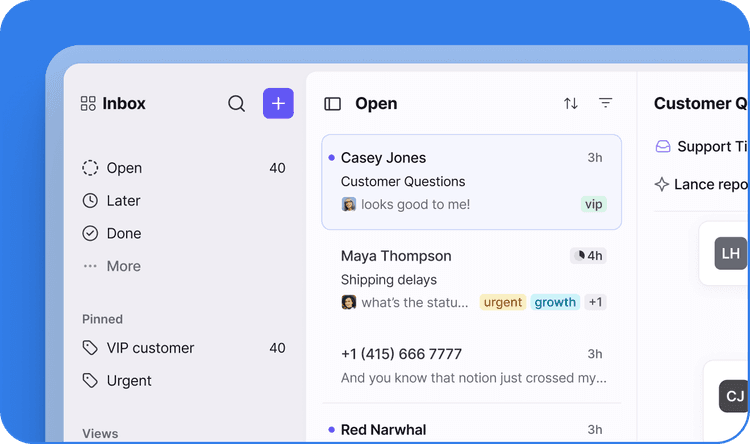
Front is a customer operations platform built for B2B. It keeps teams, tools, and conversations in sync so you can easily scale operations without losing the human touch. Front treats conversations as living threads, making it a strong choice for multi-team collaboration and high-touch customer relationships.
Interactions feel one-to-one, even at high volume
One workspace connected to your existing tools
Faster responses and higher customer satisfaction (CSAT)
Pricing: Paid plans starting at $25/seat/month
G2 rating: 4.7/5
Missive
Missive is an omnichannel messaging platform that combines email, real-time chat, and automation into a single workspace. Teams can co-draft and comment on messages together, which cuts down on silos and keeps everyone aligned without heavy ticketing workflows.
Shared inboxes for email, chat, and social channels
Internal chat and comments inside conversations
Real-time collaborative drafting
Pricing: Paid plans starting at $14/seat/month
G2 rating: 4.6/5
Ticket-first help desk platforms
Freshdesk
Freshdesk pulls email, chat, and social conversations into a unified ticketing system. Thanks to its collaborative framework and AI-driven automation, Freshdesk enables faster response times and improves efficiency without losing sight of the customer experience.
Service-level agreement (SLA) management and automations
Knowledge base and self service tools
Standard reporting and dashboards
Pricing: Paid plans starting at $19/seat/month
G2 rating: 4.4/5
Zendesk
Zendesk has an AI-powered platform that unifies email, chat, voice, and social support in a single interface. With automation trained on billions of interactions, Zendesk helps teams scale and personalize the customer journey across high-volume B2B operations.
Native AI-powered customer experience
Industry-leading scalability
Enterprise-grade reporting
Pricing: Paid plans starting at $19/seat/month
G2 rating: 4.3/5
Hiver
Hiver turns Gmail into a powerful customer service platform, letting B2B teams manage support directly from their inbox. It transforms shared accounts into collaborative workspaces with email delegation, collision alerts, and AI-powered automation. It’s a natural fit for companies already using Google Workspace.
Gmail-native ticket management
Collision alerts
Automated task delegation
Pricing: Paid plans starting at $25/seat/month
G2 rating: 4.6/5
Help Scout
Help Scout has a customer-first philosophy of swapping ticket numbers for human-centric inboxes that look and feel like a personal email to the customer. Its intuitive interface requires almost no training, making it a good option for small to midsize B2B teams that want to scale support without enterprise-level software.
Focus on usability
Customer-centric reporting
Proactive chat support
Pricing: Paid plans starting at $25/seat/month
G2 rating: 4.4/5
CRM-native omnichannel systems
HubSpot Service Hub
HubSpot Service Hub is built into the HubSpot CRM, giving B2B organizations a single source of truth across marketing, sales, and support. By connecting customer service with real-time customer relationship management (CRM) data, it helps agents deliver personalized experiences that speak directly to customer needs.
CRM-native ticketing and conversations
Built-in feedback and CSAT tools
Customer portal and knowledge base
Pricing: Paid plans starting at $9/seat/month
G2 rating: 4.4/5
Salesforce Service Cloud
Salesforce Service Cloud is an enterprise-grade, AI-powered platform built for complex B2B operations. It organizes email, phone, and social interactions into a single, user-friendly console, providing deep customization and visibility across the entire customer journey.
360-degree customer view
Scalability and customization
Integrations with the Salesforce ecosystem
Pricing: Paid plans starting at $25/seat/month
G2 rating: 4.4/5
Kustomer
Kustomer has a CRM-first platform that replaces traditional ticketing with person-centric customer timelines. By consolidating email, chat, voice, and social interactions into a single view, agents get a complete history of the customer journey. Kustomer is well-suited for B2B companies managing high-volume, multi-channel engagement.
Unified customer timeline
Embedded AI and native AI voice
No-code workflows
Pricing: Paid plans starting at $89/seat/month
G2 rating: 4.5/5
Conversational customer engagement platforms
Intercom
Intercom integrates live chat, automation, and help desk tools into a single workspace. Its proprietary AI agent, Fin, instantly resolves up to 50% of queries, while more complex issues are rerouted to human agents. Overall, Intercom offers a balance of automated support and high-touch personal service.
AI-powered agent
In-app and outbound messaging
Conversational support funnel
Pricing: Paid plans starting at $29/seat/month
G2 rating: 4.5/5
6 features to look for in a customer communication platform
Scaling B2B customer operations requires tools that provide total visibility across the customer journey — not just isolated inbox metrics. The best omnichannel customer support platforms help keep teams aligned and in control across every channel and touchpoint.
Here are the features to look for when choosing a software partner:
All your channels in one place: Email, SMS, social, chat — it should all live in one shared workspace. That way, your team stays in the loop and customers do not have to repeat themselves.
Automated workflows that keep work moving: The best platforms let you automate routine steps — such as routing, assignments, and follow-ups — so handoffs are clean and nothing gets stuck.
Collision detection and clear ownership: You need to see who’s working on what in real time. That prevents duplicate replies and keeps accountability clear.
Reporting that shows the full picture: Look for dashboards that track response times, workload, SLA performance, and team capacity so leadership can tie customer operations back to business results.
Integrations that bring context into the conversation: When agents can see CRM records, billing details, and account history without switching tabs, they resolve issues faster and with more accuracy.
AI that speeds things up without taking over: AI is most useful when it handles the repetitive work — summarizing threads, drafting replies, sorting conversations — while your team stays in control of the complex operations.
These features ensure your customer communication platform supports real B2B complexity, giving your team confidence as you scale.
Deliver top-tier customer support across all channels with Front
Growing your support operations shouldn’t mean losing clarity or customer connection. Front enables teams to deliver fast, personalized support across every channel while keeping conversations and workflows fully aligned.
Here’s how Front helps you scale efficiently:
Route queries to the right person or team so customers get answers faster.
See full customer details and conversation history, summarized by AI.
Increase responsiveness and ensure SLA compliance.
Provide omnichannel support by linking conversations with helpful resources.
Stop digging through threads and start connecting with people. Front helps B2B teams resolve inquiries quickly on every channel, turning your omnichannel strategy into a competitive advantage.
Request a demo to see Front in action.
FAQs
What is multichannel vs. omnichannel?
Multichannel means offering support across email, chat, SMS, and socials, but teams often handle each channel separately. An omnichannel strategy connects multiple channels in a unified workspace and gives your team a complete view of every customer interaction.
What are the 4 C’s of omnichannel?
Omnichannel customer service is rooted in 4 C’s: consistency, convenience, context, and communication. These 4 C’s ensure every touchpoint aligns with your brand and help teams collaborate effectively to resolve issues faster.
How do omnichannel platforms handle multi-team workflows in B2B operations?
Omnichannel platforms coordinate tasks and conversations across teams and systems, preventing duplicated work and lost context. Features like workflow orchestration, collision detection, and integrated data make sure every team sees the full customer journey and can act quickly without any bottlenecks.