



Get a customer success playbook with templates for onboarding and renewals, built to help B2B teams scale without losing visibility.
Most customer success playbooks are treated as template libraries — a few checklists, a Notion doc, a slide deck collecting dust. But for B2B teams operating at scale, a playbook isn’t just documentation. It’s how the work actually runs.
Customer success teams juggle several high-stakes motions in parallel: onboarding, escalation, and value delivery. Without a structured system, every team ends up creating its own process. Variability creeps in, reliability drops, and customers feel the inconsistency — which makes retention harder to win.
Scaling retention requires repeatable lifecycle motions that are clearly defined, visible across the organization, consistently owned, and regularly reviewed. That’s what a customer success playbook should provide in B2B: a single source of truth standardizing how work gets done.
This guide covers cover what a customer success playbook is, the core types of playbooks teams rely on, and how to build one that doesn’t break down at scale.
Key takeaways
A B2B customer success playbook is an execution system, not a reference doc — it defines how lifecycle work actually runs, not just what it looks like on paper.
Every effective playbook needs five elements: triggers, ownership, workflow, completion criteria, and inspection signals.
Focus your playbooks on the high-coordination motions: onboarding, renewal, churn mitigation, QBRs, and expansion. You don’t need one for every scenario.
Most playbooks break at scale when conversations, context, and signals fragment across tools — not because teams stop caring.
Keeping every team, tool, and customer conversation in sync is what makes playbook execution hold together as accounts grow.
What is a customer success playbook?
A customer success playbook is a blueprint for running lifecycle workflows across onboarding, adoption, renewal, and expansion. It defines what kicks off each workflow — a contract signature, a new stakeholder, a drop in usage — who owns it, the steps involved, and the criteria for completion, such as time-to-value or adoption targets.
But customer work isn’t always linear, and an effective playbook anticipates that. If a workflow needs to reopen due to churn risk or stakeholder change, the playbook outlines how to re-engage without losing context.
That kind of structure is necessary in B2B industries like logistics or financial services, where customer success is multi-stakeholder, high-context, and long-running. As volume climbs, the playbook keeps work consistent.
A quick distinction: runbooks and scripts document task-level actions; a customer success playbook defines how those actions connect across teams to deliver a consistent customer experience. And that only works when the underlying customer work is shared and visible. When conversations and actions are fragmented across tools, the playbook falls apart with them.
The 5 core elements of an effective customer success playbook
Most playbooks fail for a simple reason — they define stages, but not execution. You’ll find plenty of examples of customer success playbooks that map onboarding or renewal but don’t specify how the work actually starts, moves, and finishes. Without that level of detail, teams improvise.
An effective customer success playbook covers these five elements.
1. Trigger conditions
Every lifecycle motion must start from a defined signal. That could be a contract signature, a drop in usage, or the opening of a renewal window. Triggers remove ambiguity around when work begins and make sure workflows activate the same way across every account.
2. Ownership and accountability
Clearly name who owns each phase, especially at the handoffs. Unclear ownership is where work stalls or gets duplicated. Clear ownership keeps things moving across teams and keeps stakeholders aligned.
3. Step-by-step workflow
Execution should read like a sequence, not a menu of suggestions. Include internal collaboration points. That’s what makes work repeatable at scale, improving customer satisfaction.
4. Completion criteria
Each motion must have measurable end conditions, like adoption targets or stakeholder alignment. Without clear completion criteria, progress is hard to gauge and manage.
5. Signals and inspection
Every workflow needs metrics and health signals leaders can actually review. Inspection is how teams see whether the work is happening as intended and where adjustments are needed.
The essential customer success playbooks across lifecycle
The customer lifecycle loops, overlaps, and reopens. Renewal conversations often start while onboarding is still stabilizing for a new team, and healthy accounts can escalate unexpectedly. In B2B, this is normal — and playbooks give teams a way to run through it with visibility instead of guesswork.
Because you can’t (and shouldn’t) create a playbook for every scenario, focus on the lifecycle motions with the highest coordination risk. Here are the most common types of customer success playbooks:
Onboarding playbook: Onboarding sets the tone for the entire customer relationship. A customer success onboarding playbook must define every step — from the moment a contract is signed or new stakeholders join to when the customer reaches their first piece of repeatable value — not stop when implementation ends.
Renewal playbook: A customer success renewal playbook guides how you secure contract renewals. It lays out how to reinforce your product’s value and address its risks transparently with the customer. Success is measured by a signed renewal and strong engagement through the process.
Churn mitigation playbook: Churn mitigation kicks in as soon as warning signs appear, like declining usage or a champion leaving. Its purpose is to restore stability and confidence in the account.
Quarterly business review (QBR) playbook: QBR playbooks create structured moments for strategic alignment and shared visibility. They succeed when stakeholders leave with a clear understanding of outcomes achieved and the next steps.
Expansion playbook: Expansion playbooks identify and capture growth opportunities within existing accounts. They’re triggered by observed potential — such as increasing adoption or revenue — rather than a calendar milestone.
These playbooks intersect constantly — that’s the nature of the customer lifecycle. The goal isn’t to document every possible scenario, just to standardize the motions where mistakes are costly. Defining the high-stakes work gives teams enough structure to handle the overlaps with confidence.
How to create a customer success playbook
Building a customer success playbook starts with thinking like an orchestrator. You’re designing a system where every customer motion (from onboarding to expansion) flows predictably, even when accounts and complexity grow.
Here’s how to turn that vision into an actionable playbook.
Step 1: Map the customer journey
Lay the lifecycle out end to end, from first touch through renewal and expansion. Mark the handoffs, decision points and value milestones. Seeing the journey on one page makes it obvious where the playbook should step in with guidance.
Step 2: Define success metrics and signals
How will you know whether a motion is progressing as intended or complete? Define success signals to help your team measure progress and spot risks early. These signals often include adoption rates, stakeholder alignment, usage health, or signed contracts.
Step 3: Segment customers
Grouping accounts by size, complexity, or use case allows the team to run motions in a repeatable way while tailoring the level of attention to each segment.
Step 4: Assign ownership and accountability
Who’s responsible for content creation? Who leads customer feedback sessions? Assigning ownership to each stage and clarifying handoffs keeps work from sitting idle between teams.
Step 5: Design execution workflows
Define the sequence of actions, collaboration points, and escalation paths. Focus on coordination and flow rather than scripting conversations. This gives teams flexibility while keeping the customer’s voice at the center of the playbook.
Step 6: Build it into daily operations
Embed the playbook into tools, dashboards, and turn it into a shared routine across teams. The goal is for the playbook to guide real-time work, not sit idle as reference material.
Step 7: Measure and iterate
Use data and signals to continuously refine motions. Adjust for changes in customer behavior, account complexity, and operational load.
When a playbook evolves with the team and accounts it supports, it becomes powerful enough to transform complex customer work into scalable execution.
Why most customer success playbooks break at scale
Playbooks can look perfect on paper, but scale exposes the cracks. Then the account list doubles, every customer has four stakeholders instead of one, and the cracks show up fast.
Usually, the first thing to go is context. Conversation history splinters across emails, chat, and CRM systems, while risk signals rarely reach the team members that need them. When information is scattered like this, teams lose the shared context required to run workflows consistently across accounts. People start guessing, steps get skipped or duplicated, and the playbook stops functioning as a repeatable system.
The failures show up in predictable ways: ownership gaps during handoffs and conflicting communication because no one sees the full picture. Even with dashboards, consistent execution becomes impossible when the underlying work isn’t visible.
Customer success teams need a single operational system that keeps ownership, conversations, and signals connected. Playbooks fail at scale not because teams stop caring, but because the shared, visible context they rely on disappears.
Turn your customer success playbook into daily wins with Front
When customer work fragments, even the best customer success playbooks lose their footing. Running lifecycle motions at scale requires shared infrastructure — one system that keeps conversations, ownership, and signals connected across teams and time.
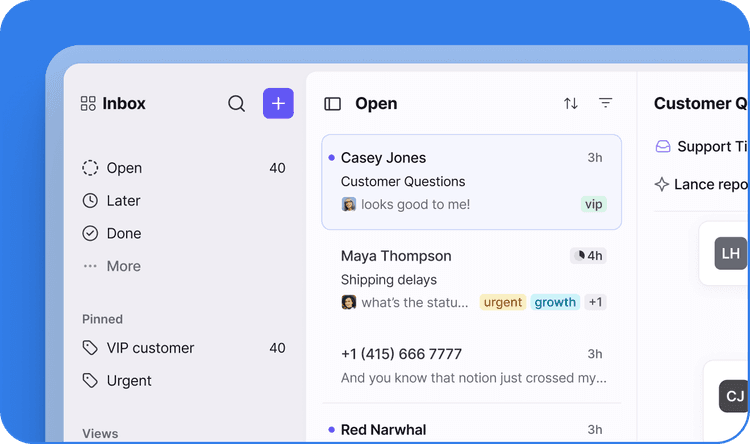
Front is that system. Built for B2B complexity, its conversation-first architecture keeps lifecycle work anchored to the conversation, instead of isolated tickets. Onboarding, renewals, and churn mitigation stay coordinated, no matter how many stakeholders or touchpoints are involved.
As complexity grows, Front keeps motions visible, inspectable, and connected. It unifies tickets and conversations in one workspace, while AI handles routine work and surfaces signals — with your team still in control.
Ready to see how? Book a demo today.