



What separates reliable B2B support teams from the rest? These 11 customer service skills show how strong systems keep quality intact as complexity grows.
A single great support interaction can stop a churn risk in its tracks. A team member with the right customer service skills, who knows how to deliver personalized, context-aware care, could be the difference between losing a key account and renewing it.
In this guide, we share how to improve customer service skills by laying out 11 ways your team can turn problems into long-term success stories.
What sets high-performing customer service teams apart?
As a support or operations leader, you’re constantly balancing two competing forces: team performance and customer satisfaction. Ticket volume climbs. Expectations rise. Headcount stays flat.
Your customers depend on your product to run critical workflows, so when something breaks, it disrupts a chain of work across teams. Great customer service, therefore, is operationally strong, coordinated, and reliable.
The best support organizations share a few characteristics:
Consistent quality across team members: Customers get the same clear, accurate help regardless of who handles the case. Knowledge is documented and operationalized, not dependent on a few experts.
Context-aware communication: When team members understand the customer’s history, setup, and previous issues before responding, repetitive back-and-forth to rediscover context no longer becomes a problem.
Proactive problem resolution: Strong teams identify patterns and eliminate root causes.
Scalability without quality loss: Processes, documentation, and systems are built to handle growth. As a result, service quality holds steady even as volume increases.
Measurable and improving: When performance relies on guesswork, improvement is hard to replicate. Metrics like resolution quality and repeat contacts support continuous improvement.
Test how well your team is performing with our quiz.
The 11 top customer service skills worth developing
A lack of support is one of the biggest drivers of churn — that’s why customer service is so important. But chat channels and hotlines aren’t enough on their own; support reps also need to be armed with the right tools and knowledge to provide the best quality of care.
With that in mind, here are 11 examples of customer service skills you should foster among your support team. To help, we’ve categorized each skill into individual capabilities, collaboration-boosting organizational capabilities, and leadership capabilities for managers.
Individual capabilities
While customer service is a team-wide process, there are skills that individuals can focus on strengthening to benefit the entire operation.
1. Problem solving
The best problem solvers on a support or operations team don’t just close the issue in front of them. They figure out what caused it and whether it will happen again. This will often require them to get creative in how they fix problems — digging in and replicating issues to figure out not only what went wrong, but what the customer was actually trying to accomplish.
Tips to develop this skill:
Encourage your team to always think about the customer’s goal before diving in with a solution. Think about how to reproduce the issue, the root cause behind it, and any long-term solutions.
How it looks in action:
A logistics operations team holds weekly case reviews where staff walk through escalated shipment disputes, identifying whether the root cause was a routing error, a carrier communication gap, or a process breakdown — and updating workflows accordingly.
2. Clear communication
Your team is the first point of contact when a customer reaches out with an issue. How they communicate will set the tone for every interaction that follows. But more than just being patient, caring, and polite when dealing with customers, team members need to advocate effectively for them internally, too. Clear communication with different departments is essential if they need to elevate a problem beyond a simple fix.
That’s two directions to communicate in. The customer-facing one also has two layers.
“Every support interaction involves two parallel conversations: the visible one, including the technical problem, the steps, the outcome, and the invisible one, the customer’s emotional state, your internal reactions, the unspoken needs beneath the question. Most training addresses only the visible portion. We give technical knowledge thorough attention. Emotional skill is left to chance.”
Tips to develop this skill:
Teach support teams the importance of sticking to the point and focusing on what can be done rather than what can’t. Jargon is the enemy of clarity, so avoid using it wherever possible.
Train the order, not just the wording; name the feeling, then solve the problem. As Atkins puts it, "the issue isn’t competence. It’s sequence."
How it looks in action:
Leadership holds a team training workshop where team members rewrite a technical product explanation in plain language, helping them understand the importance of clarity.
A team keeps a shared phrase bank, ready patterns for acknowledging a feeling, normalizing a situation, and taking ownership, so agents aren’t composing from scratch under pressure.
3. Adaptability under pressure
More than just responding to change, adaptability also requires team members to anticipate it. While thorough training and guidelines can manage customer requests consistently, there will always be situations that require reps to go off-script. At times like this, support teams need to formulate a response quickly so that the customer isn’t left stranded.
Tips to develop this skill:
Build adaptability through cross-training, rotating team members across different products, customer segments, and support channels.
How it looks in action:
A client services team member at a financial services firm is walking a customer through an account inquiry, but learns mid-call that the real blocker is a new regulatory requirement. Instead of sticking to the original troubleshooting path, they loop in the compliance team and guide the customer to a resolution that meets the new standard.
4. Product knowledge
Expert knowledge of the company’s products and services will help support teams resolve issues quickly and effectively. To go a step beyond, they should also be aware of any common problems and how to solve them, so when a frustrated customer reaches out, they already know how to de-escalate.
Tips to develop this skill:
Have reps shadow customer journeys by reviewing recorded calls, onboarding sessions, and tickets from different business segments.
How it looks in action:
A support specialist realizes that customers often misinterpret a core product feature. Their attention to detail allows them to create a clear walkthrough, preventing repeated confusion.
5. Tech-savviness
As well as being skilled in customer interactions, support specialists also need the technical know-how to explain complex concepts to customers in terms they can understand. To help them provide the best possible level of service, they’ll also need to learn how to use ticketing systems, video recording software, and AI platforms.
Tips to develop this skill:
Encourage hands-on learning through regular tool workshops and mini-projects. Consider creating cheat sheets to help with common technical issues.
How it looks in action:
To help them develop technical understanding, a manager asks team members to complete a hands-on walkthrough of the product’s new features and document the most common points of confusion they encounter.
Operational capabilities
Teams are only as strong as the processes that guide them. Here are some skills that impact the entire operation — and that everyone benefits from.
6. Collaboration and coordination
Companies with strong collaboration are more likely to share knowledge and flag problems early, especially when the coordination overhead is low. If it’s easier for teams to coordinate the steps required to complete their jobs, like synced systems for the smooth flow of customer data or a clear paper trail of a customer inquiry, the better the customer service.
In fact, making coordination too hard is a recipe for burnout. 47% of B2B businesses that are spending more time coordinating than solving customer problems confirmed losing a top performer to burnout in the past year. Thankfully, this is a completely solvable problem.
Tips to develop this skill:
Create joint sessions between the support, product, and sales teams, encouraging people to review recent challenges and wins together.
Audit where coordination overhead is highest — the handoffs that require the most back-and-forth, the threads where context keeps getting reconstructed. Those are the processes worth redesigning first.
How it looks in action:
The support team notices multiple customers are struggling with a new feature. Seeking a solution, a rep shares examples with colleagues from the product and sales teams. They join a quick sync and help shape a UI tweak that improves users’ experience.
A Director of Client Services is troubleshooting SLA breaches and identifies that the longest period of time a customer is waiting for a reply is when the support team switches from phone to email communication. Follow-up actions are lost across channels, so the Director explores how to integrate the two channels to ensure all the context is captured in the account history.
7. Data analysis and pattern recognition
Rather than only tracking surface-level metrics, your team needs to learn how to interpret data to understand customer behavior and address issues efficiently. Understanding how metrics like CSAT, first response time, and resolution rates connect to business outcomes helps your team move from reporting on performance to actually improving it.
Tips to develop this skill:
Ask your team to learn basic data terms and concepts to help them understand how metrics like expansion revenue or customer satisfaction score (CSAT) impact your business.
How it looks in action:
A rep sets time aside during the week to read customer feedback and comments and look for patterns, comparing them against quantifiable metrics.
8. Consistency
Delivering quality service once is straightforward. Delivering it the same way across every conversation, every channel, and every team member, regardless of volume or complexity, is the skill. Consistency means actively holding a standard rather than assuming it will hold itself. That includes how conversations are closed, how context is handed off between team members, and how customer expectations are set and met.
Tips to develop this skill:
Review conversation histories and customer profiles regularly so your team understands individual account context. Use shared quality benchmarks so everyone is working toward the same standard, not a personal interpretation of it.
How it looks in action:
A client services team at a logistics company introduces a quality checklist for conversation reviews — scoring active listening, resolution confirmation, and handoff clarity. Standards that were inconsistent across team members become measurable and coachable.
Leadership capabilities
Strong leaders make for resilient teams. Although these skills are most easily applied by managers, any team member can employ them to deliver better service.
9. Building accountability systems
Accountability isn’t exclusive to underperforming employees. When team members own their roles and responsibilities, including any wins and mistakes, standards are kept high, and customers receive a better overall experience.
Tips to develop this skill:
Build clear role ownership with measurable outcomes through regular check-ins with individual support staff.
How it looks in action:
A client services manager at a professional services firm assigns a team member to own communication for a newly onboarded enterprise account. When the client flags a coordination gap between delivery and account management, the manager and team member review the handoff process together and update the workflow.
10. Systems thinking
Customer operations don’t fail at the individual level. They fail at the seams. Systems thinking is the ability to see how workflows, teams, and touchpoints connect, spot where handoffs break down, and design processes that hold under pressure. For leaders, it’s the difference between solving problems and preventing them.
Tips to develop this skill:
Map your key workflows end-to-end, identifying where context gets lost or ownership becomes unclear. Look for patterns in escalations. They’re usually a signal that a process needs redesigning, not just a person who needs coaching.
How it looks in action:
A head of operations at a manufacturing company notices a recurring spike in order status inquiries. Rather than adding headcount, she maps the workflow and discovers a gap in proactive communication at a specific handoff point. A standardized update process eliminates the inquiry pattern within a quarter.
11. AI judgment
Knowing when to let AI handle a conversation and when to step in is one of the most consequential decisions a customer-facing team member makes today. AI judgment isn’t about mastering the technology — it’s about understanding which interactions benefit from automation and which ones require human context, accountability, or nuance.
Tips to develop this skill:
Work with your team to define clear criteria for which conversation types go to AI and which stay with a person. Review edge cases together so the boundaries stay sharp as volume and complexity grow.
How it looks in action:
A B2B operations team uses AI to categorize and route incoming inquiries, but team members retain full ownership of complex account issues, compliance questions, and any conversation where the customer relationship is at risk.
How Front gives customer service teams the infrastructure to apply skills at scale
The skills in this guide only go so far without the right infrastructure behind them. A team member with sharp problem-solving instincts still needs context surfaced quickly. A leader building accountability systems still needs visibility into every conversation. Coordination across teams still requires a platform that keeps everyone in sync.
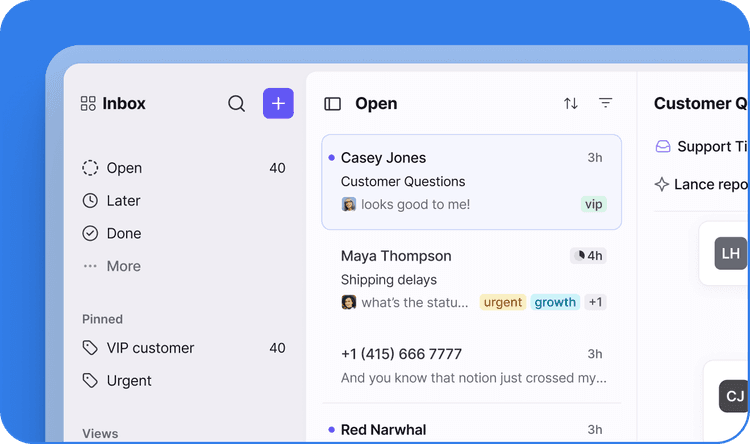
Front is the customer operations platform built for that reality. Its AI handles conversation routing and categorization, surfaces real-time insights, and flags where attention is needed — so your team can focus their judgment on the complex, high-stakes interactions that actually require it. The result is a team that can apply every skill on this list consistently, at volume, without losing quality or connection.
To see how Front works for B2B customer support and operations teams, request a demo today.
FAQs
How do you measure customer service skills across a team?
Customer service skills can be measured using metrics like customer satisfaction (CSAT), first response time, resolution quality, and consistency across interactions. Combining these with call or ticket reviews helps evaluate empathy, problem-solving, and communication skills across the team.
Should you hire for customer service skills or train for them?
You should combine both approaches. Empathy, problem-solving, and communication skills are great skills to look for when hiring new support reps. Once they’re onboarded, teach your team the appropriate product knowledge, tech-savviness, and data analysis skills they need to excel.