



Discover how B2B customer service strategies help high-performing teams coordinate and scale operations to turn complexity into measurable outcomes.
In B2B customer service, success isn’t about closing tickets — it’s about driving real impact across accounts.
When multiple teams, channels, and contracts are involved, one missed handoff can set off a chain reaction. Responsiveness is only one part of the equation when clarity and control determine the quality of an interaction.
In this guide, you’ll learn how to move beyond reactive support and ticket chasing, creating a B2B customer service system where every interaction is informed, handoffs are clearly owned, and outcomes are reliably positive.
Operational challenges B2B teams face at scale
Imagine a key account escalates an issue that’s already moved through two teams and three channels. Everyone involved has context — but none of them have all of it. The response that goes out is slow, incomplete, and out of step with what the customer already told someone else.
This is the everyday reality for B2B companies across industries. Context disappears between threads and the customer is left waiting for someone who can actually help.
These aren’t edge cases — they’re the pressure points that determine whether a B2B operation scales or stalls.
Limited end-to-end visibility across teams and channels
Customers reach out through whichever channel is most convenient to them in the moment — email one day, live chat the next.
As conversations span multiple channels and teams, it becomes challenging to see where work is stalled, overloaded, or at risk, which makes it difficult to act proactively for customers and produce accurate reports.
For B2B customers, who are often entire organizations with multiple users per account, end-to-end visibility is critical. It ensures all stakeholders are aligned and operations are on track for success.
Unclear ownership across handoffs
Slower response times, increased escalations, dropping service-level agreement (SLA) performance — that’s the reality when conversations move between teams or roles without clear ownership.
Who manages the product backlog? Who leads training? Without clearly defined owners, it’s hard to set standards within your organization and even harder to measure impact.
Context loss as work moves across systems
The difference between B2B to B2C products? B2B products tend to be more complex and layered than their B2C counterparts. Customer and operational context spans multiple workflows, security protocols and integrations.
As work moves across systems, that context fragments quickly, forcing teams to re-triage issues and make decisions without the full picture.
Routing and prioritization errors
B2B customers value personalized and accurate answers just as much as fast responses.
And as conversation volume grows, getting the right message to the right team at the right time takes more than just speed. Without strong operational controls, routing, prioritization, and execution errors compound quickly, making issues harder to fix and impacting overall service quality.
4 key practices to maintain control as volume grows
Maintaining control and consistency as volume and complexity increase comes before selecting customer service tools. Building these practices as you scale, however, can be challenging.
Here are four B2B customer service best practices to ensure consistency, high-quality answers, and effective human judgment.
1. Measure performance against SLAs and operational outcomes
Many teams know the risks of relying on vanity metrics, but the conversation often ends there. To truly move the needle, daily execution needs to be tied to metrics that matter at scale.
While “metrics that matter” can feel subjective, those that feed your operational outcomes are easy to identify: response times, SLA compliance, escalation rates, and resolution quality.
These metrics, especially in fast-moving B2B customer support environments, require long-term tracking and work best when treated as inputs rather than end results.
To use them effectively, connect metrics to what happens inside conversations — where handoffs usually break down — and guide teams to prioritize, monitor, and fix critical parts of the customer journey.
2. Design repeatable workflows that hold up under pressure
B2B service providers know that workflows are never a one-and-done fix. Metrics and dashboards can show what happened, but repeatable workflows reveal why it happened and who is responsible for the solution.
Documenting ownership rules, defining handoff logic, automating repetitive tasks, and continuously refining workflows help keep service quality predictable for everyone involved: Your team can answer questions right the first time and customers receive support that directly addresses their needs.
As a result, peak volumes and staffing changes don’t disrupt operations, and unexpected problems remain manageable hiccups — not full-blown crises.
3. Build real-time visibility across teams and channels
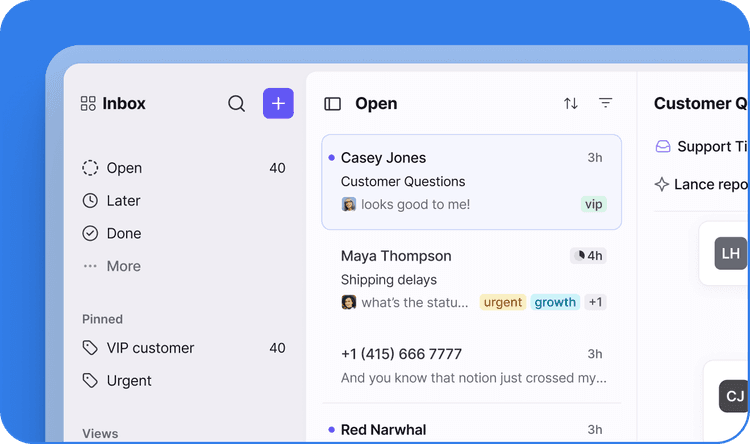
A real-time view of conversation statuses can massively simplify collaboration — and eventually be used as a way to identify customer behavior and patterns quickly.
Agents easily track workload and ownership, while leaders stay on top of team alignment without waiting for the next status meeting or manual reports.
4. Establish clear ownership for every customer interaction
One of the biggest differences between good and great B2B customer service is accountability. A single owner for each customer conversation prevents response delays, duplicate efforts, and missed follow-ups.
When ownership is built into the system — not left to guesswork — it’s far easier to see where the experience shines, where it breaks, and what to change next.
How customer service platforms support B2B operations
Companies integrating software across their operations often need higher-touch customer support and hands-on involvement. Managing complex requests on your own isn’t always easy, especially when you have:
Multiple teams involved in customer interactions
Long-running, high-context conversations
SLA-driven operational requirements
When that’s the case, a customer service platform can bring structure to daily operations. These platforms keep every team aligned, provide visibility into workload and performance, and control AI automation to support humans with judgment-heavy decisions. Front is one such example, designed for environments where coordination matters as much as response time.
Choosing the right B2B customer service approach for your team
Supporting your B2B customer service team requires the right tools. These factors can help you choose a solution that fits your operations:
Channel coverage and integration: Meeting customers where they are is a must, so choose a tool that integrates well with the platforms your customers already use.
Depth of reporting and operational insights: As your customer base grows, so does the complexity of requests and patterns. Select a platform that provides the level of reporting and insights your team needs to keep up.
Workflow coordination across teams: Workflows break down when coordination lags. As volume grows, it becomes more important to surface answers correctly the first time. Pick a platform that enables your team to collaborate in real time and with full customer context.
Ability to adapt workflows as complexity grows: What works today can slow you down tomorrow. Be sure to choose a platform that provides the flexibility to customize your customer service process.
Integration with core business systems: The right customer service tool integrates well with your existing stack. Review integration capabilities or ask during demos to avoid costly workarounds later on.
The right approach brings these elements together, giving teams the structure and flexibility needed to deliver consistent, high-quality outcomes as operations scale.
Go beyond the inbox: Keep every team and conversation in sync with Front
Higher stakes. Higher risk. Higher reward. That’s how customer service operates in B2B companies. Customers expect your team to understand their context, deliver accurate answers the first time, and respond within hours if not minutes.
Meeting those expectations requires more than an inbox. It takes a system that keeps every tool, conversation, and team in sync. Front is built for this level of complexity in customer operations, so you can scale without losing connection or control.
With Front, workflow automation handles the manual work — routing conversations, assigning ownership, and managing SLA-driven actions. Analytics give your team visibility into workload, customer satisfaction, and friction points. Integrations connect your core systems, including customer relationship management platforms.
The result? Your team stays in control and consistent resolutions turn into measurable outcomes.
Keep every conversation connected with Front. Try it for free today.
FAQs
What are common pitfalls when scaling B2B customer service workflows?
The most common mistake isn’t choosing the wrong tool — it’s choosing a tool before you’ve defined what good looks like. Teams that scale into fragmented ownership, missed escalations, and inconsistent data usually have one thing in common: they move fast on software and slow on process.
The strongest B2B customer service examples share a common thread: clearly defined SLAs, documented handoff logic, and structured escalation paths for high-value accounts — all established before a platform was selected. Before evaluating tools, get clear on where coordination breaks down today, what ownership should look like across teams, and what outcomes you’re actually holding yourself accountable to. The right tool becomes obvious once the operational picture is clear. The wrong tool — no matter how capable — will just automate the confusion you already have.
What metrics help leaders spot bottlenecks in multi-team customer service operations?
Key indicators include first response time, time to resolution by team, handoff rates between departments, backlog growth, and SLA breach percentage. If conversations bounce between teams or resolution time spikes after handoffs, you’ve likely identified an operational bottleneck.