



Customer service tiers promise a clean L1 to L3 path. In B2B, most requests branch across teams instead. Here’s how to structure tiers for that reality.
With expert insight from Cat Burston, senior technical support engineer at Front
As companies grow, the move from one-off help desk tickets to cross-team workflows is inevitable. And so are the hiccups. A handful of tickets becomes a steady stream, and before long, the queue can look more like a web than a list.
Ultimately, scaling isn’t just about answering more messages — it’s about building systems to stay coordinated while resolving customer queries. Without a way to manage the influx of new tickets, visibility and accountability break down, and teams can spend more time figuring out who should do what than actually doing it.
This is exactly why customer service tiers exist. These tiers help define how ownership should change as an issue evolves, so the right teams step in at the right moment. Done well, these tiers reduce back-and-forth, cut down on coordination times, and keep work moving without losing control.
Below, we’ll cover how to design customer service tiers for B2B operations where success depends on how well teams work together, not just on the number of conversations they close.
What are tiered customer service models?
Most customer service requests don’t need the same type of support. Instead of treating customer support as a single escalation line, teams need to clarify who’s responsible for each stage of resolution. Without a clear structure, requests bounce between teams and context gets lost.
That’s where tiered support levels comes in. Tiered customer service models sort problems into levels based on complexity, then route them to the right team. These levels create a consistent support system where every step has an owner and handoffs pass along full context.
How customer service tiers work in B2B operations
Tiered service models shape how work flows once a request comes in. A typical flow starts with intake, where an agent captures the issue and gathers context. From there, someone assesses and prioritizes the request before sending it to the right team or owner. The new owner can resolve it directly, escalate it to another group, or pull in other teams to close the loop.
That workflow sounds like a straight line, but in reality, it rarely plays out that way. Many issues don’t follow an L1 > L2 > L3 path, but branch out with multiple teams working in parallel.
Consider this support model example within a logistics company. Dispatch teams might trace the location and status of a delayed shipment while billing investigates invoicing discrepancies. Having every request move through billing — or having the account team try to investigate delays — is an inefficient use of everyone’s time. This is where customer service tiers matter most: by defining ownership when more than one team is involved.
Common customer service tier structures
In many B2B support teams, customer service tiers are referred to as L1, L2, and L3. These tiers guide how work moves through support systems rather than mirroring org charts, and they’re influenced by:
The complexity of the issue
The level of context needed to resolve it
The team or function best equipped to handle it
Here’s what each tier looks like in practice.
Tier 1 (L1): Frontline/intake
Whether you prefer the term L1 vs. T1, both take the first pass on incoming requests. Agents log issues, collect context, and either resolve the request (when possible) or prepare it for the next stage. At this level, support teams usually tie service-level agreements (SLAs) to first-response time. But speed alone doesn’t guarantee resolution, as many requests require expertise beyond Tier 1.
Tier 2 (L2): Specialized support
Tier 2 support is where teams tackle requests that need subject-matter expertise. They spend time diagnosing root causes and working through nuanced customer scenarios. SLAs in L2 often shift toward resolution time instead of immediate response. If the issue requires technical expertise, it moves to the next tier.
Much of what used to arrive at Tier 1 is now answered by AI before a person sees it — which changes what reaches the tiers above, and puts a different demand on whoever picks the case up:
“AI input is almost always ’confident’ whether it’s right or wrong, and for me it’s the appearance of confidence that is itself the big drawback. Because the response uses technical and convincing language, it can be easy to assume that it is unquestionably correct without proof. This is something I think our newer teammates are somewhat more susceptible to, as they don’t yet have the really broad core product knowledge that can detect a nuanced question or where an edge case isn’t documented.”
— Cat Burston, senior technical support engineer at Front
Tier 3 (L3): Technical/expert-level
Tier 3, or L3 support, is for the most technical or unusual issues. Teams bring in senior engineers and product specialists at this stage, since work becomes less predictable and resolution depends on the specific problem. As a result, SLAs are more flexible. The emphasis moves away from strict timelines in favor of accurate resolution.
Across all tiers, SLAs help measure response and resolution speed, but they don’t capture how work moves from layer to layer. Effective tiered systems prioritize smooth handoffs and clear communication over isolated SLA targets.
Where tiered support fails in B2B workflows
Tiered customer support models are meant to structure B2B workflows, but breakdowns still emerge as work moves from one tier to the next for these common reasons.
Loss of context
As requests move between tiers, key details can get lost or misinterpreted by the next team. Support agents have to rebuild the missing context before they can make any progress, which slows resolution and increases the risk of misalignment.
Duplicate work
When context doesn’t transfer cleanly, multiple teams end up troubleshooting the same issue at the same time. Poor visibility makes it harder to see what’s already been done, resulting in duplicated effort that doesn’t contribute to resolution.
Slow handoffs
Even with the right teams involved, transitions between tiers can introduce delays. Work may sit in queues, wait for confirmation, or pause during reassignment. Individually, these gaps seem minor, but they quickly compound across high-volume support workflows.
Lack of ownership
Some workflows don’t make it immediately clear who should act next. Requests sit idle in ticketing systems while teams assume someone else has taken responsibility. That uncertainty creates avoidable delays, even when the underlying issue is straightforward.
SLA risk
Routing issues have a big impact on SLA performance. Requests assigned to the wrong tier get redirected, slowing progress before resolution even begins. Performance metrics also become skewed, as delays reflect routing errors (not work complexity).
How to design customer service tiers at scale
The goal of customer service tiers is to reduce friction in transitions and give teams the information they need to act quickly and confidently. Here’s how to design tiers that deliver those outcomes at scale and avoid common pitfalls.
Define ownership at each stage
Every stage plays a role in how work moves forward. Clarify who owns what at each tier. With explicit ownership, support teams spend less time debating responsibility and more time resolving issues.
For the tier receiving the escalation, ownership starts before the first reply. Cat shares what she does with a case that’s already passed through other hands:
“Investigations at this level typically require a greater amount of context that isn’t easily translatable into comment notes a simple summary. I start with the escalation notes provided by our frontline team for an overview, then work backwards from there, reviewing the conversation messages and other notes left by our teams.’
Then the reply itself has a job: “My first reply should introduce myself as a safe pair of hands for their concerns and then, more importantly, advance the case in a clear direction.”
Use automated and contextual routing
In scalable customer support operations, smart routing keeps workflows stable as volume increases. Build routing logic that uses real context — like customer segment and history — to send requests to the right team from the start. This reduces unnecessary transfers and ensures each tier focuses on the work it’s suited to.
Build around visibility and reporting needs
Design tiers so progress is easy to track. Teams should see where each request sits, who owns it, and how long it’s been active at any given stage. This makes it easier to surface bottlenecks and recognize where friction builds.
Account for SLA differences by issue type
Different issues have different response and resolution times. SLAs should reflect that instead of applying uniform targets. This keeps expectations aligned with actual complexity and avoids measuring every request against the same standard.
How to know if your support tiers are working
The best way to evaluate a tiered help desk system is by analyzing how smoothly work moves toward resolution. If you can’t see how work flows across tiers, the system isn’t doing its job. The strongest signals come from:
Resolution time by tier: Knowing how long work spends in each tier shows where things slow down or get stuck.
Handoff frequency: Surface unnecessary transfers or unclear ownership by tracking how often tasks change hands.
Reassignment rates: Confusion in routing or mismatches in issue type lead to repeated reassignments.
SLA adherence by tier: Check whether each layer handles the work it’s designed for by seeing how often SLAs adhere to their intended tier.
Visibility gaps: Highlight where teams lose track of ownership, status, or progress by identifying where in the process you lack visibility.
If these analytics are inconsistent, it usually points to a deeper issue in how work is routed or owned within your support system.
Customer service tiers vs. other support models
Support models define how teams coordinate work. Some models center work around one owner for continuity, while others prioritize speed through shared ownership. Tiered support sits in the middle, adding structure without slowing things down.
Tiered support vs. dedicated account models
Dedicated models assign a single owner to handle requests, like an account manager or customer experience lead. This provides continuity and gives customers a direct point of contact.
As issues grow more complex, that owner relies on multiple internal teams to resolve them. Coordination happens behind the scenes — and without a good way to distribute ownership, work can bottleneck around that central point. Ownership is visible externally, but it’s harder to track progress internally.
Tiered support, on the other hand, spreads ownership across the workflow. Each tier owns a specific part of the work, making coordination explicit and straightforward.
Tiered support vs. swarming models
Swarming is when multiple people join together at the same time to resolve an issue. It works well for time-sensitive problems where speed matters and different perspectives are needed quickly. The tradeoff is weaker ownership. With several contributors involved, it’s not obvious who’s driving the issue or following through on it.
Tiered support adds structure to that process. It still enables collaboration, but assigns ownership at each stage and defines how work moves between teams. This keeps progress visible and helps teams manage work effectively as volume and complexity grow.
See how Front helps run customer operations with full visibility
Tiered support only works when the system behind it can keep up. B2B teams need to carry context through every handoff and maintain a real-time view of who owns what. Without that foundation, tiers don’t offer structure — they create silos.
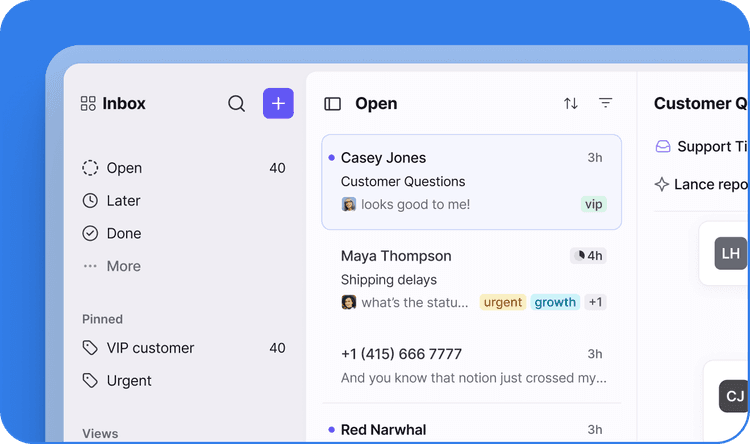
Front offers exactly that kind of control. In Front, assignments make ownership transparent so work doesn’t overlap or stall. Shared conversations keep the full history intact, ensuring no context gets lost as requests move from team to team. And comments and @mentions let teams coordinate in real time without pulling work into separate tools or threads.
Front’s automation aids in the process without completely taking it over. You can route and prioritize incoming messages by channel, topic, or customer. For example, send live chat messages to a Tier 1 inbox for fast responses, or route API-related questions to Tier 3 for technical review. Work always moves to the right place with full context at each step.
With Front, B2B leaders don’t have to choose between speed and clarity. They can scale customer support operations while keeping ownership clear and coordination tight.
Explore how Front helps teams achieve operational visibility, and watch “What High-Performing CX Teams Automate” to learn how to balance automation and control.