



Learn what drives first response time up in B2B support, how to calculate and benchmark it by channel, and which tactics bring it down most effectively.
If your first response to customer inquiries is lagging, the instinct is to push the team to move faster. That’s usually the wrong fix.
In B2B, high first response time (FRT) typically comes from operational friction: fragmented tools, unclear ownership, or breakdowns in triage and routing. Fix these workflow problems, and your FRT will improve.
This article explains the meaning of FRT in business, how to calculate it, why it tends to run high in B2B environments, and what to do to bring it down.
FRT meaning: What first response time actually measures
First response time (FRT) is the time between a customer submitting a support request and receiving the first reply from a human.
Automated acknowledgments don’t count. The point is to measure how quickly someone on your team actually engages with the customer — not how fast an auto-responder fires off a notification.
In a B2B customer service environment, FRT shows how quickly your team takes ownership of customer inquiries. And our latest research shows that 47% of B2B companies track FRT, making it one of the most commonly measured customer service KPIs.
But FRT is just one part of the picture. A fast reply doesn’t mean the issue got resolved efficiently. To track that, you must also look at FRT alongside metrics like resolution time and average handle time.
Luke Atkins, who runs internal enablement for Front’s support team, has written about exactly how that gap hides:
"A customer sends a message at 2:47 PM. Your system clocks it. At 3:45 PM, an agent replies: ’Thanks for reaching out! I’m looking into this for you and will follow up shortly.’ Your First Response Time metric shows 58 minutes. Green across the board. But the customer has made zero progress in nearly an hour."
His conclusion is blunt: "Speed without substance creates the illusion of progress."
How to calculate FRT — and what that number means
The formula for calculating overall customer service response time is simple:
Average FRT = Total FRT across all tickets ÷ Number of tickets
However, B2B support teams often prefer the median over of a simple average because it excludes outliers that can distort the results. The goal is to measure how long it typically takes to reply to customers — not to inflate the number with a handful of tickets that took unusually long.
And when SLAs apply, most B2B teams measure FRT within business hours only. For example, if an inquiry arrives 10 minutes before your support team closes for the day and you reply 15 minutes after the office opens the next morning, the FRT would be 25 minutes. The overnight hours don’t count.
In general, B2B support teams tend to target response times that look something like this across channels:
Phone: about 1 minute
Live chat: about 2 minutes
Social media: about 1 hour
Email: about 12 hours
Treat these as reference points, not specific customer service response time rules. Actual SLAs vary depending on industry, team structure, and account complexity.
And remember: you can’t optimize FRT in isolation. A fast initial reply followed by a long handle time or slow resolutions still creates a poor customer experience. Focus on smooth coordination throughout the workflow.
The real reason FRT is high: Coordination and system design gaps
According to Front’s Coordination Tax Report, the typical B2B team spends nearly 3 hours on coordination for every 1 hour spent actually solving customer problems.
That’s the real source of slow FRT. Customers wait not because their issue is hard, but because your team is stuck navigating tools, figuring out who owns the ticket, and managing messy handoffs. If you want to know how to improve the response time to customers, the answer is better coordination.
The three most common causes of poor coordination in B2B are:
Unclear ownership: When no one is explicitly responsible for the next step, nothing moves. Even urgent issues sit in the queue because everyone assumes someone else will pick them up.
Manual triage: Slow, manual intake and prioritization delays routing and escalation because agents spend too much time reviewing each message and deciding what to do with it.
Fragmented tools: When customer history lives in three different systems, your team spends the first few minutes of every ticket just assembling context before they even begin drafting a response.
These are process failures, not people failures. A slow FRT is rarely about individual performance, so address it by improving the way work is structured and handed off.
How to bring your FRT down
The best way to reduce FRT is to remove the coordination overhead that delays the first response. Here are five ways to do that.
1. Assign ownership before the first reply
When a customer inquiry arrives, someone should be accountable for it immediately. Don’t leave tickets sitting in a shared inbox waiting for someone to claim them. Set clear rules about which team members own specific types of queries. Work routes to the right person from the start, cutting handoffs and delays.
For example, a B2B SaaS company might automatically assign billing questions to the account support team and API questions to the development team. Once ownership is clear from the start, teams move faster.
2. Route requests automatically based on context, not manual triage
Manual triage takes time and often leads to misrouting. Replace it with automated routing rules and AI-powered tools that read incoming messages, identify intent, and send each request to the right team without anyone having to make that call.
See how Fundraise Up hit its 7-minute response time target using Front’s message routing and automated workflows.
3. Use AI to support replies
Make AI do the first draft. Don’t force your team to start from a blank page and dig through documentation for every ticket. Use AI to generate a first draft based on customer context and your knowledge base, then have an agent review and send the reply.
This speeds up FRT without removing ownership or judgment. You can also give agents canned responses to frequently asked questions so they always have a strong starting point.
4. Reduce repeat requests that don’t require a response
Not every ticket needs a human. Handle common requests with automation and self-service options like live chat and knowledge bases. Use autoresponders to confirm receipt of inquiries immediately, set expectations, and point customers toward relevant resources.
The goal isn’t to replace support with automation, but to keep the queue from filling up with questions your docs could answer — so your team has more time for the requests that actually need them.
5. Track FRT across channels to identify where delays happen
Compare response times across channels (email, chat, phone) to identify where the slowdowns are. The data tells you where to focus your process work.
If your live chat responses average less than two minutes but email requests take several hours, dig into the email workflow. You might find that emails sit in a different system without automated routing — an issue you can solve by using an omnichannel support platform with strong routing capabilities.
All five reduce the number. Whether that’s the number worth reducing is a separate question:
"Teams chase faster response times whilst customers wait longer for actual help. The metric improves. The experience deteriorates."
His proposed replacement is Time-to-Relief — the first moment a customer can take the next step, even if the root cause isn’t fixed yet. As he frames it: "What if we stopped asking how quickly did we respond? And started asking how quickly did we create relief?"
Track your FRT with Front
It’s hard to improve what you can’t see. When ownership, routing, visibility, and response data are scattered across separate tools, you’re guessing.
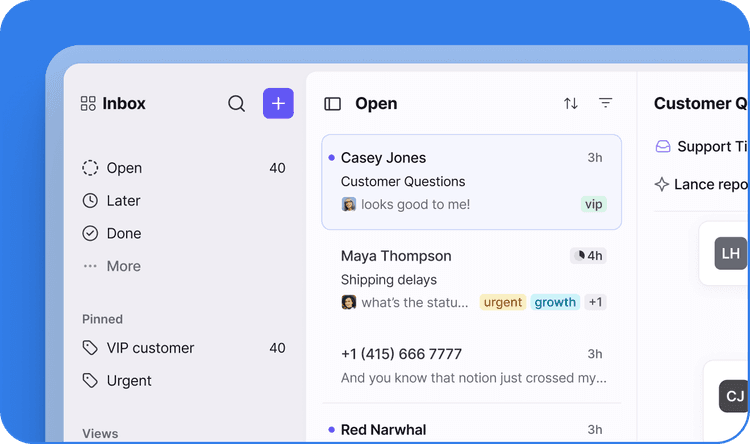
Front’s collaborative customer service platform brings everything into one place. You can easily track FRT across every inbox and channel, alongside broader operational metrics like handle time, workload distribution, and SLA performance. And with intelligent routing and AI-powered tools, your customer service team can coordinate more effectively and give much faster, consistent responses to customer inquiries.
Book a demo to see how Front keeps response times, ownership, and team coordination in one place.
FAQ
How does FRT affect customer retention?
A fast FRT shows customers you value their time, which builds trust and boosts customer retention when you follow through with fast issue resolution.
How do you set FRT targets by account tier?
Define three tiers based on customer size and strategic importance. Figure out the fastest response time your team can consistently sustain and offer that to Tier 1 accounts. Then set more modest targets for Tiers 2 and 3 that still align with industry benchmarks.
What tools help reduce FRT?
An AI-powered, multi-channel customer service platform helps you reduce FRT by automating workflows, centralizing communication, and improving coordination across teams.