



Learn how to bring customer experience optimization to every channel, with better workflows and insights that improve CSAT, response times, and retention.
When B2B teams lose customers, it’s not usually because they didn’t care enough. Instead, customers are lost when the behind-the-scenes work stops working. When routing, handoffs, and cross-team coordination break down, the customer feels every crack.
Customer experience optimization is the practice of fixing that: improving every interaction a customer has with your business by improving how work moves behind it. This article covers the metrics that matter, where coordination typically breaks down, and how to translate both into concrete operational improvements.
Definition of customer experience optimization in B2B
In B2B, optimizing CX is about more than just improving individual touchpoints. It’s about how work moves behind the scenes.
CX optimization builds better workflows, so conversations move smoothly within and across teams. It breaks down silos and aligns teams around a shared goal: meeting customer needs.
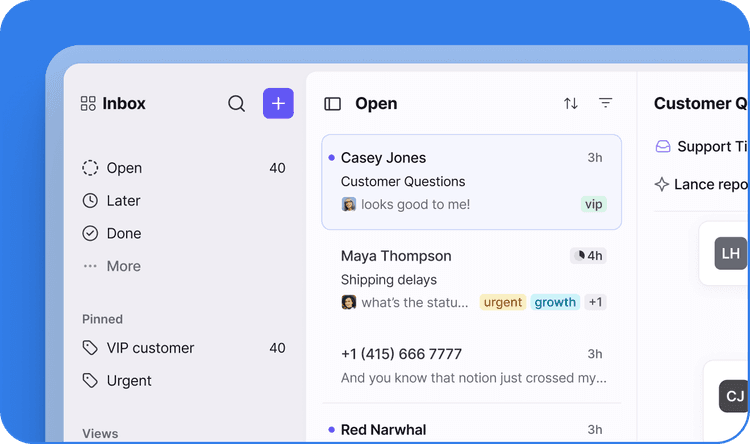
Make sure all your teams use the same tools, and that those tools give full visibility into customer conversations and context across every channel. When every team has access to the right tools and context, they can respond more effectively, resolve issues quickly, anticipate what customers need before problems escalate, and deliver a more personal customer experience.
Where customer experience breaks down in complex operations
According to Front’s Coordination Tax Report, the typical B2B company spends nearly three hours coordinating for every hour spent solving customer problems — and 42% of companies don’t track coordination at all.
Without clear visibility into how work moves across your teams, CX optimization efforts stall. After all, you can’t improve what you can’t see. Here are three of the most common reasons CX optimization falls short in complex B2B operations.
Fragmented tools
B2B conversations often span multiple stakeholders and take place on different channels. Without an omnichannel support platform, those conversations stay fragmented, with some comments on Slack and others in email threads. Important context gets lost, and teams struggle to track conversations across channels, often leading to slower resolution times and service-level agreement (SLA) breaches.
Per Front’s Coordination Tax Report, “As software got more advanced, tool-switching between systems to gather context rose from 24% to 39% — while problem-solving time stayed flat at 21–24% regardless of platform sophistication.”
Lack of shared context
Handoffs between different teams often break the flow of information and lead to lost context. If teams don’t have access to shared systems, handoffs need to include all the relevant context — and they often don’t. As a result, customers get frustrated when they need to repeat themselves or receive slow and inconsistent responses.
This challenge shows up frequently in practice.
Front’s report says that “64% of companies reported at least one customer-facing coordination failure in the past three months — including context lost between handoffs, customers asked to repeat themselves, and inconsistent answers from different teams.”
Reporting that doesn’t reflect workflows
When CX metrics fail to capture how work moves across teams, they create blind spots that make CX harder to improve. For example, metrics that focus only on customer support team performance don’t show bottlenecks, routing delays, and unclear ownership as work passes to other teams.
Front’s Coordination Tax Report found that the typical company only tracks 4 metrics: customer satisfaction (CSAT), complaints/escalations, resolution time, and first response time. Only 5% track handoffs, coordination time, and duplicate work together.
CX optimization: Key metrics that matter
These are the best customer service metrics for tracking CX and spotting areas for improvement.
Speed and responsiveness
What to track:
First response time
Time to resolution
SLA compliance
Slow response times and missed SLA targets often lead to lower CSAT scores. When they’re combined with low scores on quality metrics, they often signal friction in routing or handoffs. Addressing friction in these processes is one of the most effective ways to manage and improve the CX.
Quality and consistency
What to track:
CSAT scores
Quality assurance (QA) scores
Reopen rates
These metrics show how consistently and effectively you handle work across teams. Low scores often point to routing problems and missing context in handoffs. Use them to measure CX in terms of quality and reliability, and improve any areas with low scores.
Operational efficiency
What to track:
Volume trends
Routing accuracy
Workload distribution
It’s important to track these customer service KPIs because spikes in volume and uneven workload distribution often affect response times and increase escalations. That affects CSAT and, ultimately, retention.
Retention impact
What to track:
Churn signals
Repeat issues
Account health indicators
These indicators reveal where operational friction is quietly eroding customer relationships.
Inconsistency and poor coordination slow responses and erode account health. In contrast, well-coordinated teams and fast responses strengthen customer retention.
No single metric tells the full story of CX. Analyze these signals together to gain insights, pinpoint areas for improvement, and build better processes to deliver a stronger customer experience.
For example, SLA breaches alone signal a problem, but when you combine them with customer feedback from CSAT surveys, you can identify root causes such as coordination gaps or broken handoffs and address them directly.
Turning insights into actions for an optimal customer experience
Here’s how to optimize CX by translating metrics and feedback into continuous operational improvements.
Improve routing logic (intake and triage)
Strong intake and triage processes route customer requests quickly to the right team, reducing delays and duplicate work. For example, a customer billing dispute flows from customer support to finance and then customer success. When these handoffs run smoothly, work moves faster, and ownership and accountability stay clear.
Instead of manually routing issues, set up routing rules based on urgency, customer tier, and issue type. To go further, use AI tools to automate routing and free up your team to focus on high-priority issues.
Standardize responses (response quality)
Use templates and tone guidelines to maintain quality and consistency across channels. When messaging is consistent, customers receive a more consistent experience, no matter who handles the interaction.
Keep documentation in a shared, easily accessible knowledge base so teams can quickly find and provide accurate, up-to-date information. It also helps to use a platform that keeps customer context clearly visible, so teams can deliver more personalized support, and customers never have to repeat themselves.
Automation and AI as execution support
Use AI and automation to help teams work more efficiently without replacing human decision-making and judgment. These AI tools improve coordination and reduce both repetitive work and errors.
For example, chatbots handle status updates and basic support requests, while AI-driven automation analyzes customer sentiment and routes issues based on urgency and workload. AI assistants support your team by generating suggested replies that improve speed and consistency. And tools like Smart QA make QA at scale possible by automatically reviewing every customer service interaction.
How Front supports customer experience optimization at scale
CX optimization is a process of continuous improvement — one that evolves as customer expectations and complexity change. Success requires a system that connects every stage in the customer support workflow, providing the visibility needed to generate insights and drive action.
Front’s B2B support platform provides real-time visibility into conversations and performance, giving teams the clarity they need to drive better CX through strong analytics. It keeps every team and tool in sync, supporting coordinated workflows with clear ownership as work moves across teams.
This level of coordination enables faster routing and more consistent, high-quality responses. Ultimately, it supports a stronger customer experience based on improved SLA compliance, faster resolution times, and stronger customer retention.
Book a demo to explore how Front supports scalable, high-quality customer operations.
FAQ
What are common pitfalls when implementing multi-team CX dashboards?
CX analytics fail when they ignore cross-team workflows. Another pitfall is focusing on tracking metrics without using them to improve orchestration and deliver better customer interactions.
What tools help track handoffs between support and service without creating bottlenecks?
A modern omnichannel support platform helps teams track handoffs and maintain clear ownership as work moves from one team to another.
How can leaders ensure operational consistency when integrating new channels or software?
Leaders maintain consistency by using a platform that consolidates multiple channels into a single workspace with shared visibility across teams. They also define clear processes and workflows and align teams around the shared goal of improving CX.