



Explore smart customer service goals with real examples, linked KPIs, and tips to measure success and improve customer experience across your support team.
B2B operations run on performance, not sentiment. If you can’t tie service work to measurable outcomes, it stays invisible at the leadership table. That’s why customer service goals matter.
Clear goals give distributed teams direction, surface workflow gaps before they become crises, and create accountability across functions. They protect quality as the business scales and make it easier to prove impact to leadership.
But vague ambitions don’t drive outcomes. Successful teams use specific, measurable, achievable, relevant, and time-bound (SMART) customer service goals. In practice, that means replacing “improve customer experience” with defined targets, owners, and deadlines everyone aligns on.
Below are 10 actionable goals to help you build (or refine) a results-driven customer service improvement plan that actually moves performance numbers.
Why customer service SMART goals give B2B teams control
What you can’t track, you can’t improve — without a metric, there’s no way to know whether performance is improving or declining. Here are five reasons you need SMART customer service goals:
Align service work with revenue outcomes: SMART goals tie daily support work to retention, expansion, and churn reduction — so your operation proves impact beyond contact volume.
Create cross-functional accountability: Clear, time-bound goals define ownership across support, product, sales, and operations, reducing handoff friction and preventing issues from falling through the cracks.
Improve forecasting and capacity planning: Measurable targets — like response time and resolution rates — help operations leaders anticipate workload, allocate resources, and scale without sacrificing quality.
Reduce operational risks: Defined thresholds for CSAT, backlog size, or at-risk accounts surface problems early, giving teams time to intervene before issues escalate into revenue losses or compliance failures.
Drive continuous process improvement: Trackable goals expose workflow bottlenecks and recurring failure points, giving teams the data to refine their systems over time.
10 customer service goal examples tied to measurable KPIs
These 10 SMART examples show how multi-team operations can use clear customer service goals to achieve measurable outcomes.
1. Reduce average response time
Picture this: A B2B customer reaches out while coordinating dispatch across time zones, adjusting production schedules, or rebooking executive travel. They expect answers in less than two hours because their work depends on it. When your team is slow to respond, their operations stall. Every delayed reply erodes the value you’re supposed to deliver.
Reducing average response time protects complex downstream workflows, reduces cross-functional friction, and proves your team is operationally reliable.
Example SMART goal: Reduce average response time from six hours to three hours within the next quarter by implementing automated routing rules.
2. Improve first-contact resolution rate
For B2B customers, reaching out should mean getting a clear answer on the first ask. If they need to follow up or repeat the same issue to another team, confidence drops fast.
Improving first-contact resolution rate means fewer handoffs and less back-and-forth between teams. Customers reach a resolution faster, the team avoids duplicate work, and operational costs remain under control.
Example SMART goal: Increase first-contact resolution rate from 62% to 75% within six months by expanding the internal knowledge base.
3. Increase CSAT scores
Customer satisfaction is one of the strongest predictors of loyalty — 78% of customers are more loyal to brands when they trust the customer service. Clear CSAT goals help teams focus on improving customer service with faster resolution, early escalation of complex issues, and cross-functional collaboration. Specific targets also create a shared expectation that both routine and unpredictable problems must be closed with quality, not just speed.
CSAT shouldn’t sit with the customer support team alone. When product, operations, or engineering step in to fix root causes, they don’t just solve a customer problem — they repair the product experience itself.
Example SMART goal: Raise average CSAT from 4.1 to 4.5 (out of 5) over the next two quarters by introducing post-resolution quality reviews.
4. Reduce average handle time
Average handle time (AHT) measures how long an agent actively spends on a conversation — from the moment they engage through post-interaction work like updating records or scheduling follow-ups.
Setting a specific goal to shorten the AHT frees agents to focus on high-complexity cases instead of repetitive questions. Standardized internal notes and consistent tagging further cut time during handoffs, keeping workflows efficient without sacrificing quality.
Example SMART goal: Reduce AHT by 10% in 90 days by directing customers to self-serve sources at the start of each interaction.
5. Improve cross-team handoff efficiency
When teams collaborate well, they share context, avoid duplicate work, and resolve issues faster. But handoff efficiency is often overlooked as a goal because it’s hard to measure.
You can improve visibility by using shared inboxes, internal threads, and standardized tagging, so everyone works from the same context. Then tie the increased collaboration to a measurable outcome.
Example SMART goal: Reduce cross-team handoff time by 25% within the next quarter by centralizing communication.
6. Decrease escalation rate
Escalation rate is a useful indicator of quality control and operational maturity. High escalation levels often signal unclear processes, knowledge gaps, or missing authority at the front line.
Setting a goal to reduce escalations forces you to strengthen documentation and clarify ownership, making agents more confident about resolving issues independently. It also acts as a check for other operational goals. For example, if response times improve but escalations spike, something’s broken upstream — either quality is slipping or teams are prioritizing speed over accuracy.
Example SMART goal: Reduce ticket escalation rate from 18% to 12% by the end of Q3 by expanding frontline decision authority and updating knowledge base articles for the top 10 escalation drivers.
7. Increase customer effort scores
Customer effort score (CES) measures how easy it is for customers to get help or complete a key action. A strong CES means customers aren’t chasing updates or navigating unnecessary friction.
Improving CES requires two things: a post-interaction survey to measure effort consistently, and reliable self-serve resources that allow customers to receive instant answers on their own. Once you’re collecting responses and removing friction in the process, turn CES into a SMART goal.
Example SMART goal: Increase average CES from 5.8 to 6.5 within two quarters by expanding self-service resources and reducing ticket reopens by 20%.
8. Reduce customer churn rate
Stalled communication, declining engagement, and unused features are often the last signs before a customer leaves.
A clear, time-bound goal shifts the team mindset from reactive responses to proactive support. It creates a cadence, prioritizes at-risk accounts, and turns near-churn into a recovery opportunity.
Example SMART goal: Reduce quarterly churn rate from 8% to 5% within six months by implementing a 24-hour follow-up SLA for at-risk accounts.
9. Improve customer lifetime value
Customer lifetime value (CLV) is the total revenue a customer generates over the entire relationship with a business. It’s harder to improve and monitor with tight timelines because it unfolds over months or even years.
To make CLV goals actionable, break the metric into leading indicators: product adoption, expansion usage, and renewal rates. When customers consistently use high-value features, retention grows, and CLV grows with it.
Instead of vaguely aiming to “increase CLV,” set a goal tied to a specific driver like adoption. This keeps the goal specific enough to measure while directly supporting long-term, sustainable CLV growth.
Example SMART goal: Increase adoption of feature X among existing accounts from 40% to 55% within the next quarter through targeted educational outreach and in-app guidance.
10. Decrease ticket backlog
Unresolved conversations, reopened tickets, and requests sitting idle with no clear owner all contribute to a growing backlog. And rising backlog volume usually signals operational gaps that slow growth.
Start by giving agents clear ownership based on their specific expertise. When everyone knows who handles which types of issues, it becomes easier to categorize and route requests correctly — and to collaborate when extra help is needed. Also, look for patterns in the queue. Repeated pain points often signal a deeper issue, whether it’s billing, a broken feature, or something else. Spotting those patterns helps teams fix the root cause instead of treating the same symptom over and over.
Once ownership and root-cause work are in place, set a goal tied to short-term accountability (daily, weekly, bi-weekly). A specific, measurable goal creates momentum, enforces ownership, and ensures backlog reduction is an ongoing process.
Example SMART goal: Reduce total ticket backlog by 20% within 8 weeks by assigning clear owners to 100% of open tickets and reviewing backlog drivers in a weekly cross-functional meeting.
4 steps to match SMART goals to your operational reality
There’s no universal formula for the right SMART goal. What makes sense for a logistics company coordinating carriers won’t work for a financial services team handling compliance workflows.
Ground customer service goals in your operational reality and the KPIs your team is responsible for. Here’s how to do it:
Start with the operational bottleneck: Identify where delays, friction, or repeat work most often disrupt customer workflows or internal coordination. Map the problem to a metric that reflects real performance impact, such as response time or CSAT.
Define ownership and scope: Clarify which teams influence the outcome and what part of the workflow the goal should cover. This ensures the goal is anchored in the right place before you define the target.
Set a realistic time horizon: Choose a time frame that matches the complexity of the change, whether it’s a weekly process fix or a quarterly operational shift.
Link the goal to a broader business outcome: Make sure the metric supports a larger objective, like retention, expansion, compliance, or efficiency. That way, when you achieve the goal, it improves not just service activity but overall business performance.
Turn goals into results with Front
Setting goals is step one. Achieving SMART goals requires real-time visibility into how teams and workflows are performing.
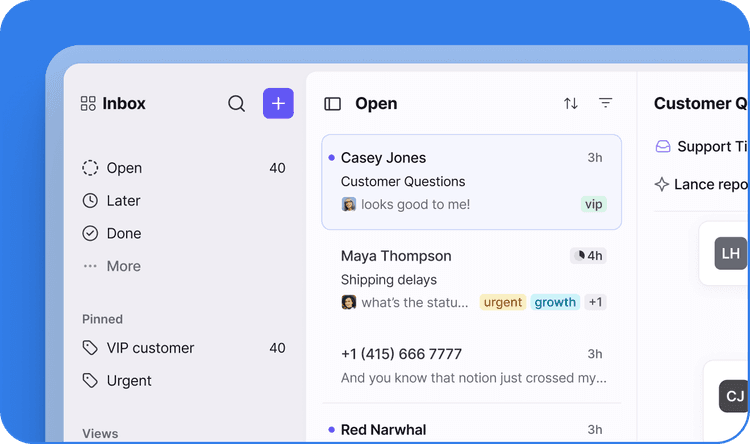
Front brings every metric into one place — from response times and conversation backlogs to cost savings and time spent per issue. With all teams, tools, and conversations in sync, you get a clear view of progress while Analytics surfaces gaps before they become problems.
Teams using Front see measurable improvements. Scratchpad, for example, delivers 100% CSAT and averages an impressive 40-minute response time with Front. Shared visibility and powerful team features make real-time collaboration seamless, while automation strengthens workflows even further — SLA warnings surface urgent requests and tagging keeps responses organized so teams know exactly when a conversation is complete.
Book a demo to turn your operational goals into measurable outcomes. Explore our full guide to build the best service team.
FAQ
How often should I review our customer service goals?
Review customer service goals monthly, and recalibrate quarterly. Use customer service goals for performance review examples in this article to evaluate individual contributions while tracking weekly leading indicators to stay ahead of risk.
How do you maintain goal alignment when service work spans multiple teams?
Centralize visibility into customer context and metrics, define clear ownership, and hold regular cross-functional reviews to ensure progress is shared, transparent, and aligned with broader operational priorities.
Do I need separate customer support and customer service teams?
Not always. Many B2B organizations combine both under one umbrella, especially in smaller teams. What matters is ownership of resolutions, escalations, and cross-team coordination. In complex, high-stakes environments, roles may specialize, but structure and handoffs matter more than titles.