



Discover how B2B teams measure customer effort score, uncover operational friction, and turn insights into faster resolutions and consistent service.
If you want to spot where your B2B operations are losing momentum, start with customer effort — the time, steps, and friction it takes for customers to get something done.
A customer effort score (CES) is a metric that cuts through the noise and shows how hard your customers have to work to resolve an issue or complete a task.
Picture a logistics team fielding repeated shipment inquiries because tracking information isn’t accessible or reliable. Or, consider a financial services firm managing compliance requests that bounce between departments, creating delays and duplicate follow-ups.
In both cases, high effort isn’t only a customer pain point — it’s a real-time drag on your operations. CES connects directly to team performance, from missed service-level agreements (SLAs) to avoidable escalations. When customers have to push harder, your systems (and your people) are pulling in the wrong direction.
In this guide, we’ll walk through what a customer effort score is and how teams can use this metric as a practical signal. Plus, we’ll explore how AI is reshaping customer effort and whether CES still matters as automation takes on a larger role in B2B operations.
Why customer effort matters in high-volume workflows
In high-volume B2B operations, friction creeps in as a slow, steady drain rather than a dramatic spike. That’s exactly why understanding CES is crucial. It highlights where your workflows quietly buckle under pressure.
A delayed dispatch update here. A duplicate request there. A misrouted manufacturing request that requires “just one more follow-up” to reach the right team. Individually, these issues may appear harmless, but collectively, they weigh down your entire operation.
The impact compounds quickly. SLAs that once felt predictable start to slip as customers chase answers. Resolution times stretch with every unnecessary loop. And internally, what was once clear becomes harder to see, as effort hides away in day-to-day operations.
Monitoring CES closes that gap by tying workflow design to customer experience, pinpointing exactly where customers are forced to wait or push harder to get the job done.
3 key metrics that signal customer effort
“As you scale, use metrics like CES (customer effort score) to measure the effort customers go through to reach a human, which will surface in the scoring and feedback,” says Kenji Hayward, Senior Director of Customer Support at Front.
This point highlights an important shift: CES isn’t just about how smoothly someone can complete a task — it’s also about how hard it is to get the right help, especially when a customer needs a human.
As AI-powered support grows, teams need to rethink how they measure and establish CES benchmarks. Where does effort show up (and where does it disappear) throughout automated flows and human handoffs?
Here are three key metrics worth watching to capture the full customer support experience, including human, automated, and hybrid interactions.
1. First response and resolution effort
Customer effort and response time move together. If one rises, the other follows, as customers wait or repeat steps unnecessarily.
AI-powered support changes how that plays out. First response time may drop because AI agents reply instantly, but if the reply doesn’t resolve the issue or route it correctly, customers re-ask, rephrase, or push to reach a human customer rep.
Response times may look better on paper, but the experience doesn’t improve. Resolution effort follows the same pattern. Automation removes friction for routine tasks, but weak handoffs add it right back. When customers are forced to repeat context or navigate multiple steps to reach the right person, effort increases, and so does time to resolution.
This is where customer operations and CES tools like Front close the gap. Conversation routing and SLA tracking reduce unnecessary handoffs, while AI-assisted triage gets requests to the right team faster. That combination smooths resolution paths and, ultimately, lowers CES.
2. Repeat contact and escalation rates
When customers come back a second or third time for the same issue, either automation didn’t fully resolve the issue or the context got lost when a human finally stepped in. Most of the work falls on the customer as they’re rebuilding the conversation from scratch every time.
Every repeat contact signals effort seeping into the process. What should have been resolved the first time turns into longer threads and more frequent escalations.
Front’s ability to carry multi-team conversations and assign clear ownership across automated and human touchpoints reduces this repeated effort.
3. Complexity across channels and teams
Ever feel like customers aren’t dealing with one support system, but five at once?
Customers expect businesses to meet them where they are, so companies spread support across email, chat, SMS, and more. That improves access on the surface, but it also creates more places where work can break down.
Customers don’t think in channels — they think in problems. But when those channels don’t connect, customers end up repeating information just to keep things moving. Effort increases, even when the underlying issue stays simple.
CES picks this up immediately. Disjointed workflows raise perceived effort, and even a “successful” resolution can feel frustrating if customers have to do the coordination on their own.
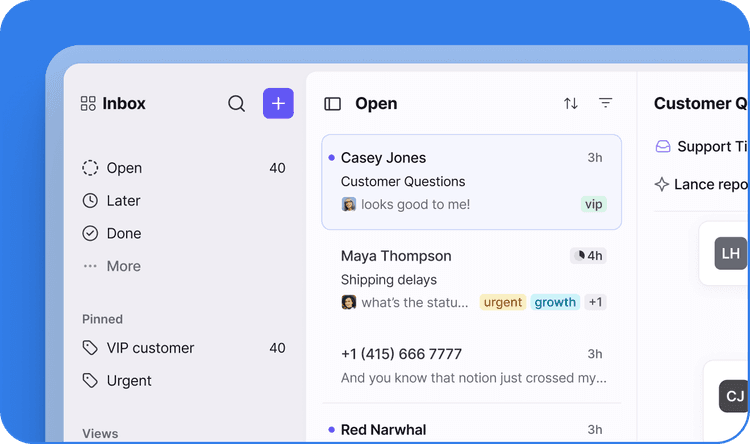
Front solves this with a unified workspace. All support channels live in one place, with shared context across AI and customer-facing teams. Conversations stay connected and teams stay aligned.
How to measure customer effort score
Teams typically measure CES through a post-interaction survey that asks customers how easy it was to complete a task or resolve an issue.
Here’s a breakdown of a CES survey example:
The survey asks, “How easy was it to resolve your issue today?”
Most teams use a 1–5 or 1–7 scale, where 1 indicates high effort and 7 indicates very low effort (very easy). In this setup, higher scores signal a better experience. Some teams also use Likert or emoji-based scales, and others add a follow-up question to capture the context behind the score.
To calculate CES, teams take the average of all responses. If 100 customers respond to the survey, with an average score of 4.5 (out of 7), then the CES is 4.5.
CES becomes more meaningful when it’s tracked over time and paired with net promoter scores (NPS) and customer satisfaction scores (CSAT). Together, these three numbers help teams identify friction across conversations and workflows and read customer sentiment with confidence.
Using CES insights to reduce customer effort
Understanding CES is only the first step. The real value comes from using those signals to redesign workflows and prevent effort from piling up in the first place.
Here are four ways to reduce customer effort.
Map effort to specific workflows
Friction reveals itself when you connect what customers do with what your teams actually execute behind the scenes.
A customer may look like they’re breezing through onboarding, while their actions quietly trigger setup work across product and data teams. Even routine billing requests can bounce between finance, engineering, and support queues before anything moves.
Once you map the full workflow, the hidden effort becomes impossible to ignore.
Prioritize bottlenecks that increase effort
Not all friction carries the same weight. Some issues quietly multiply effort across the system.
When customers report high effort on workflows with repeated escalations or delayed handoffs, you’ve likely found a bottleneck worth fixing first. The key is to connect CES signals to operational data. Is SLA compliance wavering? Is workload distributed evenly across teams?
When effort scores and operational metrics align, you can pinpoint exactly where effort compounds instead of guessing.
Close the loop across teams
Friction has a habit of traveling. Support teams see it first, then operations feel it, while product hears about it only after escalation.
Closing the loop means every team uses the same CES signals, not just the team who got the original request. Otherwise, the same pain points resurface in different forms and no one connects the dots.
With Front, assignments drive clear ownership of next steps. Internal comments preserve context as work moves, and collision detection prevents teammates from duplicating each other’s work.
Test changes and track impact
Reducing customer effort doesn’t end with a single fix. Every change needs a check against through real customer feedback.
You tweak a workflow, then monitor how CES shifts over time. That ongoing loop shows whether improvements actually reduce friction or just move it elsewhere.
With Front Analytics, teams track those trends alongside operational metrics to see whether fewer handoffs and faster resolutions hold up in practice or introduce new points of friction.
Reduce customer effort with Front
Here’s the catch: When customer effort increases, operational drag isn’t far behind.
The CES scale is a window into how your B2B workflows actually perform. High effort points to inefficiencies, such as missed SLAs and clunky handoffs. Low effort signals the opposite: well-coordinated operations that move work forward without friction.
And that’s where Front comes in. By bringing conversations, teams, and workflows into one place, Front helps operationalize CES insights. With Copilot, teams move faster with AI-assisted replies while maintaining accuracy and control. The outcome is less friction for customers and more predictable performance for teams.
If CES is already on your radar, it’s time to put it to work.
Explore how Front turns CES insights into functional workflows. And download our guide to help customers feel seen at every step of their journey in the age of technology.