



Customer lifecycle management connects ownership, handoffs, and customer signals across B2B teams so lifecycle strategy becomes consistent execution.
Imagine your company has just landed a major B2B client. Over the next year, your sales, operations, and finance teams all touch that account — but each team works in a different system. A missed follow-up here. A delayed handoff there. Before long, the client is frustrated, even though the service itself is running fine.
Customer lifecycle management (CLM) is how B2B companies close those gaps before they chip away at trust and revenue. CLM isn’t just about following a standard lifecycle model — it’s about coordinating work across teams over months or even years of a long-term customer relationships.
At its core, CLM is about building trust throughout every stage of the customer journey.
This guide walks through the day-to-day work behind successful CLM, highlighting the role of clear ownership, structured handoffs, conversation-driven insights, and proactive risk detection in building trust. You’ll also find practical ways to make your lifecycle program measurable and ready to scale.
What CLM really means in B2B operations
In B2B operations, CLM covers every stage of the customer journey:
Awareness
Consideration
Conversion
Retention
Advocacy
For example, when a logistics company signs up a new shipper, the onboarding team needs to get them moving freight quickly. As shipments ramp up, operations has to track exceptions, offer efficient customer support, and resolve issues before they turn into churn.
Customer lifecycle management vs. customer lifecycle marketing
When you see CLM through the lens of consumer businesses, you often end up with a strong focus on marketing campaigns. A B2B customer lifecycle map, however, is more about operational efficiency and long-term relationships. CLM is also distinct from customer relationship management (CRM), as the table below shows.
Customer lifecycle strategy vs. customer lifecycle execution
It’s also important to distinguish between strategy and execution. A strong customer lifecycle strategy should:
Define the customer lifecycle stages you want to focus on.
Set goals for each stage.
Specify the customer lifecycle analytics you’ll track.
Clarify ownership.
Establish your overall approach to CLM.
But strategy without execution goes nowhere. Customer lifecycle execution focuses on:
The daily work of managing customer relationships at each stage.
Strong operational coordination, handoffs, and workflows.
Close collaboration between teams.
The right tools and processes to keep work moving.
Why CLM breaks down at the B2B scale
As B2B companies grow, ownership often becomes fragmented across teams, context drops during handoffs, and customer communication across channels.
Here’s where the work can break down at each stage of the customer lifecycle:
Awareness: Marketing leads this stage, but prospects often reach out to operations teams with technical questions before making a purchase. If ownership is unclear, responses slow down and first impressions take a hit.
Consideration: Prospects ask questions to understand the offering, and context can be lost as conversations move across teams. When customers have to ask the same question several times, it creates frustration.
Conversion: When customers move from onboarding to implementation, there’s a risk that the handoffs between sales, onboarding, and support are inefficient, leading to delays and misunderstandings. If the operations team isn’t aware of promises the sales team made, customers can lose confidence fast.
Retention: Day-to-day support and adoption work require close attention to customer conversations so teams can reduce churn before it starts. It’s easy for teams to miss warning signs if they’re scattered across different systems.
Advocacy: To transform customers into advocates, operations teams need to deliver outstanding service, increase customer engagement, and look for growth opportunities. If teams have poor visibility into satisfaction trends and account health, they can miss growth opportunities.
Best practices for operational CLM
Teams can get ahead of these common operational challenges by building workflows that hold up at scale.
Here are five customer lifecycle management best practices to help you do that.
Define accountability across the customer lifecycle
When ownership is unclear, you get delays, duplicated work, and missed opportunities.
For example, when a company signs up a new financial services client, onboarding delays occur if the sales, implementation, and relationship management teams each wait for the others to act. The client treasury team grows frustrated at the delays, and trust declines early in the customer relationship.
Instead, make it clear which team owns the decisions and outcomes at each lifecycle stage. Clear ownership of the onboarding process in the above example would give the customer a strong first impression, and maintaining that clarity throughout the lifecycle sets the stage for customer retention and contract renewal.
Create structured handoff processes between teams
Handoffs between teams are a natural part of the customer lifecycle. The customer deals with support, operations, customer success, finance, and sales at different points. Teams must transfer context between those groups.
In small companies with straightforward operations, knowledge sharing between teams is often informal. However, as B2B operations scale and complexity increases, standardizing handoffs is essential. Use templates to capture the full context, shared workflows to move the work forward and clear escalation paths when something’s stuck.
Build lifecycle intelligence from conversations, not just account data
Customer conversations are the most reliable signal of lifecycle health.
Consider a manufacturing customer that seems stable in a CRM dashboard. Invoices go out on time. Executives aren’t required for escalations. But a closer look at support conversations shows the customer is struggling to compare reports across systems and hasn’t fully adopted the product.
When teams capture and log those conversations in a central system, they can identify patterns of operational friction early and put a customer service recovery plan in place to avoid churn. In this example, support could walk the customer through the reporting workflow, clear up confusion and lift satisfaction — without waiting for the account manager to raise the alarm.
Be proactive in identifying lifecycle risk
As customers move through the different lifecycle stages, you’ll see specific operational signals that indicate potential breakdowns and churn risk. Delayed customer responses can indicate disengagement, repeated escalations are a sign of operational friction, and repeated reopenings show that the customer is unhappy with ticket resolutions.
When teams monitor those signals and fix the underlying issues, you can prevent churn and boost contract renewals. Proactive monitoring and intervention beats reactive firefighting every time.
Coordinate cross-functional responses to lifecycle risk
Lifecycle risk often results from knowledge silos, inconsistent messaging, and duplicated work.
For example, when a prospect at the consideration stage asks a detailed operational question, the response needs to be coordinated — with sales as the primary point of contact, and product and engineering contributing their expertise without stepping on each other.
When teams achieve strong alignment at different stages of the lifecycle, you create a strong customer experience and boost the retention rate.
How customer lifecycle management tools enable team coordination
Effective coordination across multiple teams at scale is tough, but using the right tools can make it much easier. Customer operations platforms built for collaboration can give teams shared context and full visibility across all lifecycle stages.
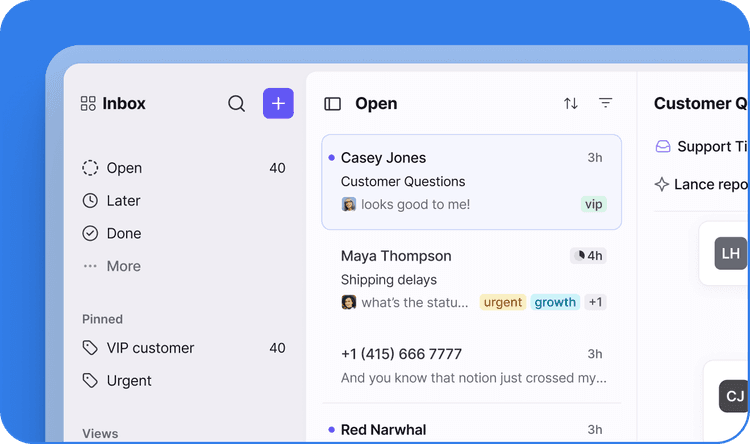
Front keeps every team, tool and customer conversation in sync across the lifecycle. When teams use a single operational hub to manage customer relationships from day to day, it’s easier for them to implement the best practices we looked at earlier. It provides the operational layer that turns customer lifecycle strategy into consistent execution.
Run complex customer lifecycles with Front
CLM is about clarity, control, and coordination over time. And the data highlights why efficient service is such a powerful retention strategy throughout the lifecycle. According to Front’s research, 78% of B2B customers remain loyal to brands they trust for customer service, while 59% will abandon a brand after just three negative experiences.
Front is the customer operations platform built for B2B complexity. It helps teams coordinate across channels and resolve issues efficiently.
With Front’s unified workspace, your team can maintain context as customers move through the lifecycle. Clear ownership and structured handoffs become easier thanks to assignments, internal comments, and collision detection. And Front’s AI-powered tools help analyze customer conversations to identify churn risk and boost retention.
With clear ownership, structured handoffs, and full visibility into customer communication, lifecycle management becomes predictable and outcome-driven. Put the right processes and workflows in place, give teams the right tools, and your lifecycle program can start running like it should.
FAQs
What is the customer lifecycle?
The customer lifecycle is the complete journey a customer takes with your company, starting from initial awareness and continuing through purchase, ongoing engagement, and ultimately loyal advocacy.
How to measure customer lifecycle health in B2B operations?
The best customer service metrics to track are service-level agreement consistency, time to resolution, escalation frequency, and retention/churn trends. These metrics will show you details of the operational reality that high-level satisfaction scores like customer satisfaction and Net Promoter Score can’t.
How do integrations impact CLM success?
Integrations break down knowledge silos, provide better visibility into key customer issues, and enable better collaboration to enhance the customer experience. They streamline operations and give your team the tools they need for effective customer lifecycle management.