



Learn how B2B leaders optimize customer support vs. customer service, reduce bottlenecks, improve CSAT, and scale multi-team workflows effectively.
In large, multi-team organizations, the difference between a smooth renewal and a lost customer often comes down to coordination.
When support and engineering fall out of sync, a key customer’s renewal can quickly come under threat. The customer emails, chats, and calls — expecting continuity, not repetition — but small cross-team delays add up. One missed handoff triggers a missed service level agreement (SLA), frustration builds, and that frustration turns into churn.
This is the reality of high-stakes, multi-team customer work: misalignment snowballs into major business risk. Strong customer support and customer service stop that spiral.
Many B2B companies use the terms “customer support” and “customer service” interchangeably. What matters isn’t the label, but the operational structure underneath: who owns what, how handoffs work, where accountability lives, and how well teams actually meet customer needs.
Here’s a breakdown of the operational reality of customer support vs. customer service, the metrics that expose coordination gaps, and how to fix them before they cost you a customer.
Customer support and service: Key operational differences
In B2B environments, the difference between customer service and customer support isn’t about titles or who answers tickets. It’s about where each function sits in the operational chain.
What is customer support?
Customer support operates closest to the issue. Support teams own reactive problem-solving: handling questions, incidents, and product or service failures across channels, all under SLA constraints.
In logistics, that might mean resolving a shipment tracking failure. In financial services, it could be investigating a transaction error. In SaaS or tech, think troubleshooting integrations or product bugs. In every case, speed, accuracy, and technical context directly affect SLAs and customer trust.
What is customer service?
Customer service focuses on experience continuity across teams and stages, especially when it comes to non-technical and transactional queries. It’s less about a single issue and more about the entire journey working smoothly.
In manufacturing, that could mean coordinating order changes between operations and fulfillment to prevent production delays and ensure on-time delivery. In travel and logistics, it could mean managing disruptions that require consistent cross-department communication to avoid delays and maintain service quality. Customer service ensures handoffs, escalations, and expectations stay aligned.
The key differences fit into four categories:
4 support and service coordination gaps and how to fix them
Even the strongest teams struggle when coordination breaks down. These gaps lead to missed SLAs, duplicated work, and declining customer satisfaction.
Here are four of the most common points in B2B operations — and how to fix them.
1. Inconsistent service delivery
The best service standards mean nothing if teams don’t deliver them consistently. When performance management is reactive (or invisible), customers notice. Answers vary by agent, tone shifts across chat and email, and customer service starts to feel unreliable. Over time, customers lose confidence and look elsewhere to resolve issues.
How to fix it: Have the support team share frontline signals (SLA breaches, repeat contacts, CSAT dips) while the service team provides workflow data like handoff times and escalation paths. Review these metrics regularly, and tie coaching and process improvements directly to the data. The goal: a consistent experience and a professional tone across every interaction.
2. Inefficient handoffs
Inefficient handoffs aren’t just misrouted tickets. They happen when one team treats an issue as routine while the next team views it as high risk, creating a mismatch in priority. This misalignment can lead to incomplete onboarding or weak resolutions, and the problem often boomerangs back as repeat contacts when customers realize their issue was never fully resolved.
How to fix it: Create a shared severity framework (e.g., routine, high impact, revenue risk) based on account tier, contract stage, failed attempts, or feature area. The service team embeds it in routing and escalation logic, and the support team applies it consistently when triaging issues. That way, every handoff carries the right urgency.
3. Unclear ownership
When ownership isn’t explicit, issues stall. Support escalates an issue to engineering or customer success, but without a clear owner, it just sits in limbo.
In B2B, this often shows up during technical escalations, integration issues, or onboarding blockers — anywhere multiple teams are involved and accountability can quietly disappear. The SLA clock keeps ticking, the customer starts chasing updates, and internal teams start pointing fingers, while no one is actually driving the fix.
How to fix it: Assign a single owner for every cross-team escalation. Build this into the process, requiring every escalation to have an owner field, clear next step, and a regular update cadence.
4. Scattered communication
When key context lives in separate documents, side emails, or private chats, no one has the full picture. Customers end up repeating themselves, new agents restart troubleshooting from scratch, and resolution times balloon. Teams do the work twice and still deliver a weaker result.
How to fix it: Use a unified workspace where teams can leave comments, collaborate in real time, and tag owners. Make sure the support team enforces it day to day. Before escalating or resolving, agents should document the “current state” and next steps in the thread.
Effective coordination in practice: 5 examples
What do your customers actually need, and how can your customer care and support and service teams use the right skills and systems to meet those needs?
The answer varies, but once you see it in practice, it’s much easier to spot where your own teams are falling short.
1. Escalation without losing the thread
A technical issue starts in chat, moves to email, and requires engineering input. Instead of closing the interaction, the support team retains ownership while engineering works internally in the same thread.
A single conversation record means faster resolution, fewer follow-ups, and higher CSAT. And the customer never has to repeat themselves.
2. Sales and support alignment during renewal risk
A high-value account repeatedly contacts customer support because unresolved performance issues keep resurfacing, especially near renewal. Support flags the account as at risk, and customer success and sales step in early with full context.
Shared severity rules give high-risk accounts immediate attention. This improves customer retention and protects revenue by addressing critical issues before trust erodes.
3. Context-rich onboarding handoff
Onboarding is one of the most fragile moments in the customer lifecycle: Everything feels unfamiliar and requires effort to figure out. And after the deal closes, a flood of onboarding questions start coming through email and chat.
By keeping all sales notes, commitments, and customer use case context in a single shared system, the support team can respond quickly and maintain continuity. The result: faster adoption and a handoff the customer barely notices.
4. Support-product feedback loop on recurring issues
Support notices repeated tickets about feature confusion across channels. Instead of handling each case in isolation, they tag the product team with consolidated examples and customer impact and then update the knowledge base.
This kind of structured feedback loop solves the root cause, improves the resolution time, and reduces overall operational load — improving both efficiency and CSAT at the same time.
5. Incident communication across teams and channels
When a service disruption hits, it often affects multiple customers at once. Your support, operations, and success teams need to formulate a response quickly to avoid making customers feel like they’ve been abandoned.
When tickets arrive via email, phone, or chat, teams should issue a single, clear status update — either a pre-planned or quickly drafted message — that explains the situation, its impact, and next steps. Teams should maintain a regular update cadence and a defined escalation path. These centralized, consistent messages reduce duplicate tickets, lower panic-driven contact spikes, and build stronger customer trust, transforming a high-risk moment into a chance to strengthen the relationship.
Keep support and service teams in sync with Front
Understanding the difference between customer support and customer service is only the starting point. The real challenge for leaders is operational: equipping teams with the right skills and the right customer operations platform to manage high-stakes, multi-team workflows without losing speed, empathy, or accountability.
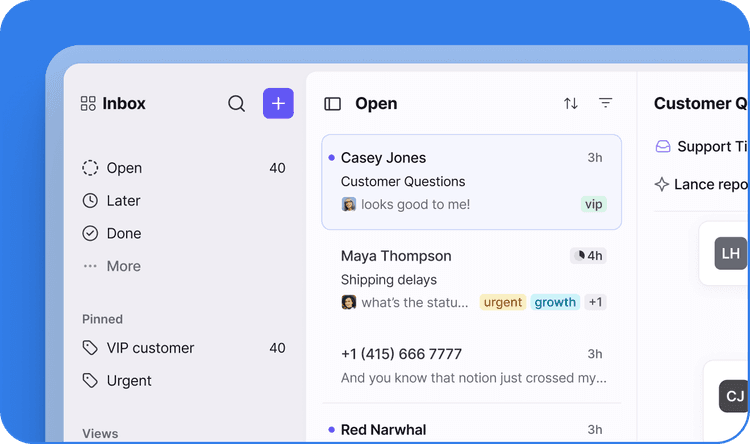
Front is designed for that reality. It brings email, chat, and other channels into one coordinated space, so conversations don’t splinter and no message — or owner — falls through the cracks.
That alignment shows up in faster resolutions, stronger customer retention and satisfaction, and a more reliable customer experience across every channel. Instead of chasing scattered messages, teams stay focused on strategy and meeting customer needs at scale.
Ready to turn operational complexity into a competitive advantage? try Front Collaboration and see how Front keeps support and service teams in sync.
FAQs
Do I need separate customer support and customer service teams?
Not always. Many B2B organizations combine both under one umbrella, especially in smaller teams. What matters is ownership of resolutions, escalations, and cross-team coordination. In complex, high-stakes environments, roles may specialize, but structure and handoffs matter more than titles.
Should support handle tickets while service handles relationships?
That split can work, but especially in B2B, tickets are relationship moments. A more useful distinction separates reactive issue resolution from proactive journey and process ownership. Whatever the model, both customer support and service need shared visibility so context carries cleanly through every handoff.
How do we measure whether our support and service coordination is working?
Don’t stop at surface metrics, like CSAT or first response time. They’re important, but they show outcomes, not coordination. Track ticket reassignment rates, escalation turnaround, repeat contacts, and where work stalls between teams. If you can’t see handoff friction and ownership gaps, you can’t fix them.