




Discover customer service challenges and practical solutions to fix them. Learn how teams can streamline workflows and resolve issues effectively.
It can happen to even the most well-organized B2B customer service teams. There’s a sudden surge of customer requests — and at the same time, multiple communication channels need attention.
These high-pressure moments can expose deeper operational gaps, like unclear ownership and limited visibility across teams.
As volumes climb, small gaps become big ones. Even routine tasks — like billing queries or password resets — start piling up, creating delays that frustrate customers and hamper the service experience.
The good news: most of these problems follow predictable patterns. Once you can name them, you can fix them. This article breaks down the most common customer service challenges, explains why they happen, and offers practical ways to move past them.
Why customer service is so hard to get right
Providing top-tier customer support in B2B environments is a balancing act, requiring speed, accuracy, and coordination — often all at the same time. Even small mistakes can snowball into larger issues that threaten long-term partnerships.
That friction rarely comes from a lack of effort. It comes from broken handoffs and scattered communication. When context doesn’t travel with a conversation, teams duplicate work, provide conflicting answers, and leave clients waiting in limbo.
These issues show up repeatedly in B2B organizations. Once you recognize them, you can start addressing them.
5 most common customer service challenges — and what to do about them
Most problems with customer service often stem from the same root causes: limited visibility and siloed tools. To help you understand how to handle customer service issues effectively, here are five common customer service problems and solutions.
1. Slow response times
When requests pour in through email, chat, phone and social media all at once, teams can fall behind fast. The usual culprits: too few people, too many tools, and no clear system for deciding what gets handled first.
Solution: Centralize all interactions from calls, chats, and emails, into one unified platform. Use automation to route requests to the right teams instantly, and set priority rules so urgent issues and your most important accounts get attention first.
2. Difficult customer interactions
For support agents, tense interactions are part of the job. But in B2B environments, many of them are avoidable. When agents enter a conversation without knowing what’s already been said — or who’s responsible for what — a straightforward question can turn into a frustrating back-and-forth. The customer feels like they’re starting from scratch every time.
Solution: Ensure all teams have full account context so no one enters a conversation blind. For faster issue resolution, give service agents read-to-use templates for recurring conflict scenarios, such as renewal disputes or delayed SLAs. This helps agents respond quickly, consistently, and confidently.
3. Poor response quality
When volume spikes, maintaining speed and accuracy becomes challenging. Agents are expected to respond quickly, often while toggling between systems and working with incomplete information. Without shared context, teams end up guessing or duplicating work. The result: a drop in both response quality and customer confidence.
Solution: Automate repetitive tasks, like order status checks and delivery updates, and give agents a reliable internal knowledge base for fast reference. With quick access to accurate information, teams face fewer bottlenecks and provide high-quality responses consistently.
4. Inconsistent answers
Customers expect the same answer whether they reach out through email, chat, or phone. But when different teams own different channels, work from separate tools, or reference outdated documentation, conflicting answers are inevitable.
Solution: Merge communication channels into a single system so agents have one source of truth for company policies and messaging. When all agents work from the same documentation, customers get the same answers no matter where they start the conversation.
5. Generic responses that ignore context
Every customer interaction should reflect what you already know—past purchases, previous issues, and account history. When agents don’t have that context, they default to generic responses, and customers feel unheard (even if their issues are resolved).
Solution: Connect your customer data so agents can see the full picture in one place—order history, past conversations, and account notes. With that context at their fingertips, agents can tailor every response instead of starting from zero.
4 internal team that affect service quality
Not every customer service issue starts with customers. Many begin inside the team, and only surface when capacity is stretched or processes are unclear, resulting in poor experiences, slower responses, and missed expectations.
Here are four common internal team challenges that hamper service quality and how to address them:
Burnout and capacity constraints: When support teams are stretched too thin, quality drops. Agents skip details or rely on guesswork just to keep up. To avoid team burnout, build sustainable workloads and stronger prioritization frameworks. When teams know exactly what to do and when, they effectively address customer needs, improving customer engagement.
Knowledge gaps and inconsistent training: Without shared, up-to-date guidance, agents are likely to deliver conflicting answers. Standardize onboarding and invest in continued training to make it easier for teams to stay aligned with expectations.
Poor cross-team communication and handoffs: When issues bounce between teams without direct ownership, customers notice, and loyalty starts to erode. Without coordination, teams waste hours tracking down context or figuring out who should handle what. Strengthen handoff processes and clarify escalation paths to prevent these disruptions.
Inconsistent workflows or ownership: Undefined processes trigger repeated work, missed follow-ups, and unclear expectations across teams. When no one knows who owns what, it leaves critical tasks unresolved. Establish standard workflows and ownership rules to maintain accountability and ensure consistent service.
3 operational problems and how to solve them
Disconnected tools and fragmented workflows are among the biggest obstacles for service teams. When agents have to hop between platforms just to answer one question, every interaction takes longer than it should — and the customer feels it.
At the same time, support teams face growing pressure to scale without adding headcount. But relying on more people instead of better operations can add complexity without fixing the underlying issues.
A more sustainable approach: improve workflows with automation and AI-powered tools. Automation reduces manual work, helping teams move faster and deliver a cohesive customer experience. It frees customer service agents to spend more time on solving customer problems, instead of searching for information.
Here are some technology challenges that slow teams down:
Disconnected tools: Too many agents juggle multiple systems to access customer history, which slows productivity and increases errors. The solution is consolidated communication channels that cut out unnecessary back-and-forth.
Inefficient routing: Poorly defined workflows lead to delayed handoffs, misrouted requests, and longer response times. Automated routing ensures every inquiry reaches the right team or support member.
Outdated knowledge sources: When information lives in outdated and disconnected systems, accuracy suffers. Centralize and regularly update knowledge sources so teams can respond confidently in every interaction.
Improve customer service operations with Front
Customer service challenges are inevitable. What separates high-performing teams is how they respond. Teams that invest in strong operations enhance service quality without adding complexity or extra pressure on agents.
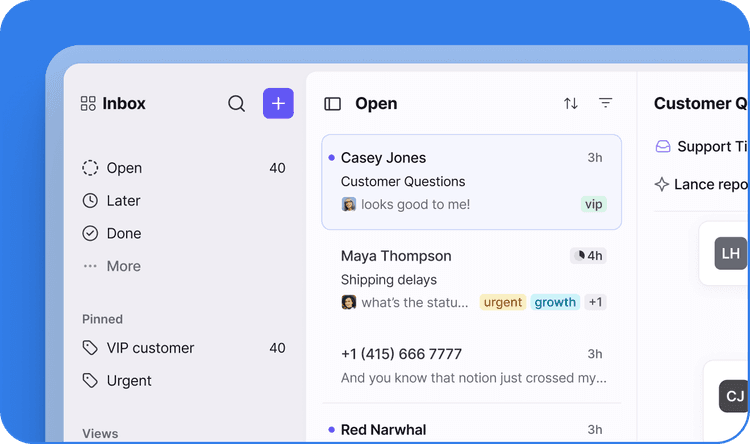
Front brings every customer conversation into a shared workspace. Email, SMS, WhatsApp, and chat all live side by side to give agents full context on customer needs and engagement. With fewer tools to manage and better visibility into customer history, teams have more bandwidth for fast, accurate support. Plus, Front’s shared inbox model boosts accountability. Internal comments and collaboration tools make it obvious who owns each request so nothing gets lost or endlessly handed off.
Behind the scenes, automation handles routine work, while analytics pinpoint bottlenecks and workload imbalances. AI acts as a smart assistant, giving agents context-aware suggestions, resulting in better CSAT scores and less agent burnout.
Front helps your team deliver great service — consistently and at scale.
FAQ
What are some causes of customer service failure?
Customer service typically falls short due to broken processes, like unclear handoffs, limited visibility into customer history, and inefficient workflows that delay responses.
How do you identify weak points in customer service operations?
Look for patterns, like increasing resolution or response times, inconsistent answers, or declining CSAT scores. You can also review customer feedback or speak directly with customer service agents about where processes break down.
What’s the difference between a customer service challenge and customer service failure?
Customer service teams face daily hurdles like high inquiry volumes and complex internal coordination. When these challenges go unresolved, they turn into failures that fall short of customer expectations and damage customer loyalty.
Can automation improve customer service without sacrificing quality?
Yes! If it’s applied to the right things.