



Discover how operational leaders use customer service automation to streamline workflows, maintain team visibility, and improve response consistency.
When B2B customer operations scale, everything scales with it. More channels, more stakeholders, more handoffs per request. Even the most capable customer service teams discover that the real challenge isn’t scale, it’s control. Work is happening everywhere. No one has a clear line of sight across all of it.
That’s the problem automation actually solves. Not speed for speed’s sake — visibility. The right automation gives you control over multi-stakeholder workflows by making ownership obvious, keeping handoffs clean, and running every request through a consistent, repeatable process.
None of this replaces human judgment. Automation strengthens it. It gives your team the confidence to deliver great customer experiences at scale because the system is doing the coordination work behind the scenes.
Building a strong customer service automation strategy should encompass the decisions you need to make, the outcomes you can expect, and creating automated customer service systems helps you build predictable, coordinated systems.
Why automation is non-negotiable for high-volume B2B customer operations
Growth is supposed to be good news. But for B2B customer service teams, it usually shows up as a flood of requests across more channels than anyone planned for — with the same headcount expected to cover all of it.
Customer support automation helps teams manage this operational complexity by taking over repetitive tasks, speeds up responses, and freeing your team to focus on resolving complex issues and building strong customer relationships.
Take a fast-growing manufacturing company. Their customer support lead realizes order status questions are eating up most of the team’s time. So they automate status notifications and route routine questions through a chatbot. Now customers get answers instantly, and the team can focus on exceptions — and complex, multi-stakeholder problems that actually need their expertise.
Both sides win. Teams maintain control over critical tasks. Customers get faster response times, improved SLA compliance, and less runaround.
How to automate customer service without losing operational control
The goal of customer care automation isn’t to hand everything to a bot. It’s to reduce take the repetitive, predictable work off your team’s plate — without sacrificing quality or SLA compliance.
Our best practices will help you enjoy all of the benefits of automated customer service software — without losing visibility and control.
Set up smart routing to reduce manual handoffs
Every customer request that lands in the wrong queue costs time — twice. Once, to figure out the mistake, and again to reroute it.
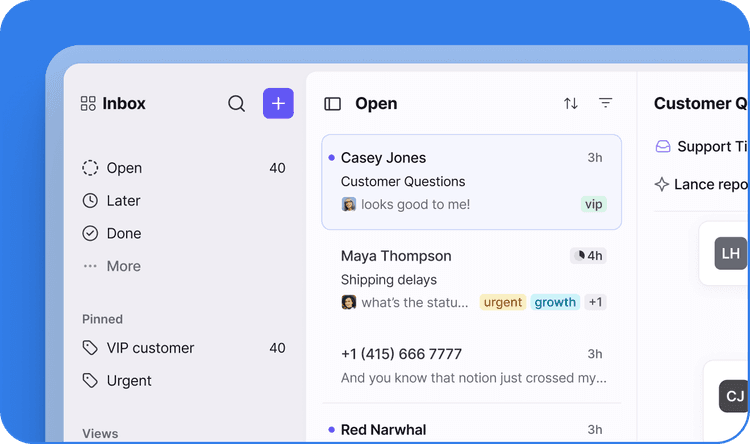
Customer service automated solutions, especially automated routing, fix this by analyzing the content and sentiment of incoming messages, tagging them, assigning priority levels, and sending them to the right team from the start. Your team is able to stop playing traffic cop and start working on those questions that actually require them.
Routing also decides what reaches a human at all. At Front, that’s scoped by account size:
“Our inboxes are split by account size, MME, Commercial, and SMB. The AI teammate is fully enabled on the SMB and Commercial inboxes. It reviews the conversation, performs a deep analysis, and if it feels confident enough to send out the reply, then it will. If it doesn’t, it kicks it back to the support team and gets assigned to a teammate.”
The same rules decide where automation doesn’t run yet:
"We don’t have it fully enabled for our MME inbox just yet, we’re still doing some testing, but we’re working on it.”
And because you own the rules, you can adjust them whenever your team’s needs shift. That’s operational control that stays with you, not locked inside a black box.
Use AI-assisted replies strategically
AI-powered customer service tools are a force multiplier for high-volume teams. They summarize complex issues, suggest responses that match your brand voice, and let agents review and edit before anything goes out. Managers still retain oversight without having to write every message themselves.
Picture a financial services company dealing with account inquiries across email, live chat, and internal channels like Slack and Teams. Many of these queries are similar — account balances, transaction records, or reconciliation checks — but the details are specific to each customer. AI-powered tools help agents draft each message quickly, so agents can focus on the numbers and nuances that matter for each account.
Connect your systems for end-to-end visibility
Automation is only as good as the data behind it. When your service channels, support platform, and CRM all feed into the same system, your AI tools give better answers and your team gets one place to see how every inquiry is moving through the pipeline.
Here’s how that makes a difference in practice. A logistics company could use a basic bot to deliver status updates and answer FAQ. But when that bot can pull a customer’s full history — past orders, open issues, previous conversations — it stops sounding like a bot and starts sounding like someone familiar with the account.
Use real-time analytics to maintain oversight
Before you automate anything, look at your operational dashboard. Where are the bottlenecks? What’s eating the most time? Start there.
Once you set the rules, AI tools distribute workloads across the team to avoid overburdening anyone. Continue watching the data, then refine the rules, adjusting the scope of automation when you need to redirect effort. The goal isn’t to set-it-and-forget-it — it’s continual improvement.
Balance automation with human judgment
Fully automated customer service isn’t a realistic or desirable goal. High-quality customer support requires human expertise to solve complex problems, coordinate across teams, and increase customer engagement.
Draw clear lines. Automate the repetitive, predictable tasks. Keep human oversight and control on everything else, and make sure to direct high-value interactions involving nuance and discretion to the right agents for personalized resolutions.
Track performance and continuously improve automation workflows
Once active, monitor customer service automation analytics to measure the impact. Track SLA adherence, response times, and operational friction. You should see positive trends across all key metrics. If you don’t, fine-tune the automation tools — whether by refining workflow rules or adjusting their scope.
Monitor workflow performance in real time
Pick a single customer request and trace it from start to finish — creation, prioritization, routing, and resolution. Then check the overall workload distribution within the team. Did the automated tool send the request to the right team members? If not, that’s your first optimization target.
Identify bottlenecks and optimize routing rules
When monitoring performance, watch for operational inefficiencies that could frustrate customers. See if there are particular stages where delays occur or particular agents handle too many requests to process efficiently. Also watch out for unnecessary escalations: Important and complex issues must be escalated to managers, but they shouldn’t be overloaded with routine cases.
Where you find bottlenecks and inefficiencies, adjust routing rules to improve efficiency. Use your control over the rules governing these automation tools to derive the most benefit from them.
Use data to refine automation boundaries
Customer service analytics show where automation is working well and where you need to refine it.
When offering self-service options through AI-powered chatbots, you should see a faster time to resolution for simple queries. But if customers reopen tickets too frequently, it’s a sign they’re not satisfied with the chatbot’s responses. In such cases, you may need to train the chatbot better, give it access to more knowledge bases, or make it easier for customers to reach human agents.
Track team capacity and workload distribution
When automation absorbs the repetitive work, your team’s capacity changes. People who used to spend hours on status updates now have time for higher-value work. Track these changes in the metrics to see how much capacity the team has and how work is distributed between team members.
As Isaiah notes, “we had an OKR of Front AI fully resolving 10% of support’s conversations in Q2, and we blew that out of the water, and we got it up to 33%. It’s been a huge change, and a weight lifted off us.”
What matters is where the freed time goes:
“We can spend more time making sure we’re performing all the troubleshooting steps we can. Before, the time was technically there, but there was always that pressure of knowing how much else you had to get done. Now, we have more room to slow down, dig deeper, and make sure we’re doing everything we can to help the customer.
As capacity opens up, shift your team toward proactive action and higher-judgment work: deeper troubleshooting, peer support, and proactive outreach that prevents churn.
Most tools dodge complexity. Front gives you control over it.
Customer service automation helps support teams manage the growing complexity without giving up the visibility they need to run the business. Front is a customer operations platform built for these environments, enabling teams to coordinate workflows across channels, maintain control, and resolve issues with confidence and efficiency.
Workflow automation, AI-assisted communication, and built-in collaboration tools work together to keep handoffs clean and every team member on the same page.
See how your team can run complex workflows with clarity and control. Explore Front to keep conversations, tools, and teams in sync without losing oversight.
FAQ
What is customer service automation?
Customer service automation means using tools like AI chatbots to answer customers and complete other routine support tasks automatically.
What are the common challenges with customer service automation?
One common challenge is over-automation, where companies rely too heavily on automated solutions and make it hard for customers to reach the human support team. Other challenges include automating without clear goals and lack of visibility into what’s been automated.
What are the key considerations when selecting a customer service automation vendor?
Key considerations are integration capabilities, scalability, and the ability to create customized workflows to fit your team’s needs. Also look for strong security and analytics, along with customer support capabilities.
How can organizations measure the ROI of automation beyond SLA improvements?
Automation should lead to improvements in customer service metrics, such as faster response times, higher customer satisfaction, and reduced churn.