



Discover how to reduce customer churn with operational strategies that improve workflows, ownership, and cross-team coordination across B2B teams.
Customer churn isn’t just lost revenue. It’s a sign that something broke in the experience you promised.
People come in with clear expectations, but subpar onboarding, missed escalations, lost context in handoffs, and inconsistent customer service slowly erode credibility. When a customer leaves, it’s usually because those issues have become a pattern.
This guide breaks down how to reduce customer churn in complex, multi-team B2B environments — with strategies you can act on today.
The operational story behind your churn rate
Every customer interaction tells a story about your operations.
What your churn rate really measures is whether teams share context, hit their SLAs, and catch problems before they snowball.
Retention strategies matter, but churn rates tell you whether your day-to-day operations are actually preventing customer loss.
A support ticket rerouted three times, a renewal conversation started without full context, and an unresolved product issue sales didn’t know about — these gaps seem small on their own, but together they form the experience that pushes customers to leave.
But great customer service does the opposite. In fact, Front’s State of Service Expectations report found that:
78% are more loyal to brands when they trust the customer service
67% would pay more for exceptional B2B customer support
60% are willing to pay more for faster response times
Types of churn and what they mean for B2B teams
Most B2B teams deal with three types of customer churn:
Voluntary churn: A customer actively chooses to cancel their service or subscription, often due to poor customer experience.
Involuntary churn: The customer didn’t choose to leave. A payment failed, a card expired, or a contract lapsed without anyone catching it.
Revenue churn: You didn’t lose a customer, but you lost revenue — often caused by downgrades, pauses, or scaled-back projects.
The labels matter less than the patterns behind them. Scattered conversations, unresolved billing tickets, and growing feature gaps are all operational misses that drag down customer satisfaction (CSAT).
Calculating customer churn: A formula for B2B teams
Reducing customer attrition rate, or customer churn, starts with calculating the churn rate.
Here’s a practical formula B2B teams can use:
Customer churn (%) = (Number of customers lost during a specified period / Total number of customers at the start of the period) x 100
Here’s an example of how you might lose customers: A mid-market SaaS company on an annual contract starts submitting more “small” support tickets. Support resolves each one, but doesn’t flag that they’re all tied to the same workflow limitation. That means the overarching issue is never resolved.
Product sees separate feature requests instead of seeing a pattern. Meanwhile, Finance opens a billing ticket after a seat-adjustment confusion, and the customer success manager (CSM) isn’t looped in. Nothing looks critical on its own, but context ends up scattered across support, product, finance, and customer success teams. By renewal time, the customer feels like they’ve been re-explaining the same problem for months — and they quietly become another “lost customer.”
Long story short: Scattered signals and poor cross-team visibility turn fixable misses into preventable churn.
9 strategies to reduce customer churn
Churn in B2B comes down to how well your teams are structured, how clearly processes are owned, and how work moves across functions.
Here are nine customer churn reduction strategies, grouped into three categories, to help you regain control of retention.
1. Prevention strategies
Stop churn before it turns into revenue loss by identifying friction early, assigning ownership, and resolving issues before customers decide to leave.
Identify at-risk accounts early
Churn signals appear long before a cancellation notice. Drops in product usage, unresolved support problems, or repeated workaround requests should trigger structured action, not passive monitoring.
Start by agreeing on what “at risk” means across teams. For support, it may be the same account opening 3+ tickets in 30 days and escalating to a supervisor. For a product, you may define risk as a 60% drop in feature adoption within a month of launch.
Once you’ve set those thresholds, assign clear ownership so every signal triggers outreach — not just a note in a spreadsheet. Then track the impact: time-to-intervention, save rate for flagged accounts, and renewal outcomes for previously at-risk customers.
Metrics to track: Health score trends, time-to-first-intervention
Segment accounts by support needs and urgency
Not every customer needs the same level of attention — but your most complex and valuable accounts definitely need more.
Segment clients by contract size, product complexity, and support intensity. Route conversations so high-impact clients get the right expertise fast. This reduces delays that seem minor internally, like a request sitting in the wrong queue for a day — but may feel critical to the customer.
Metrics to track: SLA adherence by segment, resolution time for priority accounts
Maintain context across every customer interaction
Customers lose confidence when they have to re-explain history with every interaction.
Centralize onboarding notes, past escalations, and renewal conversations so teams work from a shared context. This is especially important during handoffs — when a conversation moves from support to success to sales to finance, the customer shouldn’t have to start over.
Metrics to track: Repeat issue rate, CSAT after handoffs
Clarify cross-team process ownership
When no one owns a problem, customers pay the price.
Map ownership for onboarding gaps, adoption risks, and billing issues. If everyone assumes someone else is handling it, nobody is. This kind of clarity prevents issues from stalling between teams or sitting in limbo.
Metrics to track: Time-to-owner assignment, ticket aging across teams
Improve your onboarding experience
Onboarding sets the tone for the entire customer journey. Misaligned expectations, unclear milestones, or delayed results often surface months later as churn.
Align sales promises with implementation steps during onboarding, so customers understand what outcomes to expect and when.
Metrics to track: Time to value, onboarding completion rate, early-stage churn
2. Coordination strategies
These strategies address the cross-functional gaps — misrouted requests, stalled escalations, unclear accountability — that turn manageable issues into reasons to leave.
Optimize escalation workflows
An escalation shouldn’t just mean forwarding a message to whoever’s available. It needs clear criteria, defined ownership, and response timelines to aid customer churn prevention.
Define what qualifies for escalation, who owns each type (billing, technical, product), and the response expectations. Clear escalation paths reduce internal back-and-forth and show customers that their issues are moving forward.
Metrics to track: Escalation resolution time, reopened escalations, churn among escalated accounts
Collect team feedback and close the loop
Support, success, and sales teams can reveal issues customers don’t state directly. Regularly review information from these teams to understand where loyalty is weakening. Translate these insights into process improvements or product changes.
Closing the loop with action reduces recurring friction and shows customers that their feedback leads to concrete change.
Metrics to track: Recurring issue frequency, resolution rate of top feedback themes
3. Recovery and optimization strategies
Recovery strategies reduce churn by actively intervening as soon as risk is confirmed, re-engaging stakeholders, resolving blockers, and recovering revenue that would otherwise be lost.
Create structured save and downgrade workflows
When churn risk is confirmed, these strategies help you intervene fast — re-engage stakeholders, remove blockers, and recover revenue before it’s gone.
Metrics to track: Save rate, downgrade retention rate, revenue retained
Reduce involuntary churn through billing control
Not all customer churn reflects dissatisfaction. Sometimes, failed payments, expired cards, or contract confusion lead to involuntary churn.
Mitigate these operational problems by sending automated reminders before payment dates, running dunning workflows, and conducting pre-renewal check-ins. It’s a small effort that prevents unnecessary losses and shows customers you’re paying attention.
Metrics to track: Involuntary churn rate, payment recovery rate
How Front helps teams turn churn strategy into daily practice
Cutting churn isn’t about one heroic save. It’s about building operations that catch problems early and keep every team on the same page.
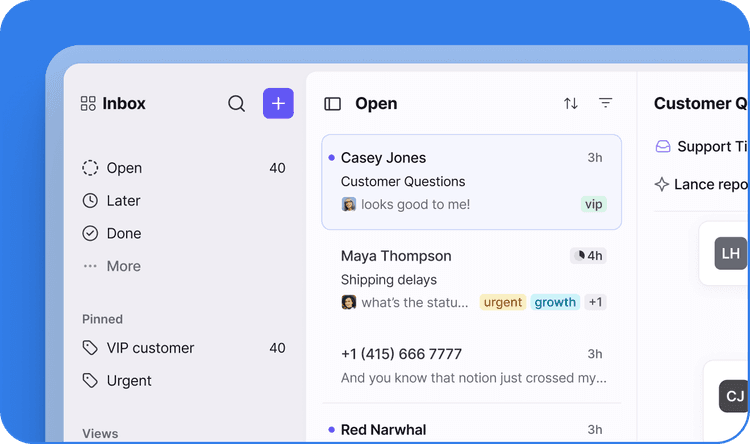
Front turns churn strategy into daily action. Shared inboxes and internal comments keep context intact across teams, and analytics flag churn risks before they spiral.
With Workflow Automation, Front keeps multi-team workflows in sync, minimizes friction, and improves customer experience. The result is a smoother process for your teams and a better experience for your customers.
FAQ
How should we prioritize accounts for churn prevention?
Focus on accounts where the revenue is high and the warning signs are piling up: shrinking contract value, renewal delays, product usage drops, unresolved support issues, and declining engagement from key stakeholders. Focus first on high-value customers showing multiple risk indicators, especially where cross-team friction suggests the customer experience is breaking down.
How can we measure the impact of churn prevention initiatives?
Measure results by tracking changes in metrics, like customer retention rate, expansion revenue, renewal rates, and time-to-resolution for risk signals, alongside qualitative feedback from at-risk accounts. To understand what reducing churn means in practice, connect operational improvements to real outcomes. Fewer escalations, faster handoffs, and better context sharing lead to fewer downgrades. These actions also help save renewals and extend customer life cycles.
What causes customer retention rates to drop suddenly?
A sudden decline in customer retention rate usually follows a major product issue, pricing change, service disruption, or breakdown in customer support during a critical moment like renewal or onboarding. A situational example of customer retention rate dropping could be a dip after a product update causes integrations with other software to fail, leading multiple accounts to cancel within the same billing cycle.