



High AHT is rarely just a speed problem. See how context, handoffs, and ownership affect handle time, and how to improve it without sacrificing quality.
You’ve seen it happen: A straightforward customer request turns into a multi-threaded conversation, pulling in sales, product, and support. Timelines stretch and ownership gets blurry. Nothing is technically broken, but nothing moves cleanly, either.
That’s where average handle time (AHT) starts to climb.
The real risk isn’t just slower responses, but unpredictable operations. As handle time grows, capacity planning becomes less reliable, service-level agreements (SLAs) come under pressure, and consistency across customer interactions begins to drift. Behind it all is the coordination load of high-context, cross-team work.
Front’s Coordination Tax Report makes this clear: Much of AHT is spent chasing context and aligning internally, not solving the problem. Longer handle times usually point to operational complexity and fragmented communication, not agent performance.
AHT isn’t just a speed metric. It’s a signal of how work moves, how clearly ownership is defined, and how visible performance really is. How you reduce AHT is less about speed and more about building operations that move cleanly and reliably at scale.
Where high AHT creates friction across teams and SLAs
A simple ticket shouldn’t feel like a puzzle, but when information is scattered across systems, inboxes, and personal notes, that’s exactly what it becomes. Before a team can take action, someone has to reconstruct the story: what’s already happened and what’s still pending.
As the request moves between teams — finance for billing, engineering for product issues, account management for follow-up — every handoff introduces a pause. Ownership blurs and context has to be rebuilt from scratch. Switch channels, and the picture fragments again.
Work slows because context fragments and workflows fall apart. AHT grows in those gaps, as people rebuild coordination at every step.
Key drivers of AHT in complex customer operations
The reasons for high AHT often boil down to operational friction. In most cases, you can trace them back to five core issues:
Limited visibility across tools and conversation history: A support lead handling an enterprise account checks the CRM for contract details, digs through email threads for past decisions, and scans internal notes for updates. No single source holds the full conversation, so teams spend time stitching it together.
Unclear ownership and responsibility boundaries: A renewal question falls between sales and support, and neither team is clearly responsible. Work pauses while teams sort out ownership, which slows every step that follows.
Manual routing, follow-ups, and status tracking: Teams route requests, chase approvals, and track status outside structured systems. A customer rep follows up manually with finance or legal just to move a ticket forward.
High-volume, multi-channel coordination demands: Teams manage conversations across email, chat, and internal tools. This spread increases coordination overhead and fragments context.
Workflow bottlenecks between departments: Teams depend on other departments for inputs, such as product validation or approvals. These dependencies create bottlenecks and extend resolution times.
Together, these create misaligned workflows and fragmented context, driving SLA risk, reducing predictability, and making it harder to scale without adding headcount.
5 strategies to reduce AHT without sacrificing quality
The pressure for AHT reduction often leads teams to cut corners on quality assurance. Many “efficiency” tactics speed things up in the short term but pull customer satisfaction (CSAT) scores down.
Leaders see the impact and customers leave interactions without real resolution. These five AHT tips set the right expectations and shift how you define success.
1. Keep every conversation connected and easy to follow
Although most AHT improvement plans focus on call centers, the B2B reality is different. In addition to calls, B2B teams manage emails, chats, support tickets, SMS, and even social media.
And as the number of channels grows, so does the responsibility to keep every customer conversation connected and easy to follow. Shared inboxes and AI-assisted summaries help make this possible.
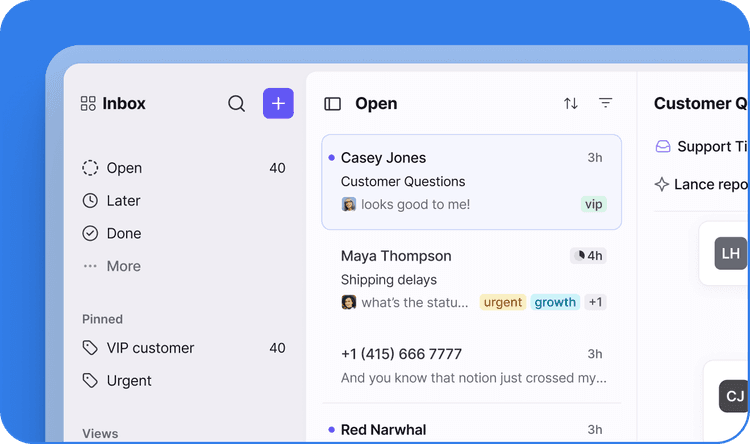
Shared inboxes keep full customer context in a single thread everyone on the account can see. AI-assisted summaries pull out the most important moments and surface the why — why a customer is struggling, escalating or coming back for a third time.
A customer operations platform handles this natively. Smaller teams can stitch together something similar in-house, though the upkeep adds up fast.
2. Assign clear ownership for each interaction
In theory, every customer issue gets solved by a help center article before it reaches your team. In reality, B2B doesn’t look like that.
That’s why teams build a triage function to capture the top drivers of inquiries and route them to dedicated queues. A financial services team, for example, might send all payment reconciliation questions to a dedicated account operations lead, while loan servicing or credit-related questions go to a separate specialist who understands underwriting nuances.
Each owner remains accountable for their own area, so when a high-value client flags a discrepancy, there’s no ambiguity about who steps in and resolves it.
3. Use automated routing to reduce coordination delays
Enabling automated routing simplifies ownership, reduces time spent re-routing, and lowers the risk of context loss.
Instead of manually reviewing every interaction and spreading themselves too thin as volume increases, customer reps can respond to inquiries as soon as they land in their inbox.
Department routing, skill-based routing, timezone routing, and workload balancing routing establish a consistent logic so that requests reach the right person the first time.
4. Tighten workflows to keep SLAs on track
Alongside smart routing, creating a centralized, searchable, and up-to-date knowledge base helps customer reps find answers faster and respond with accuracy the first time.
But not every request has a quick or self-serve fix. Most don’t. To reduce AHT as much as possible, build SLA-aware escalations into the workflow.
5. Give teams real-time analytics they can act on
Use conversation intelligence, live dashboards, and next-best-action recommendations so reps have the signal they need in the moment, not in next week’s report.
These tools analyze interactions and prompt customer reps with next steps. Plus, they track key performance indicators, such as first response time and time to resolution, to identify trends and provide in-the-moment assistance.
With AI-powered knowledge tools, the impact of these capabilities is even greater: Relevant answers and account context surface faster, which reduces time spent searching across systems or internal handoffs.
How operational coordination translates into business impact
Tickets pile up, teams toggle between systems, clients wait longer than they should. In B2B, the pressure to move fast is constant, and it can strain coordination to the breaking point.
When that happens, the cost shows up fast: missed SLAs turn into churn, and revenue takes a hit.
Fix the coordination problem, and AHT drops — and when it drops, the business feels it in four places:
Response time improvement: Close coordination helps teams resolve issues faster and keep work on track, preventing costly downstream delays.
Retention rates and account longevity: More consistent and timely support strengthens customer trust and leads to long-lasting relationships.
SLA adherence: Tighter processes improve time to resolution, reducing the risk of penalties and reinforcing reliability with partners.
Operational efficiency gains: Aligned workflows reduce duplicate effort and allow teams to handle more volume without adding headcount.
These benefits show up across industries — for example, in logistics through faster exception handling, in financial services via improved client support consistency, and in manufacturing through more efficient issue resolution and reduced downtime.
Reduce AHT without rushing customers with Front
When “move faster” becomes the only AHT strategy for customer reps and AI agents, the cracks show up quickly. Reducing AHT in B2B takes something different: keeping conversations, ownership and context in sync across teams.
Front is built for exactly that.
As a customer operations platform, Front keeps every team, tool and customer conversation in sync. Routing rules send conversations to the right owner from the start, full customer history stays visible to everyone who needs it, and context follows the conversation across every channel.
Explore the platform to see how it works. And if reducing AHT is a priority, tie it directly back to overall support performance.
Download Front’s customer service metrics guide to learn how to track and improve these results.
FAQs
How often should teams review and update their AHT benchmarks?
Teams should review AHT benchmarks quarterly — or in high-change environments, even more frequently. Regular updates ensure targets reflect evolving workflows, tools, and customer expectations rather than outdated operating conditions.
Should AHT targets vary by issue type or customer segment?
Yes, AHT targets should flex based on issue complexity and customer value. Standardizing across all cases risks oversimplifying work and undermining both service quality and CRM.
How does AHT relate to first contact resolution (FCR)?
AHT impacts FCR through the depth of resolution during each interaction as shorter handle times can lead to incomplete fixes and repeat contacts. Balanced correctly, slightly longer AHT can actually enable thorough resolution, which, in turn, improves FCR and reduces total workload.