



What is customer service recovery, and which strategies actually work? See proven tactics B2B teams use to rebuild trust and cut churn.
Even the most efficient B2B operations encounter service gaps as they scale. It’s how teams respond to these moments that ultimately shapes customer satisfaction (CSAT) and loyalty.
Customer service recovery is the process of resolving complaints in a way that protects relationships and reduces churn — turning a frustrated customer into a happy one.
The stakes are high. According to our recent industry report, the State of Service Expectations, 50% of customers will push their team to switch providers after three or fewer bad experiences. But here’s the flip side: Effective recovery turns frustration into trust and keeps customers engaged.
Below, we’ll cover what service recovery is, how it works in complex operations, and seven proven strategies to resolve complaints quickly and maintain customer loyalty.
What is customer service recovery?
Customer service recovery is the structured approach teams use to address customer issues and restore trust after a service gap. It goes beyond simply fixing the problem — it’s about responding promptly, easing frustration, and preserving loyalty.
When done well, recovery doesn’t just prevent churn — it can actually strengthen the customer relationship, turning a moment of dissatisfaction into an opportunity for deeper trust.
The service recovery paradox: When fixing a mistake strengthens loyalty
Here’s a counterintuitive finding: In some cases, excellent service recovery can make customers even more loyal than if the issue had never occurred. This is known as the service recovery paradox: You can achieve higher CSAT by resolving an issue efficiently than you would if there had been no issue at all.
Of course, this isn’t a justification for poor service. But when something slips through the cracks, it’s a reason to prioritize intentional, high-quality recovery — because the payoff in satisfaction and long-term loyalty is real.
From service gap to resolution: A customer service recovery playbook
Now that we understand what service recovery is, let’s look at applying it in practice.
Here are seven practical service recovery examples to address service gaps, resolve customer complaints effectively, and turn dissatisfied customers into loyal advocates.
Before issues escalate
1. Use the right tools to deliver service recovery consistently
As operations scale, invest in professional customer service software to help you address issues promptly and consistently. With the right tools, your team can identify problems quickly and collaborate on solutions that keep the customer satisfied.
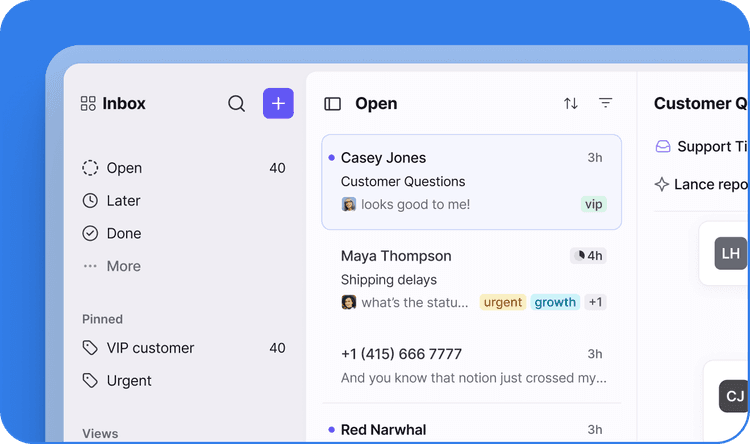
For example, your team might use the customer service platform to message customers across a range of different channels, communicate internally, make notes, assign different people to work on an issue, and use AI tools and software integrations to work faster and more efficiently. All of these steps ensure that recovery has a consistent process.
2. Track complaints to spot service recovery gaps
Use complaint management software to log customer complaints from multiple channels and provide your team with the full history and context. They can work together to provide a speedy resolution, and you can identify patterns in complaints, revealing where you need to improve your product or service recovery processes.
During resolution
3. Take ownership of the problem to prevent escalation
When you’re resolving a customer’s problem, the first step is to take ownership. Listen carefully, acknowledge the issue, and clearly communicate who is responsible for fixing it.
Even if multiple teams are involved behind the scenes, the customer should have a single point of contact. Give that person the authority to do what’s necessary to resolve the issue and keep the customer informed throughout the process.
4. Take immediate action to reduce frustration
Frustration can build quickly when a customer thinks nothing is being done. It’s important to take action immediately and let the customer know what you’re doing to solve their problem. With a quick, decisive response, you can defuse the situation and improve customer satisfaction.
Sometimes, resolving an issue takes longer than expected. In those cases, it’s important to keep the customer informed about delays, too. While customers expect fast solutions, they’re more understanding about slow resolutions when you communicate that your team is actively working on it. The key is to avoid leaving them in the dark — silence is the fastest route to frustration.
After resolution
5. Follow up with the customer to rebuild trust
Although resolving issues quickly is the cornerstone of effective service recovery, following up afterward is equally important. Reach out to confirm the customer is fully satisfied and hasn’t encountered any additional problems. Remember: Closing the ticket doesn’t always mean the customer feels heard.
Follow-ups also provide the opportunity to offer the customer a small gesture— a discount, a credit, or other bonus to make up for their initial experience. What you offer should depend on the severity of the issue. Thoughtful gestures go a long way toward reinforcing loyalty and improving customer retention.
6. Learn from the experience to prevent repeat failures
Every service recovery is an opportunity to strengthen your operations. Use an internal quality scorecard to log what happened and how it was resolved. Apply these insights to prevent the same issue from recurring and to continuously improve the experience for future customers.
7. Use automation to catch problems before customers do
Put automated tools in place to identify future issues early. Front’s Smart QA and Smart CSAT products use AI to analyze customer conversations and detect quality and satisfaction issues so your team can take swift, proactive action before small problems turn into lost accounts.
Why service recovery is more than damage control
Customer service recovery delivers tangible business benefits beyond simply keeping customers. When you refine the process and exceed customers’ expectations, you can expect several outcomes:
Lower churn: Resolving complaints helps retain accounts you might otherwise lose, reducing churn. With 47% of businesses reporting annual churn losses exceeding $500,000, getting recovery right has a direct impact on your bottom line.
Higher NRR and LTV: Increased customer loyalty will generate higher net revenue retention (NRR) and customer lifetime value (LTV). In other words, strong recovery doesn’t just save accounts — it grows them.
Stronger customer acquisition: Service recovery is often framed in terms of retention, but it can help you win new business, too. When you deliver an exceptional customer experience, you’ll get more recommendations and referrals, and your reputation will make it easier to attract new clients.
Lower risk: The patterns you find during customer service recovery can highlight potential operational risks, enabling you to prevent future issues.
Better operational efficiency: Quick, decisive recovery saves time and resources. That will show in your customer support efficiency metrics.
Investing in service recovery creates measurable revenue impact while building a more resilient, efficient business.
Coordinate service recovery across teams with Front
Effective service recovery builds customer loyalty — but it requires teams to work in sync. Front centralizes all customer conversations and uses AI to make recovery faster and smarter.
Collaborate on complex inquiries across email, SMS, live chat, and more. Coordinate next steps and handoffs, while stakeholders jump in at the right moment with full context.
Front gives your team the tools they need to deliver lightning-fast responses, follow up consistently, and gather CSAT feedback. Smart QA and Smart CSAT catch potential quality and satisfaction issues before they affect customers.
Book a demo to see how your team can deliver excellent service recovery at scale with Front.
FAQs
How do you coordinate service recovery across multiple teams?
Service recovery in B2B often involves support, operations, account management, and product teams. The most effective way to coordinate is by centralizing communication in a shared workspace, so every team has visibility into context, ownership, and progress — without switching tools or losing critical details.
When should service recovery be automated vs. handled by humans?
Automate the routine steps — initial triage, acknowledgment, and routine follow-ups — to ensure speed and consistency. Human intervention is best for complex issues that require judgment, coordination across teams, or where customer relationships are at stake. AI works best when it routes issues to the right person at the right time, with full context.
What’s the difference between service recovery and complaint management?
Complaint management focuses on logging and responding to customer issues. Service recovery goes further by actively rebuilding trust, coordinating across teams to resolve root causes, and using insights to prevent future problems. It treats each service gap as an opportunity to strengthen the customer relationship.