



What is customer experience management? Learn more in this guide for B2B teams on what CXM is, how it differs from CRM, and how to execute at scale.
Customer experience management (CXM) is one of those terms that sounds like a boardroom buzzword — until you see the numbers: 59% of companies say they’ll switch to a competitor after just three bad experiences or fewer. For B2B support teams, CXM is a direct driver of retention and revenue.
Most B2B support teams want to improve customer experience (CX). The challenge is keeping it consistent as the company grows, workflows get more complex, and interactions require coordination across expanding teams.
In this guide, we’ll break down what CXM is, why it matters, how it differs from customer relationship management (CRM), and what it looks like in practice. Plus, you’ll also get practical strategies to strengthen CX across the entire customer journey.
What is customer experience management?
CXM is how support, success, and account teams manage and improve customer interactions — from onboarding and product adoption to support and renewal.
The goal is to make every interaction a positive one, no matter which channel the customer uses.
That means providing consistent customer service on a day-to-day basis, providing personalized communication, listening to customer feedback, and improving every interaction over time.
Effective CXM depends on well-coordinated teams, and minimal friction. When the right systems are in place, support teams can respond quickly — whether the customer reaches out by email, chat, or phone.
Why CXM exists: Fixing execution at scale
CXM exists to solve problems that show up as companies grow.
Left unchecked, these issues can harm your CX goals. CXM provides the structure and processes needed to deliver a consistent, connected experience.
Here are the main challenges B2B companies face as support scales:
Channel fragmentation: When customer interactions spread across multiple channels with no central record, information gets lost and customers grow frustrated.
Missing context: Teams that don’t have access to the full conversation history are forced to make decisions with incomplete information, and CX can suffer.
Handoff breakdowns: As more teams get involved in resolving customer issues, handoffs can become confusing and inefficient.
Visibility gaps: Without shared visibility across people, tools, and teams, companies risk sending duplicate or conflicting responses — which undermines the entire experience.
CXM brings structure and shared insight to these problems, turning fragmented work into a coordinated, reliable customer journey.
Understanding the difference: CXM executes what CRM records
While CXM and CRM may seem similar at first glance, the distinction is clear: CRM gives your teams information about the customer relationship, while CXM focuses on managing interactions to actively improve it.
5 strategies teams use to maintain CXM
CXM is about day-to-day actions, not grand strategies. Here are five steps your team can take to improve CX in their daily operations.
Maintain context as work moves between people and teams
Handoffs are a common friction point for CX teams. Make sure your team uses software that provides a single source of truth documenting every customer interaction. When relevant, use formal handoff templates with structured fields to capture all the necessary information; unstructured notes are often insufficient.
Information should flow smoothly between teams so everyone has the context they need to deliver a seamless CX.
Define clear ownership for every customer issue
When multiple people and teams work on an issue, ownership can get murky. Every customer issue should have a single, clearly defined owner — and the customer should always know who their point of contact is and when to expect updates.
If an issue needs to be escalated or handed off to another team, document the ownership transfer internally while maintaining the same point of contact for the customer.
Centralize visibility across channels and teams
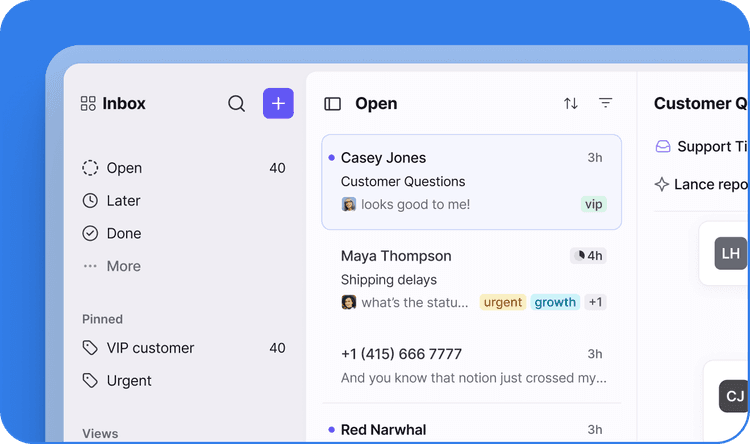
Strong CXM requires shared visibility. Every team working on a customer issue should use the same systems — and see the same information. Whether the customer reaches out by email, chat, or any other channel, the full conversation should be visible in one place.
Standardize service to keep it consistent at scale
Customers want consistency, and delivering it at scale requires standardized workflows and playbooks. Use communication templates to keep messaging clear and consistent, and use AI tools to automate routine workflows, provide faster responses, and maintain personalized communication at scale.
Turn customer feedback into process improvements
Every customer interaction is an opportunity to collect feedback. But effective CXM goes beyond collection — feedback needs to be categorized, routed to the right teams, and acted on. Build a positive feedback loop where insights drive improvements that raise the bar for future interactions.
After all, CXM isn’t a linear process. Customer work constantly shifts between teams. The best CX and brand loyalty strategies focus on continuously refining processes and workflows to improve team alignment, minimizing disruptions as tasks change hands.
Benefits of CXM across the customer journey
When you focus on CXM and make operational improvements aimed at improving the CX, you start seeing the benefits across the customer journey.
Here are some examples that illustrate the importance of CXM:
Greater continuity across customer interactions: Every stage — from sales and onboarding to support, success, and renewal — stays connected with strong CXM. The business impact shows up in faster resolution times and higher retention and customer loyalty.
More reliable follow-through beyond initial resolution: CXM pushes teams to focus on meeting customer needs — not just closing tickets. Better follow-through means lower reopen rates, higher customer satisfaction (CSAT) and Net Promoter Score (NPS), and stronger lifetime value (LTV).
Better handling of long-running or complex accounts: Clear ownership and standardized processes make it easier to manage B2B accounts alongside multiple stakeholders — driving higher renewal rates and stronger LTV.
More predictable performance as complexity grows: Standardized processes and workflows lead to consistent service quality, more efficient operations, and lower costs to serve each customer.
Stronger alignment across the full support lifecycle: CXM connects teams across the customer journey, ensuring smooth handoffs and shared context. The result is stronger customer relationships and a better overall experience.
These benefits emerge because customer work stays connected over time. Learn more about improving CX in this Front-sponsored report by Harvard Business Review Analytic Services.
The system underneath: How Front enables CXM at scale
Successful CXM at scale relies on the right operational system. You need shared infrastructure that keeps everyone connected in a complex B2B environment as customer work moves across roles and teams.
Front takes a conversation-first — rather than ticket-first — approach, giving teams everything they need to coordinate across channels. With omnichannel support, collaboration tools, workflow automation, analytics, and AI built in, Front provides the infrastructure teams need to run CXM at scale.
CXM is an operating model, and it only works when it’s backed by the right platform. Book a demo to see how Front can support CX execution for your business.
FAQs
What metrics are essential for monitoring customer experience?
The key metrics to track include churn rate, CSAT, NPS, average resolution time, and customer effort score.
How do teams maintain context across complex customer conversations?
A strong customer experience platform is essential for maintaining context at scale. The right CXM software ensures every team has full visibility into customer interactions across all channels.
What’s the difference between CXM and customer service?
Customer service focuses on resolving issues. CXM is broader — it aims to improve every interaction the customer has with your company across all touchpoints and throughout the entire journey.
What role does automation play in customer experience management?
Automation helps support teams work more efficiently, reduce response times, and personalize customer interactions at scale. These capabilities strengthen the customer experience and play a key role in effective CXM.