



Explore what an omnichannel customer experience means in B2B operations and how teams keep customer conversations connected across channels at scale.
In B2B operations, customer conversations rarely stay in one place. A conversation might start with a quick email, but your support team then needs to coordinate with operations and account management to give an accurate response. Meanwhile, a different stakeholder sends a Slack message about the same issue, and no one connects the two.
When conversations move across multiple channels and teams without a shared system behind them, consistency breaks down and visibility disappears. Let’s explore what an omnichannel customer experience means, why it matters for B2B teams, and how to build one that holds together under real operational pressure.
What is an omnichannel customer experience?
An omnichannel experience is a system of connected communication throughout the customer journey. It spans teams, touchpoints, and channels to create a web where everyone has access to the context they need, when they need it.
That’s different from a multichannel experience, which is simply about operating across multiple channels. An omnichannel experience connects those channels so conversations feel consistent and frictionless, often through an integrated customer experience platform.
Why an omnichannel customer experience matters for B2B teams
In complex B2B relationships, coordinating across channels and teams creates serious operational drag. Front’s Coordination Tax report found that B2B teams spend nearly three hours coordinating work for every hour spent solving customer problems, which compounds into days of wasted time across a single client relationship.
When you build a true omnichannel customer experience, you remove the operational friction that results from disconnected workflows. Teams coordinate more effectively. Issues get resolved faster, and wait times drop. And because everyone works from the same customer context, the quality of every interaction stays consistent.
That consistency, maintained over time, builds the kind of customer relationships that hold. You improve retention with a service operation that works.
5 biggest challenges in omnichannel customer experience
Without the right operational workflows and systems, more channels simply create more operational friction. Here are the main customer support challenges B2B teams face.
1. Customers lose continuity as conversations move across channels
The person who sends the Slack message assumes your team will connect it to a colleague’s email about the same issue. If that doesn’t happen, support either gives an inconsistent answer or asks the customer to repeat themselves. The result is an unnecessary back-and-forth that erodes trust and wastes time on both sides.
2. Cross-team handoffs make ownership harder to track
Handoffs are where ownership quietly disappears. When a support team needs to pass the issue along to operations and account management, and there’s no ownership tracking system, nobody knows who’s responsible for the next step. The issue stalls, context gets lost, and the customer waits.
3. Fragmented systems create operational drag
Customer information scatters across email, chat apps, Slack threads, and CRM records when there’s no central system of record. Teams waste time switching between tools and searching for context. Meanwhile, customers experience longer wait times and inconsistent service — not because the team doesn’t care, but because the system doesn’t support them.
4. AI and automation lose accuracy without shared context
Front’s Coordination Tax report also found that 71% of companies had experienced significant AI issues in the past three months. Automation can help you manage omnichannel operations at scale, but AI is only as useful as the context you give it. When AI agents can’t access the right customer history and operational data, their responses become wrong or unhelpful, and customers lose trust fast.
5. Reporting becomes harder to unify
When conversations and data live in separate channels and systems, you can’t get the complete picture. If customer support metrics only capture part of the operation, any decisions built on that data are working from an incomplete view. You need cross-channel visibility before you can make good calls about where to improve.
How to create an omnichannel customer experience strategy
Effective operations depend on connected conversations, shared visibility, and clear ownership. Follow these omnichannel customer experience best practices to make it work.
Map how customer interactions move
Start by documenting how a conversation travels, from an incoming request through every team, system, and channel. Pay attention to where the channel switches, where ownership changes hands, and what the escalation path looks like. This gives you the foundation for connecting your workflows in ways that reflect how your team actually operates.
Create a shared source of customer context
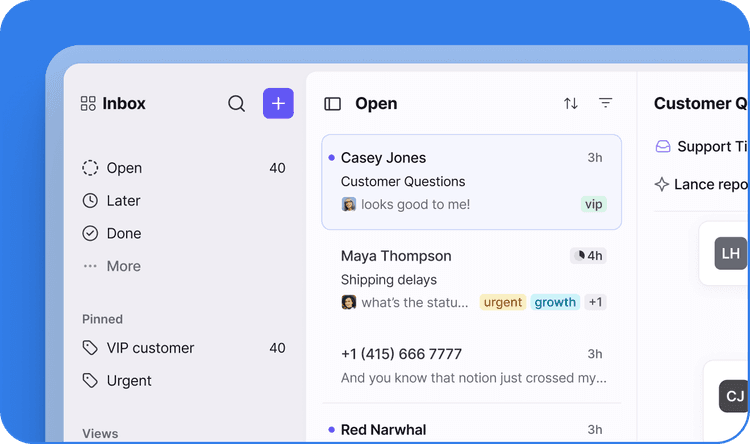
Multiple teams working on the same request need to see the same conversation history, account records, and operational details. The only way to make this work at scale is with an omnichannel customer support platform that gives real-time visibility across all teams.
Connect operational systems and channels
Teams coordinate more effectively when they don’t have to leave one tool to get information from another. Integrate communication channels with your CRM, ticketing systems, and operational tools so data flows across platforms and teams can share context without the extra work.
Build clear ownership and escalation paths
Efficient routing and handoffs are the backbone of a strong omnichannel customer experience. Use automated workflows and well-defined routing rules to make sure conversations go to the right people. Standardize your escalation and handoff processes so that ownership, context, and accountability stay clear at every stage.
Use automation to support workflow coordination
Automated workflows standardize how work moves and eliminate repetitive coordination tasks. Use automated customer service tools to prioritize incoming requests, handle routing and escalations, and follow rules you set in advance. The same systems can send notifications and reminders about customer milestones, SLA risk, and other signals that need attention, keeping your team focused on the work that matters.
Measure continuity across the customer journey
Track how your strategy is performing by analyzing omnichannel customer data across teams and touchpoints. Ticket volume spikes and growing backlogs signal workflow bottlenecks. Handoff failures and disconnected customer experiences tell you where coordination is breaking down. Use that data to bring your systems and teams closer together over time.
Examples of omnichannel customer experience in practice
Logistics and transportation operations
Uber Freight used to coordinate work across Outlook and Microsoft Teams. After consolidating its channels in Front, the company cut reply time from just over three hours to under an hour and 30 minutes.
Hermes Worldwide moved from Gmail to Front for both customer and interdepartmental communication. The result: stronger accountability across its global departments and AI-driven quality insights through Smart QA.
Financial services and compliance workflows
Column tripled its team’s efficiency and reached Inbox Zero in 30 days after switching to an omnichannel customer experience with centralized workflows. Column has 32 separate inboxes for different customers and uses sophisticated routing rules to prioritize messages automatically by subject and urgency.
Travel and hospitality coordination
Stewart Travel Management created an omnichannel experience with AI assistants that help its team draft responses quickly. Automated routing balances workloads, and better data synchronization feeds its analytics. Average response time is now 39 minutes — well below its SLA target of one hour and 30 minutes.
Built for this: How Front runs omnichannel customer operations
To deliver a successful omnichannel experience amid B2B complexity, you need a strong operational layer to connect everything. That’s where Front comes in.
Front is the omnichannel customer experience solution built for B2B teams, keeping every team, tool, and customer conversation in sync so you can scale without losing the thread. Organize and grow your workflows with clear ownership and consistent, well-coordinated communication across teams.
Book a demo to see how Front handles omnichannel customer operations in real B2B environments.
FAQ
What channels are most important in a B2B omnichannel customer experience strategy?
The most important channels depend on your customers’ preferences, but common ones include email, live chat, Slack, Teams, and customer portals.
What platforms do B2B teams use to manage omnichannel customer experience?
Most teams use a dedicated omnichannel support platform that’s built specifically for the complexity of B2B conversations. Front is a great option because it keeps everything in one system and organizes multi-step workflows.
What’s the difference between omnichannel and multichannel customer experience in B2B operations?
Multichannel means operating across multiple channels independently. Omnichannel connects those channels into a single, coordinated operation so context travels with every conversation.