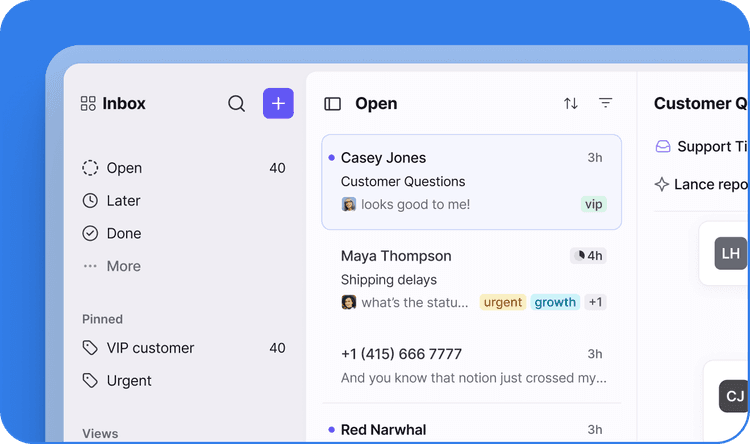





Learn what customer relations means in B2B, why it matters, and how teams keep conversations, context, and ownership connected across accounts.
Generic customer relations miss the mark for B2B. Loyalty programs and marketing campaigns work for consumer brands, but they don’t move the needle when you’re managing multi-stakeholder accounts, cross-functional handoffs, and relationships that directly affect your customers’ revenue.
In B2B, customer relations span your entire operating environment — support, sales, finance, and everyone in between. The customers on the other side often have multiple stakeholders, too. What determines whether those relationships last isn’t charm or commitment. It’s operational discipline: consistent communication, clear ownership, and systems that keep context from getting lost.
This article covers how to build customer relationships in B2B environments, why it matters at scale, and what strong execution looks like in practice.
What does customer relations mean in B2B?
Customer relations is a set of strategies and processes that companies use to build and maintain long-term relationships with their customers.
In B2B, that means managing ongoing relationships across multiple internal teams and external stakeholders throughout the customer lifecycle — not just at the point of a support request. Effective support and problem resolution are table stakes. What separates teams that actually retain and grow accounts is what happens in between: the systems and workflows that track overall relationship health, ensure consistent communication, and build trust over time.
Most companies use customer relationship management (CRM) systems to manage this work. But a CRM alone doesn’t allow you the full picture. Pairing it with a customer support and communications platform gives every team shared visibility into what’s happening across an account, so nothing slips between tools or threads.
Customer service vs. customer relations
Customer service is reactive, resolving issues, answering questions, and helping customers use your product. Customer relations focuses on the longer term, maintaining health, building trust, and making sure every team’s work adds up to a coherent experience.
For strong B2B accounts, these two things work together. Proactive communication and consistent follow-through build the kind of trust that keeps customers long after the issue is closed.
Why customer relations matter in complex B2B operations
In B2B customer service, a single request rarely stays in one place. It moves across teams, channels, and stakeholders, and each transition creates a potential point of failure.
Front’s Coordination Tax report found that at mid-market scale, a single customer request averages 11 touchpoints (six with the customer and five internally between colleagues). At that volume of handoffs, context doesn’t just fade — it gets lost. Customers end up repeating themselves. Responses become inconsistent. The research found that 64% of companies experienced at least one customer-facing coordination failure in the past three months.
4 benefits of a strong customer relations strategy
1. Higher customer retention across long-term accounts
Consistent, well-coordinated service builds the kind of trust that earns long-term accounts. When customers know they can get reliable responses from a team that understands their history and priorities, they’re more likely to stay. That retention is the foundation of stable, predictable revenue.
2. More consistent customer experiences across teams and channels
Customer experience (CX) is another important aspect, as B2B customers often depend on your team to resolve issues that affect their own operations. They need to be able to count on you. A centralized system that keeps every team aligned on context and communication standards is how you deliver that — regardless of which team or channel a customer uses on any given day.
3. Stronger trust through effective communication
Credibility is built on communication that doesn’t require customers to chase you down. Teams that reach out before problems escalate, keep stakeholders informed, and follow through on commitments create relationships that are hard to replicate and hard to replace.
4. Better visibility into customer needs and account health
When you’re gathering feedback consistently and tracking the right signals, problems don’t blindside you. You can see which accounts are at risk before they churn, act on friction before it compounds, and build a clear picture of what each customer needs, not just their latest request.
What strong customer relations look like in practice
Strong relationships show up in how teams communicate, preserve context, and learn from feedback. Here are some examples of customer relations practices that lead to positive connections.
Proactive communication before problems escalate
A centralized platform gives all teams shared visibility into customer context. That helps them spot problems early and provide proactive support rather than reacting after issues become major inconveniences.
Say your support team identifies a potential delay in a manufacturing order. Notifying the customer in advance, with enough lead time to adjust their workflows, is the difference between a well-managed situation and a relationship-damaging surprise.
Consistent omnichannel communication
Strong customer relations require omnichannel customer support with consistent service standards and response times across every channel. If a logistics manager reaches out via Slack about a shipping issue and an executive follows up by email two days later, those conversations need to be connected. Otherwise, you’re asking the customer to repeat themselves and creating the conditions for inconsistent responses.
Clear ownership at every handoff
Ambiguous ownership is where context dies. Every escalation — from support to finance, or from one team to another — needs a named owner who has full context and confirmed the handoff. When a professional services client’s billing inquiry escalates to your finance team, the customer should know exactly who owns it now and what happens next. That accountability is what makes trust replicable at scale.
Feedback loops with defined action paths
Gather customer feedback regularly and define processes for putting it into action. A structured feedback loop alerts you to recurring issues and helps you fix them before they put accounts at risk of churn.
If CSAT data shows that new financial services clients are frustrated with unclear documentation requirements, that’s an operational gap — not a satisfaction problem. Define the fix, update the process, and track whether the signal moves.
To make these practices work, you need to track measurable customer service signals. Front’s analytics tools — including Smart CSAT and real-time reporting — give teams the visibility to act before problems compound.
Metrics teams can use to evaluate customer relations
Use these customer service key performance indicators (KPIs) to measure success:
Customer retention: This is the clearest indicator of whether your customer relations program is working. If churn is climbing, look for operational friction points, including coordination failures, inconsistent communication, and unresolved recurring issues.
Customer satisfaction (CSAT): This score is a direct measure of how customers experience individual interactions. The qualitative feedback that comes with CSAT surveys is often where you find the recurring themes that metrics alone can’t surface.
Customer lifetime value (CLV): When relationships are strong, accounts are more likely to grow over time. Increasing CLV is a signal that you’re not just retaining customers, but expanding them.
Response and resolution times: Speed matters in B2B, where slow responses can directly affect a customer’s operations. Track trends over time to catch deterioration before customers feel it.
Repeat issues: Customers reopening tickets for the same problem is a signal that your team’s first response didn’t actually resolve the root cause. Bring this number down by improving coordination and context sharing at the point of resolution.
Escalation volume: Some escalations are unavoidable. But a high escalation rate often points to gaps in frontline training or context — problems you can fix without adding headcount.
How B2B teams use Front to run customer relations without losing the thread
Proactive communication, shared context, and consistent follow-through don’t happen by themselves. They require a system that keeps every team, every conversation, and every piece of account context in sync, especially as accounts grow more complex.
Front’s Coordination Tax report found that the typical B2B company spends nearly three hours coordinating for every one hour spent solving customer problems. That operational friction puts customer relationships under strain, no matter how well your teams handle direct interactions.
Front is the customer operations platform built for this B2B complexity. It’s where your teams keep customer conversations, ownership, and workflows in sync as accounts scale, so context doesn’t disappear between tools, and customers never have to start over.
Explore Front today and build better relationships with your customers.