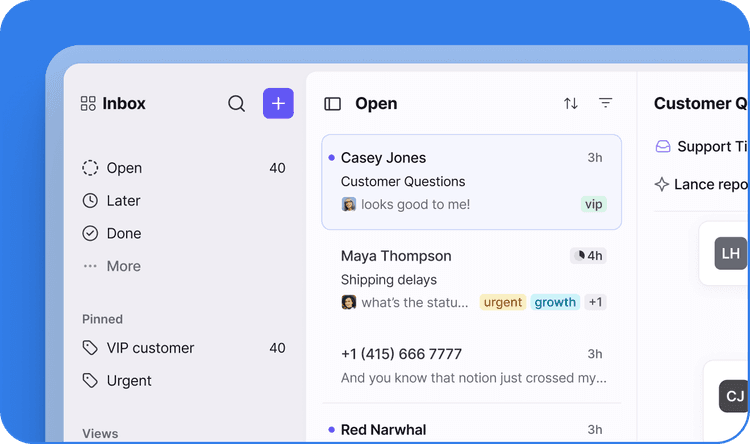





Email works fine until accounts multiply and threads bloat. See how B2B teams manage growing customer relationships without losing the history.
While one-off projects and sales are welcome, it’s long-term customer relationships that make the biggest difference for B2B companies. Regular outreach, coordinated workflows, and shared context build trust and credibility, making renewals and expansion more likely.
Consider a compliance inquiry: When a long-term client reaches out, the right team can respond more quickly because they already understand the customer’s history and expectations. Even with automated routing, a strong customer relationship makes the interaction smoother — the team provides guidance tailored to the client’s preferences and context, avoiding unnecessary back-and-forth. That familiarity not only helps customers get faster answers, but also makes it easier for support to deliver consistent service.
Use this guide to learn how to manage customer relationships in a B2B environment, with tips for tracking conversations and building loyalty from the first touchpoint to the closed sale.
What does B2B customer relationship management involve?
Managing B2B customer relationships requires keeping information organized and communication consistent. Beyond basic contact details and deal history, teams must manage timelines, shared context, and customer-specific details so every interaction feels informed and consistent.
Imagine your business provides manufacturing supplier software, and a customer reaches out because they can’t find an important invoice. As a support rep, having a strong relationship with that client makes your job easier. Because you know their preferred communication channels and file formats, you have the context needed to locate the invoice fast.
That familiarity speeds up resolution, raises the customer experience, and supports retention.
Why managing strong customer relationships becomes harder as companies scale
For smaller businesses, maintaining relationships with customers can be as simple as individual check-ins and automatic renewals. But when your company grows, email chains bloat and accounts become hard to track. At scale, you need a customer relationship strategy that can handle the sheer volume and greater complexity.
Here are some of the challenges B2B companies face as they grow.
Increasing conversation volume
More customers mean more conversations to keep up with. When you’re constantly bouncing between threads across people and channels, you risk missing important details or going dark on a reply.
Multiple departments interacting with the same accounts
Larger accounts involve more stakeholders — both on the client side and internally. Information silos form and disconnected processes lead to crossed wires and inconsistent outcomes.
Fragmented communication across tools
Between emails, instant messages, and hallway conversations, you risk repetitive conversations that waste time and lead to confusion. A strategic customer relationship management brings communication together in one place and organizes the flow of information.
Loss of context during internal handoffs
Without clear and accessible documentation, incoming team members and new account managers don’t have enough context to understand a client’s history, their current needs, and next steps.
5 steps for B2B customer relationship management success
High volumes and complex accounts don’t have to break your customer relationships. Effective customer relationship management involves organization, clear processes, and the right tools — all of which get easier to maintain when you build them early.
Here’s how to serve customer needs and build client relationships that last.
1. Unify conversations
A great customer experience depends on making people feel understood, and that’s hard when conversations are scattered across a dozen different places. Bring communications into just one or two shared platforms.
When conversations live in the same accessible place, every team member knows where to find information and who to loop in. Responses become faster and more consistent, and duplicated work drops dramatically.
2. Establish clear ownership for every request
This customer relationship management technique is one of the most important because it builds accountability. When everyone knows who owns what, there’s no confusion about where to send a request or who’s responsible for resolving an issue, leading to a smoother customer experience.
Clear ownership matters even more for accounts that require communication with multiple teams or departments. Defining points of contact for different issues avoids back-and-forth and gets customers their answers faster. Plus, when clients work with the same people every time, they build more trust and stronger relationships.
3. Preserve context across teams and systems
Context is about more than what a customer’s business does. It includes their goals, key stakeholders, and the reason they chose to work with you. Losing this context means overlooking opportunities or missing key objectives.
When transferring ownership or exchanging information between teams, keep context intact. Store all relevant files and details in a shared system so when questions arise, anyone on the team knows where to go.
4. Use structured workflows to coordinate communication
Without a clear structure, every conversation follows a different path, leading to skipped steps and dropped instructions. Set up a system for consistent customer communication so information moves predictably, even as you scale.
Route incoming messages to the right place and write on-brand replies faster by incorporating AI into your customer service workflow. Automated systems sort high volumes of information with less manual effort, giving teams more time to focus on personal interactions that boost customer satisfaction.
5. Track signals that reflect relationship health
Don’t rely on customer feedback alone to learn how each account is doing. Define measurable operational signals and key performance indicators — like response-time trends, conversation volume changes, and customer lifetime value — to spot risks early and step in before issues escalate. Pair these data points with periodic feedback to avoid leaving gaps.
6 benefits of implementing a B2B customer relationship strategy
With a plan in place, your team can provide more consistent service and keep clients loyal. Here are six benefits of implementing a customer relationship management strategy:
Improved retention: Clients notice when you put in the effort. Regular check-ins and attention to detail show customers you understand their context and are working hard to meet shared goals, which encourages them to work with you in the long term.
Greater service consistency: Customers may have different communication styles and service requirements. A flexible strategy makes it easier to tailor interactions without sacrificing consistency.
Better visibility into account health: Including measurable goals and touchpoints offers a clear view into how each customer is progressing. With this information, you can adjust your strategy to fill any gaps and allocate more resources to at-risk accounts. For example, if your goal is a 95% customer satisfaction score but a client is only at 80%, you know to pay closer attention to their needs.
Stronger continuity across touchpoints: Whether customers are talking to sales or a support rep, the experience should feel the same. Consistent tone, messaging, and information across every channel build trust and reduce confusion.
Better reputation: When loyal customers get high-quality service and enjoy working with your team, they’re more likely to make repeat purchases, upgrade service plans, and even refer your business to others. A strong reputation leads to faster growth and organic marketing.
Higher engagement: Long-term relationships encourage customers to take an active role in their journey, whether that means asking more specific questions during onboarding or inquiring about new services. This customer engagement allows you to identify their needs and strengthen relationships further.
Maintain strong long-term customer relationships at scale with Front
Successful client relations depend on communication across every team and conversation, and that can’t happen without a good system.
Start with a customer operations platform that understands your stakes and handles complexity with ease. Front is built for intricate B2B environments that need consistent, high-quality operational support. Front uses automation to save you time and deliver personalized service to every customer, giving you the power to scale with confidence and strengthen relationships.
See Front’s guide to customer communication and try Front for free to resolve queries faster, coordinate across teams, and improve customer retention at every touchpoint.