



A practical playbook for SaaS customer support, covering strategy, best practices, and the metrics B2B teams need to scale without losing quality.
If your support strategy focuses on closing tickets, you’re missing the point. Good software-as-a-service (SaaS) customer support isn’t built around speed, but actual conversations and customer relationships.
In SaaS, recurring revenue is on the line — which makes support a growth function, not a cost center. Proactive, well-coordinated experiences accelerate time to value and reinforce renewal decisions, while reactive and disconnected interactions frustrate customers and put revenue at risk.
Explore what SaaS customer support is, the three pillars of an effective strategy, and the best practices to follow, along with the metrics to track as your business scales.
What is SaaS customer support?
SaaS customer support is the help companies provide to customers using their software-as-a-service products. In B2B SaaS businesses, support goes beyond resolving issues and answering technical questions — it builds long-term relationships by helping customers succeed with your product.
Unlike traditional software support, which focuses on one-time transactions, SaaS support is ongoing. It helps customers learn how to use your product and get more value from it over time — not just during onboarding, but through the entire relationship. When customers achieve that value, they become more likely to renew contracts, which is key for a subscription-based SaaS business.
This long-term commitment is what differentiates the SaaS customer support model from B2C or transaction-based support. It’s more complex to run and requires strategies and metrics tailored specifically to B2B SaaS environments. That’s why support in SaaS companies isn’t just a service function but also a growth engine.
How SaaS customer support drives growth, not just satisfaction
Most SaaS teams default to speed and volume as their primary measures of success. Those metrics matter, but they only capture part of what support actually does.
Support talks to customers more than any other team. That means front-line teammates often know what features are working, where friction appears, which accounts could grow, and which might be slipping away.
That visibility translates to real business impact. Here are four examples:
Retention: When your support team shares information with customer success about which customers are at risk of churn, teams can work to improve customer retention.
Product intelligence: With smoother handoffs to the product team, agents consistently pass on feature requests and report bugs and usability issues, creating a customer feedback loop that helps improve the product.
Buying decisions: Quick, accurate customer support during testing or evaluation makes prospective customers more likely to buy, and smooth onboarding support ensures they become long-term customers.
Expansion revenue: Strong customer support builds customer satisfaction and confidence over time, making customers more likely to buy new products or upgrade existing ones.
The 3 pillars of a SaaS support strategy
A scalable SaaS customer support strategy relies on three structural pillars.
1. A support team built for scale, not just volume
Great SaaS customer support is proactive. Instead of resolving issues as they arise, teams anticipate problems and provide guidance before issues escalate. But as your SaaS business grows, delivering proactive support becomes more difficult.
To sustain it at scale, your support team needs a platform that provides smart notifications and reminders to engage customers across the customer journey. Plus, you need specialized roles like support operations to design efficient, scalable workflows and systems.
2. A technology stack that keeps every conversation in sync
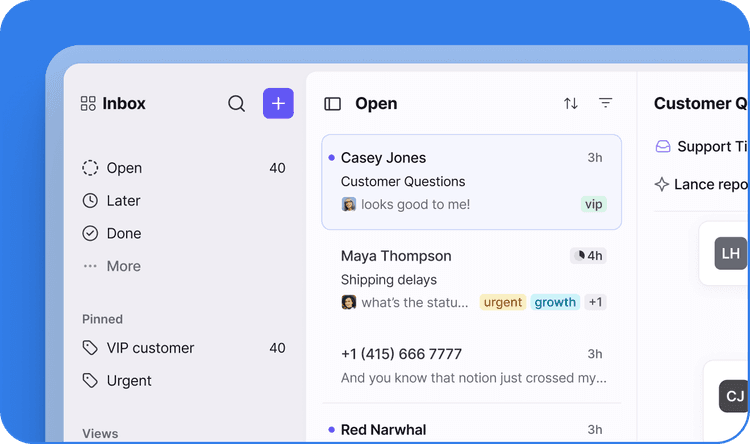
The right customer service software helps teams deliver a consistent customer experience consistently. Look for an omnichannel support platform that lets your team manage customer conversations, share context, and collaborate without losing the thread.
As your operations scales and ticket volumes increase, automation becomes key. Choose a system that uses AI to handle repetitive tasks — like prioritizing and routing conversations — so agents can focus on resolving issues that require human judgment.
3. Resources that make self-service work
Our research on service expectations found that “expansive self-service” is one of the qualities customers value most. But it only works when implemented well. Sparse FAQs and basic chatbots create a frustrating customer experience.
Build a comprehensive knowledge base your team can maintain without breaking a sweat, then let customers use live chat to find answers from it quickly. When the knowledge base is consistently updated and the live chat reliably guides customers to the right information, you reduce ticket volume and cut response times.
SaaS customer support best practices
Once you have the structure in place, it’s all about execution. Scaling support teams often try to close more tickets, faster — but that’s exactly where quality slips. A better approach is to build repeatable systems and workflows.
Here are five best practices to deliver consistent support at scale.
1. Be proactive
Proactive customer support anticipates customer needs before they surface. Build that guidance into your products: contextual tips and nudges based on how customers use the product, automated onboarding flows that guide users through key actions, and automatic alerts that notify customers about issues, bugs, or changes.
2. Build omnichannel consistency
Omnichannel customer support is non-negotiable. And at scale, this doesn’t mean adding more channels, but creating systems that preserve context and quality across chat, email, phone, and in-product messaging. That way, customers experience a single, continuous conversation, no matter where they reach out.
3. Close the loop with feedback and act on it
Support teams generate more product intelligence than any other function in the company. Capture those insights by creating processes to route them to the product, engineering, and customer success teams. That way, all functions can work toward improving the customer experience.
4. Use AI to augment your team, not replace it
AI should handle repetitive tasks so your team moves faster, but resist the urge to over-automate. The goal is to help the support team move faster while preserving human judgment and a personalized customer experience.
Define clear workflows for when and how AI should assist teams. For example, use it to summarize complex conversations, suggest replies, and answer simple inquiries. But be explicit about when human agents should step in to maintain oversight and make the final call.
5. Build a support operations infrastructure that creates leverage
As your support operations grow, you’ll need a well-designed, highly functional operational layer to the customer service desk without relying on constant hiring and short-term fixes.
Focus on designing efficient customer service workflows to improve routing and create smoother handoffs. Then create an internal knowledge management strategy to give everyone access to the same reliable, up-to-date information. Finally, build a system of well-connected, tightly integrated tools, with detailed analytics to help you spot trends and continually improve the service experience.
The metrics that actually matter in SaaS support
What you measure shapes what your team focuses on and how agents behave. Relying on too few metrics, or the wrong ones in isolation, creates blind spots. Effective SaaS support teams track a bunch of metrics that reflect both operational performance and customer experience.
One of the most important KPIs for support is customer satisfaction (CSAT), which captures how customers feel about a specific conversation. It signals churn risk early so you can fix the issues that could affect retention later.
Also measure first response time (FRT) to confirm you’re helping customers quickly, and first contact resolution (FCR) to gauge how effectively issues are resolved without unnecessary back-and-forth.
Finally, monitor contact rate to understand how often customers reach out for support and at which points. Use this data to identify where your product is creating friction and needs improvement.
No single metric tells the full story. Read them together, in the context of what’s happening in daily customer interactions, to get a complete picture of how your support team is performing.
How Front helps SaaS teams run support as a strategic operation
SaaS customer support teams face two recurring challenges: high conversation volume across channels and maintaining quality as complexity grows. The solution isn’t to add more tools, but to coordinate work efficiently across channels, systems, and teams.
Front is the customer operations platform built for complex B2B environments. It keeps every team, tool, and customer conversation in sync so support teams operate from a shared context. With workflow automations, Front frees your team to focus on managing customer relationships — not juggling tools or chasing conversation volume.
Book a demo to see how Front helps SaaS teams deliver coordinated, high-quality support at scale.
FAQ
In a SaaS organization, what’s the difference between customer success and customer support?
Customer support resolves issues for customers, while customer success works to drive long-term retention and grow customer relationships over time.
How are SaaS customer support tiers typically structured as teams scale?
SaaS customer support teams often use three tiers, with generalists handling simple queries in Tier 1 and escalating more complex issues to specialists in higher tiers.
How does AI improve customer support in SaaS?
AI automates repetitive tasks, powers self-service options like live chat, and helps support agents work more efficiently by suggesting replies and summarizing conversations.